For Marketing Leaders


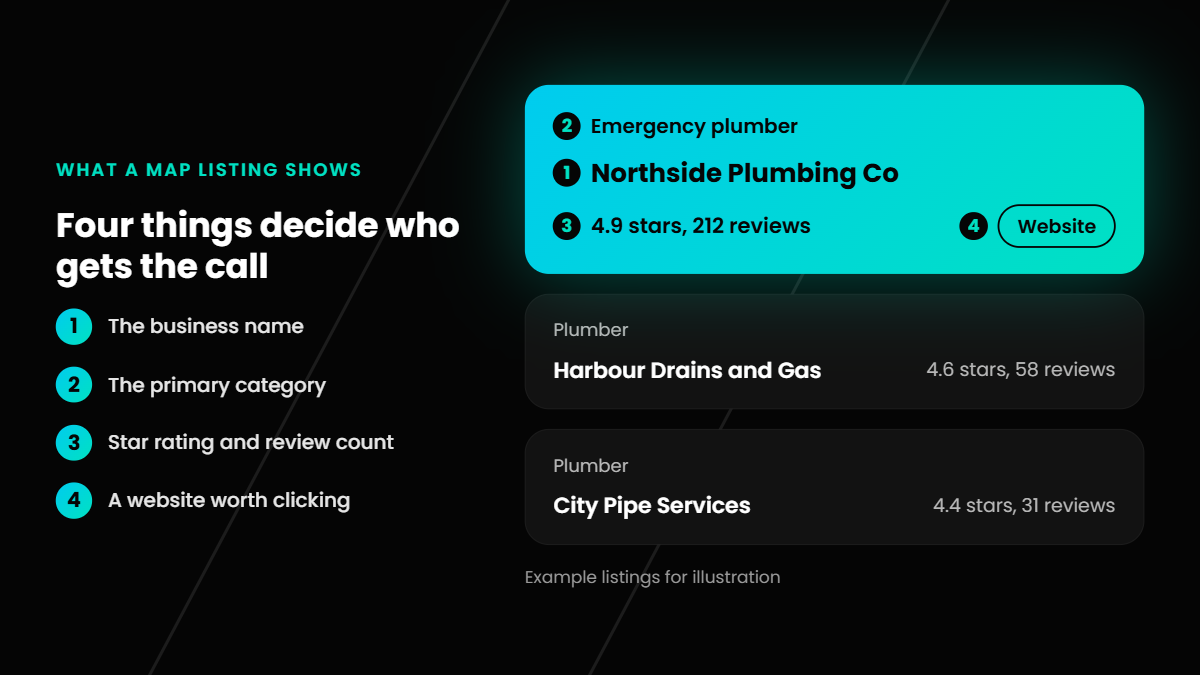
It is 6:40am and a pipe has burst under a kitchen sink in Brisbane’s north. The homeowner grabs their phone, types “plumber near me” and taps one of the first three businesses they see. Your phone never rings. The job was decided before you knew it existed.
That is how local search works for tradies, brokers, electricians, plumbers and mid-sized service companies. Only a few businesses get the prime spots, and the search engines decide who. Those spots appear on Google Maps, in the normal search results, on Apple Maps and increasingly in AI search tools. So what separates the businesses at the top from the ones buried further down?
This guide answers that in plain language. We cover how Google ranks local businesses, the three levers you control (your profile and business name, your reviews and your website), a step-by-step plan, what it costs in Australia, and what we have seen work for clients in Queensland and New South Wales.
One honest note before we start. Nobody can guarantee the number one spot, and Google says there is no way to request or pay for a better local ranking. What you can do is build the signals that search engines and AI tools look for, one at a time, and give yourself the best shot at the top.
The short version
- Google ranks local results on relevance, distance and prominence, and the same basics help you on Apple Maps, Bing and AI tools.
- Your Google Business Profile carries the most weight, then reviews, then your website.
- Your primary category is the single biggest factor, and your business name matters too, as long as it matches your real name.
- A dedicated page for each service you offer is the strongest thing your website can do for local rankings.
- Expect to budget roughly $6,500 to $14,000 for a small business website that includes on page SEO setup, and $3,000 to $6,000 a month for ongoing SEO with an agency like us. You can also do several of these steps yourself for free.
How Google decides who ranks locally
Google says local results are mainly based on relevance, distance and prominence. Each one works like this.
- Relevance is how well your Business Profile matches what someone typed. A complete, detailed profile helps Google match you to the right searches.
- Distance is how far you are from the searcher, or from the place named in the search. You cannot move your business, so this one is mostly out of your hands.
- Prominence is how well known you are. Google reads links, articles and directory listings from across the web, and it counts your review score and review volume.
That leaves two of the three in your hands, and they are where the work pays off. Relevance comes from how you set up your profile and website. Prominence comes from reviews, mentions and links.
Specialists who study this for a living back that up. In Whitespark’s latest survey of 47 local SEO specialists, the primary Google Business Profile category came first of 187 factors. Proximity to the searcher came second, and keywords in the business name came third. Being open at the time of the search ranked fifth, which is a good reason to keep your hours accurate, including after hours and public holidays.
Two more points matter for how you plan. Google keeps the real weightings private, so every list you see is an expert estimate. And the map listings (the “local pack”) and the normal blue link results use different mixes of signals, so a good plan covers both.
Local visibility also reaches beyond Google. Apple Maps and Bing Places run on their own listings, and AI search tools draw on your business details, reviews and website. Accurate details and a clear website help you wherever people find you, so this guide uses Google as the main example and keeps the advice useful across platforms.
The three levers that move the needle most
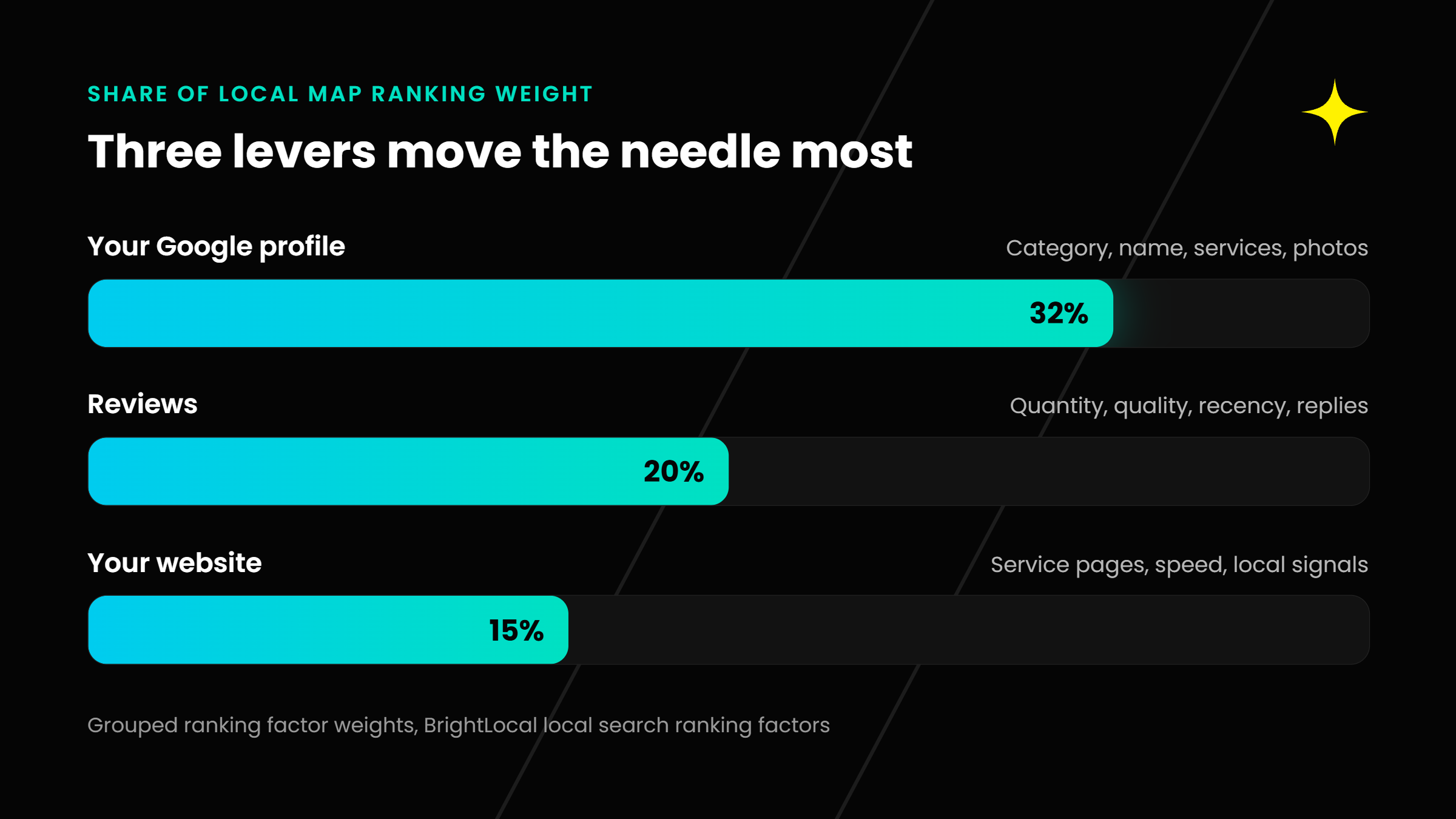
When you group every ranking signal, three stand well above the rest. BrightLocal’s latest breakdown of local pack factors puts them in this order.
| Lever | Share of map ranking weight | What matters most inside it |
|---|---|---|
| Your Google Business Profile | 32% | Primary category, business name, additional categories, accurate hours and address |
| Your reviews | 20% | Star rating, number of reviews with text, how recent they are, steady growth |
| Your website | 15% | A dedicated page for each service, clear local signals, matching details |
The remaining weight is split between behavioural signals such as clicks and calls (9%), links (8%), citations (6%) and personalisation (6%). These are expert estimates, so treat them as a guide to priorities and not as exact maths.
Your business name sits inside the profile lever, and it is a strong one. Keywords in the business title are the third most influential single factor in Whitespark’s list, and the primary category is first. The name comes with a rule though. Google wants it to match your real world business name, and adding extras such as service descriptions or location details can get a profile suspended. We cover how to handle this properly in Step 1.
Reviews matter more than they used to. BrightLocal reports their weight rose from 16% in 2023 to 20% in the map results. Your website matters just as much. Even a perfect map position only earns you the click, and your website turns that click into a phone call.
Step 1. Set up your Google Business Profile properly
This is the biggest lever, so it comes first. Most profiles we audit have been filled in once and never touched again.
Claim and verify it. Google recommends verifying your business so it can confirm you are allowed to represent it. An unverified profile limits what you can do and is unlikely to rank well.
Choose the right primary category. This single choice is the top factor in Whitespark’s survey. Pick the most specific category that describes your main service, and base it on what you want to be found for. A business that does mostly electrical work and a bit of air conditioning should choose the electrician category first.
Add secondary categories for other services you genuinely offer. Additional categories ranked eighth in the same survey. A 2023 BrightLocal study found businesses with four additional categories had the best average map ranking, so use them where they are true.
Keep your name honest. Your business name should match what customers see on your signage, website and invoices. If your trading name already includes your trade, such as “Smith Plumbing”, that is a legitimate advantage. Adding extras like “Brisbane Emergency Plumber 24/7” is the fastest way to get a profile suspended, and it is not worth the risk. Our advice is to win on the signals below and leave the name alone.
Get your hours and address right. Being open when someone searches is a top five factor. If you run from a home office and serve customers at their premises, follow Google’s service area rules and hide your address. Whitespark’s experts note that a visible address helps rankings, but the right answer for a mobile tradie is to follow Google’s rules and win elsewhere.
Fill in everything else. Add your services, service areas, a clear description, photos of real jobs and short videos. Google lists photos and videos among the ways to improve your ranking. The description itself carries little ranking weight according to BrightLocal, but customers read it.
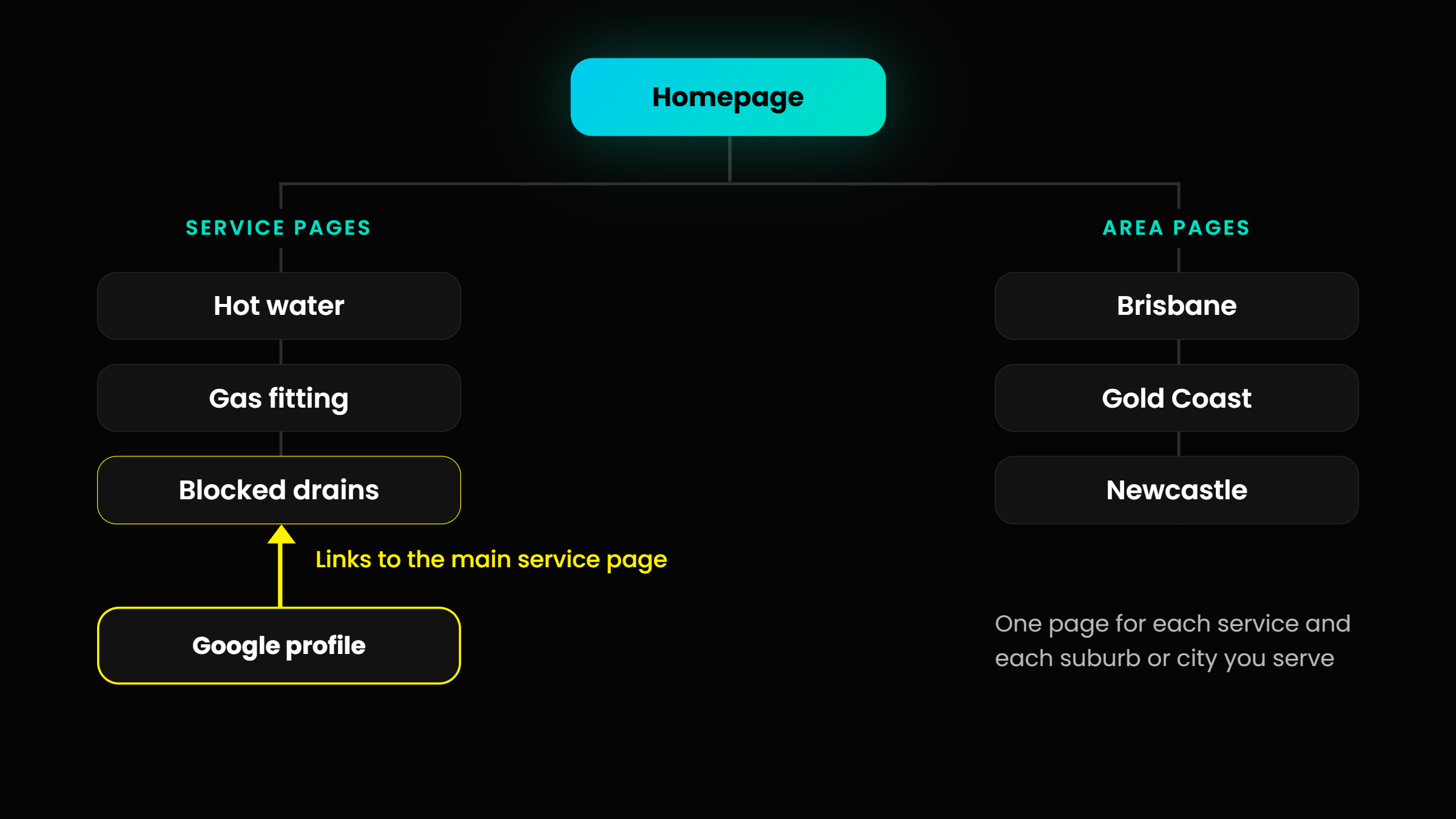
Point the profile to the right page. Link your profile to the page that matches your main service, which is often better than your homepage. Whitespark’s experts rank keywords in the title tag of that landing page among the factors that count.
A quick profile checklist
- Verified and claimed by the business owner
- Most specific primary category chosen
- Every true secondary category added
- Business name matches your signage exactly
- Hours correct, including public holidays
- Services and service areas listed
- At least 10 recent photos of real work
- Website link goes to the most relevant page
Step 2. Build a website that backs up your local listings
Google reads your website to decide whether your profile deserves to rank. It also reads it to decide whether the person who clicked through should trust you. A thin, slow or vague site undercuts everything you did in Step 1.
Give every service its own page
This is the most useful thing a local website can do. BrightLocal and Whitespark both report that a dedicated page for each service is the top website factor for the normal local search results, and it also counts for the map pack. A plumber with one “Services” page is competing with one hand tied. A plumber with separate pages for blocked drains, hot water systems, gas fitting and emergency callouts is giving Google a clear answer for each search.
Our rule is one keyword cluster per page. When two pages chase the same search, they usually both rank worse. We explain how to plan this in our guide to website SEO and link structure.
Add location pages only where you really work
If you serve Brisbane, the Gold Coast and Newcastle, each area can deserve its own page with real content. Mention the suburbs you cover, show jobs you have done there and include local details a customer would recognise. Pages that swap one suburb name into the same text do not help you, and they can hurt.
Make your details match everywhere
Your name, address and phone number on the website should read exactly like your Google profile. Put them in the footer, on the contact page and in your local business schema markup. Embed your map on the contact page.
Help visitors act in seconds
Behavioural signals, such as clicks, calls and direction requests, account for around 9% of the local pack weighting. A site that makes people hunt for the phone number wastes that. Put a tap to call button at the top of every page on mobile, show your licence numbers, add photos of real work and list your reviews on the page.
Keep it fast and trustworthy
A fast mobile site does not move rankings as much as the factors above, but it decides whether the visitor stays. Pass the Core Web Vitals checks (we walk through the fixes in our Core Web Vitals guide), and show who is behind the business. Real names, real faces and real credentials build the kind of trust we cover in our article on E-E-A-T.
This work also pays off in AI search. BrightLocal’s data shows on page signals are the largest group of factors for AI search visibility, at 24%. If you want to go deeper, read our guide to building websites for AI visibility.
Step 3. Earn the reviews that put you in the top three
Reviews do two jobs. They lift your ranking, and they decide whether the person who sees you in the local results chooses you or the business next to you.
In Whitespark’s survey, a high star rating ranked sixth among map pack factors, and the number of Google reviews with written text ranked ninth. Review recency came in at eleventh. A steady flow of reviews over time ranked fourteenth and beat occasional bursts. In other words, a steady stream of recent reviews looks healthier to Google than one big burst long ago.
Here is the routine we recommend to tradies and brokers.
- Ask at the moment of peak happiness. That is usually right when the job is finished, the invoice is paid or the loan settles.
- Make it one tap. Send the link by SMS, add a QR code to your invoice or leave a card with the customer. Every extra step costs you reviews.
- Ask for details. A customer who mentions the service and the suburb adds relevance, and BrightLocal notes that customers naming your services or location can reinforce it. Do not script what they write.
- Reply to every review. Google recommends replying to reviews, and it shows future customers that someone is home. Keep replies short and human.
- Handle bad reviews calmly. Thank them, offer to fix it and move the conversation offline. Prospects judge you by how you respond.
- Never buy reviews or offer rewards for them. It breaks Google’s rules and it is the quickest way to lose the trust you are building.
A small habit usually beats a big campaign here. Asking every happy customer, every time, keeps the flow steady and the profile fresh.
Step 4. Keep your details consistent and earn local mentions
Prominence is partly about how well known you are across the web. Google says it draws on links, articles and directories, so what other websites say about you counts.
Start with consistency. Your business name, address and phone number should be identical on your website, your Google profile, Facebook, Apple Maps, Bing Places, Yellow Pages and any trade directory you appear in. Citations carry about 6% of the weighting, so they are a supporting actor and not the lead. Still, clean and matching details also help AI search tools decide whether to trust and recommend you, so it is cheap insurance.
Then earn mentions that mean something. Links from locally relevant websites are the ones to chase.
- Your trade association or industry body
- Suppliers and manufacturers who list approved installers
- Local chambers of commerce and business networks
- Sponsorships of local sporting clubs and events
- Local news, when you have a genuine story
One link from a respected local source is worth more than dozens of random ones, which is the same principle we use for link structure on every site we build.
What local SEO and a website cost in Australia
Here is the honest picture. Australian agencies publish local SEO ranges of roughly $1,000 to $3,000 a month, for example Safari Digital, Clickmatix and FirstPage (small business range of $1,000 to $2,500). Those are the agencies’ own published figures, so treat them as indicative. Prices rise with competition, the number of areas you serve and the state of your current website.
Our own pricing sits at the upper end of that range for ongoing work, because our retainer covers more than local SEO. The ranges below match how we price and are wide enough to stay useful as costs change over time. They are in AUD and exclude GST. For specific, current prices, visit our pricing page.
| What you need | Typical range (AUD, excluding GST) | What it covers |
|---|---|---|
| Website for a small or service business | $6,500 to $14,000 once off | A custom designed site of around 10 pages, on page SEO setup, speed and tracking built in. Usually takes a few weeks |
| Larger website for a mid sized company | $15,000 to $35,000 once off | More pages, UX research, landing pages for paid campaigns and CRM integrations. Usually takes a few months |
| Ongoing SEO and marketing | $3,000 to $6,000 per month | Local SEO, often combined with Google Ads, social ads and conversion work, usually on a minimum term |
| Hosting | $40 to $100 per month | Fast, backed up hosting for one website |
| Website maintenance | $500 to $1,000 per month | Updates, backups, security scans and a small amount of support time |
Our SEO services page explains what each level of investment includes. Where you land in each range depends on your market, how many areas you serve and the state of your current website.
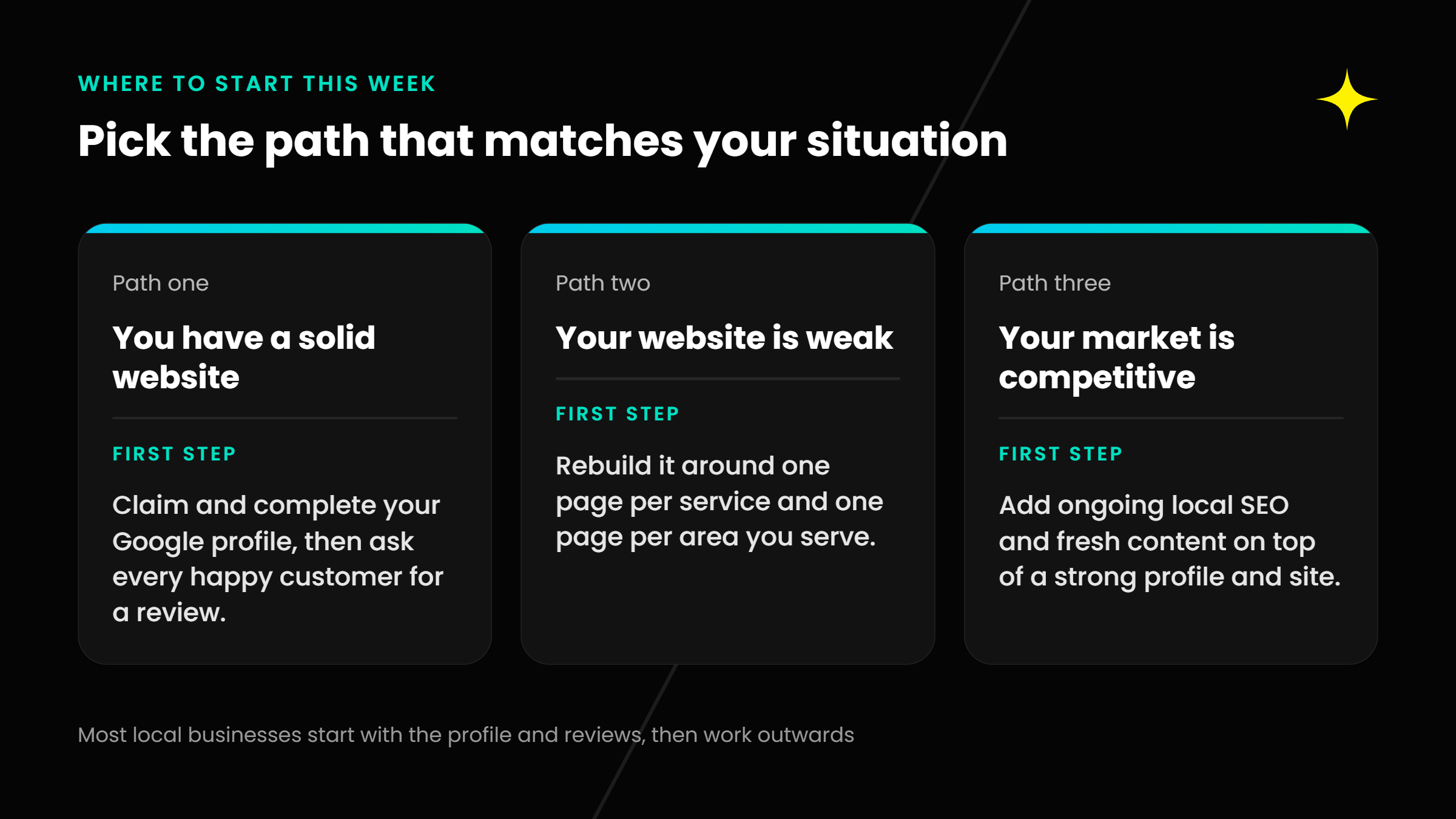
Which path fits your business
- Your website is solid. Do the profile, review and consistency work yourself (Steps 1, 3 and 4). It costs time and no money. Bring us in when you want it done for you or you want ads and SEO working together.
- Your website is the weak link. Start with a new website build that includes on page SEO setup, so your service pages are structured correctly from day one. Then decide whether you want an ongoing retainer.
- You are in a competitive market. In big markets such as Sydney and Brisbane, trades and brokers fight hard for the same few spots. A retainer that combines SEO, ads and conversion work gives you more ways to compete while your organic rankings build.
None of this is a guarantee of position. Rankings take months to build and depend on your competitors, so be wary of anyone who promises a specific spot in a specific week.
How we do this at Mindesigns, and what it has delivered
We run web design and SEO inside one team, so your profile, your website and your tracking are planned together from the first wireframe. Our process looks like this.
- Research. We use Semrush to find the searches your customers actually make. Commercial searches go to your service pages, and informational ones go to your blog. We weigh difficulty against fit, because an easier keyword that genuinely matches your service often beats a bigger one you cannot yet compete for.
- Map. We use AI to draft a sitemap from that research, and our team reviews and refines it. Each page gets one keyword cluster, so pages support each other and never compete.
- Build. We design reusable templates for service pages, area pages and case studies, with schema markup, headings and image descriptions built in, and we make sure the site loads fast.
- Measure. Calls, forms and quote requests are tracked in GA4, so you can see which channel produced each lead and what it cost.
Here is what that looks like for real businesses.
Sell Gold Sydney
Sydney’s gold buying market is crowded, and Sell Gold Sydney’s old site was slow and gave visitors no clear next step. We rebuilt it around dedicated landing pages for high intent searches such as “sell gold Sydney” and “cash for gold near me”, added a gold price calculator that captures leads, and tracked every call and form in GA4. In the year after launch, tracked conversions rose by 274% and sessions grew from 60,000 to over 105,000, and paid ads hit a 560% return in their best quarter. Client Ibrahim Barakat says he consistently ranks at the top of Google for great keywords. Read the full case study.
Eakins Finance and Insurance
Eakins is a Cairns broker that came to us with a slow, outdated site, almost no traffic and earlier SEO content that was not working. We ran a UX audit, rebuilt the site on WordPress and then took on ongoing SEO and Google Ads. As at May 2024, tracked in GA4, website traffic was up 1,190% and leads were up 630%. One SEO article generates around 30 leads a month, and Google search ads bring leads in at about $100 each. Lauren Eakins puts it simply, saying the new site pays for itself every single week. Read the full case study.
EMG Antennas
EMG Antennas is a Sydney antenna and CCTV installer that started as a one person business. Its old website lacked credibility and it had no marketing in place, so we rebuilt the site and ran SEO and Google Ads together. Between month one and month twelve, monthly website visitors grew from 78 to 6,430 and leads grew from 6 to 129 a month. As the enquiries increased, the business grew from a one person operation into a team of three. Read the full case study.
If you are curious how a service business grows past its first million, read our guide on how to scale your business past $1 million in revenue. It starts with making your website convert before you buy more traffic.
Seven mistakes that keep good local businesses buried
- Stuffing the business name. Adding services or suburbs to your name risks a suspended profile, which can wipe out your visibility overnight.
- Picking a vague primary category. The primary category is the top factor in Whitespark’s survey, so a generic choice costs you ground.
- Sending every search to the homepage. Each service needs its own page, and your profile should link to the most relevant one.
- Letting your details drift. A new phone number on the website and an old one on Facebook confuses Google and customers alike.
- Collecting reviews in bursts. Steady beats sudden, and replies matter as much as the stars.
- Treating one platform as the only channel. Our earlier guide on Google Maps leads makes the same point. A listing works best alongside a strong website and other marketing.
- Never measuring. If you cannot see which calls came from the map, the website or ads, you cannot decide where the next dollar goes.
Frequently asked questions
How long does it take to rank in local search and on Google Maps?
There is no fixed timeline. It depends on how competitive your area is, how complete your profile is, how many reviews you have and how strong your website is. Think in months and not days, and be wary of anyone who promises a specific position by a specific date.
Do I need a website to rank in local search?
A profile can appear without one. On page signals carry around 15% of the weighting though, and your website is where a click becomes a phone call. Most businesses that get serious about local search end up investing in the site too.
Can I pay Google to rank number one in local results?
No. Google states that local ranking cannot be requested or paid for. Google Ads run separately and are labelled as ads, so they work alongside your map and organic rankings and do not replace them.
Can a tradie without a shopfront rank in local results?
Yes, service area businesses rank every day. A visible address is one of the ranking factors in Whitespark’s survey, so a mobile business can find it harder in some searches. Follow Google’s service area rules, then make up ground with your category, reviews and service pages.
Does this also help me show up in AI search tools?
It does. Consistent business details, good reviews and a clear service page structure feed both Google and AI tools. BrightLocal found on page signals are the biggest factor group for AI search visibility.
What will it cost me?
The profile, review and consistency work costs you time but no money. A small business website that includes on page SEO setup usually costs roughly $6,500 to $14,000, and ongoing SEO with an agency like us is roughly $3,000 to $6,000 a month. See the costs section above or our pricing page for the full breakdown.
Where to start this week
Ranking at the top of local search rewards the businesses that do the basics well and keep doing them. Fix your category and details, ask every happy customer for a review, give each service its own page and track where your calls come from. Do those four things and you are ahead of most of your competitors.
If you would rather have a team do it with you, that is what we are here for. We have taken businesses like Sell Gold Sydney and Eakins Finance from an underperforming website to a steady flow of enquiries, and we are happy to look at yours. Book a free planning session and we will review your profile, your website and your local competitors, then tell you where the quickest wins are. You will leave with a clear plan, even if you decide to do the work yourself.
You can also contact our team directly.