For Marketing Leaders

An AI website builder can produce a good-looking draft of your website in minutes, but a draft is only the starting point. Whether that site brings you leads depends on the keyword strategy, the technical build and the content behind it, and those still need people who understand SEO.
If you have searched for how to build a website with AI, which AI is best for creating websites, or whether AI can build you a website, this guide answers each question directly. We are Mindesigns, a Google Partner and Semrush Partner agency with offices in Sydney and Cairns. We build WordPress websites for Australian service and B2B businesses that depend on SEO and Google Ads for leads, and we use AI every day in that work. Everything below comes from what we have seen work, and fail, on real client sites.
The short answers
- Can AI build me a website? Yes, a draft in minutes, but a human still needs to be heavily involved in the process, from our experience. A site that ranks on Google takes strategy and a careful technical build.
- Which AI is best? It depends on the job. Our own results come from Claude working with WordPress and Elementor. If you are very knowledgeable about SEO and site building, that moves the needle much more than the AI version you use.
- Will an AI-built site rank on Google? It definitely can, when it is planned around real keyword data, has valuable content and is built properly.
- Does AI replace a web designer? It replaces slow, repetitive tasks. Judgment, proof and technical SEO still need an expert.
- Can I appear in AI search results? You can improve your chances with the same fundamentals that help you rank, plus clear, trustworthy, well-structured content.
Myth 1. Can AI build me a website in minutes?
AI can build you a website draft in minutes. It cannot build you a website that wins customers in minutes, and the gap between the two is where most businesses lose money. In simple terms, you still need a human expert if you want your website to perform.
AI is genuinely good at layouts, first-draft copy, image ideas, and page structure. A tool can turn a short prompt into a homepage, a services page and a contact form faster than any designer could sketch them.
What the draft usually lacks is everything Google and your customers check before trusting you.
- Keyword and market fit. AI doesn’t know which searches your customers use, how hard each one is to win, or where your competitors are weak unless you give it that data.
- Real proof. Generic copy reads like every competitor’s site, which can drag your results down in rankings. Original photos, case studies, reviews, and named people show real experience.
- Technical foundations. Page speed, heading structure, internal links, schema markup and clean URLs rarely come out right by default. That is where our experienced developers come in handy.
- Accuracy. AI can state services, prices or credentials that are simply wrong, and a human has to catch them.
Google has said it rewards helpful, people-first content however it is produced, and its spam policies target mass-produced pages made mainly to manipulate rankings. A site that is all AI-drafted with no real expertise behind it sits on the wrong side of that line.
The practical answer is to let AI do the fast work, the data crunching, and put your experts on the decisions that matter. That is how we use it at Mindesigns on every web design project we take on.
Myth 2. Which AI is best for creating websites?
There is no single winner, because the right tool depends on what you need the website to do. Most options fall into three groups.
| Approach | Best for | Strengths | Watch out for |
|---|---|---|---|
| All in one AI site builders | Quick brochure sites and testing an idea | Very fast, low cost, no developer needed | Limited control over technical SEO and platform lock-in |
| AI working with WordPress and Elementor | Service and B2B businesses that need leads from Google | Full control of structure, speed, schema and content, with AI editing the live site | Needs an expert to set up and review the work |
| AI planning plus custom development | Complex sites and bespoke functionality | Built exactly to the brief | Higher cost and longer timeline |
Our honest experience is with Claude and WordPress together. When Claude is connected to a WordPress site built in Elementor, AI can edit pages directly, updating copy, headings, metadata and layouts under human review. We believe that is where website management is heading, because AI stops being a separate tool you paste from and becomes part of how the site is maintained and improved over time.
WordPress also gives us control over the technical details that decide rankings, such as site speed, heading tags, internal and external links and schema markup. We can build custom solutions where a client needs them through our custom website development service, and we use Semrush and Google’s own tools as our data sources, so decisions are based on real search numbers.
Other platforms are worth knowing about. Business owners often mention Wix, Squarespace, Framer, Lovable and Hostinger’s AI builder, and some report good results with them for simple sites. We haven’t used them on client projects yet for their AI features, so we cannot vouch for them, and you should test them against your own goals.
A useful rule for choosing any tool is to ask whether you can control your page titles, headings, URLs, speed and schema, and whether you can take your site with you if you leave.
Myth 3. Will an AI-built website rank on Google?
It can, and the deciding factor is what you do before the AI builds anything. Most businesses build the website first and think about SEO later. We reverse that order, and AI makes the planning stage far faster than it used to be.
Google does not mark a site down just because AI helped build it. Its guidance on AI generated content says the test is whether the content is original, helpful and shows real expertise. AI use is fine when it isn’t used mainly to manipulate rankings.
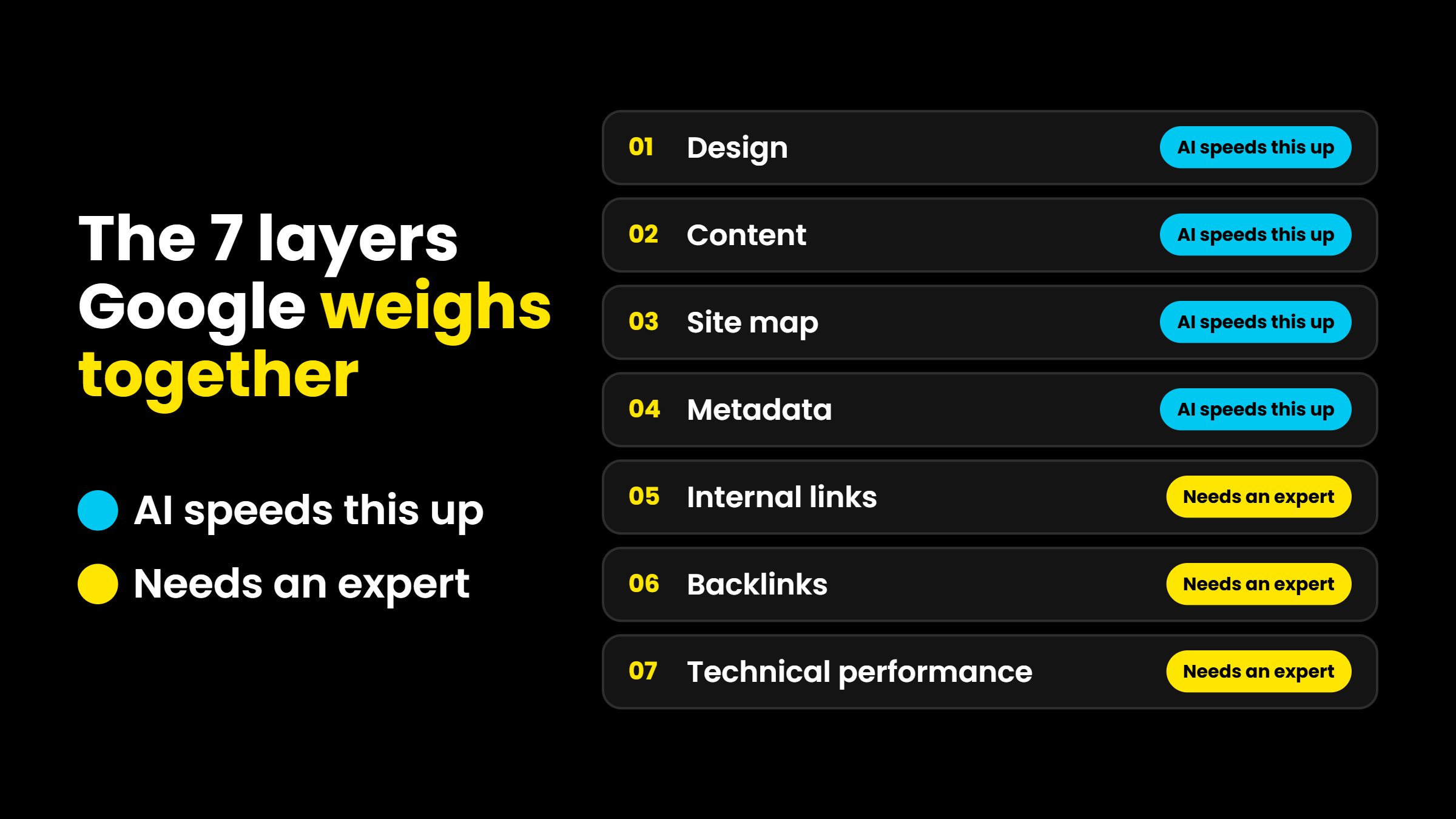
Your website is a set of layers that Google weighs together. Those layers are design, content, site map, metadata, internal links, backlinks and technical performance. A site that gets one or two right and ignores the rest struggles to rank, which is why so many businesses spend thousands on a website and see no traffic.
Here is the planning process we use, explained step by step in our short video.
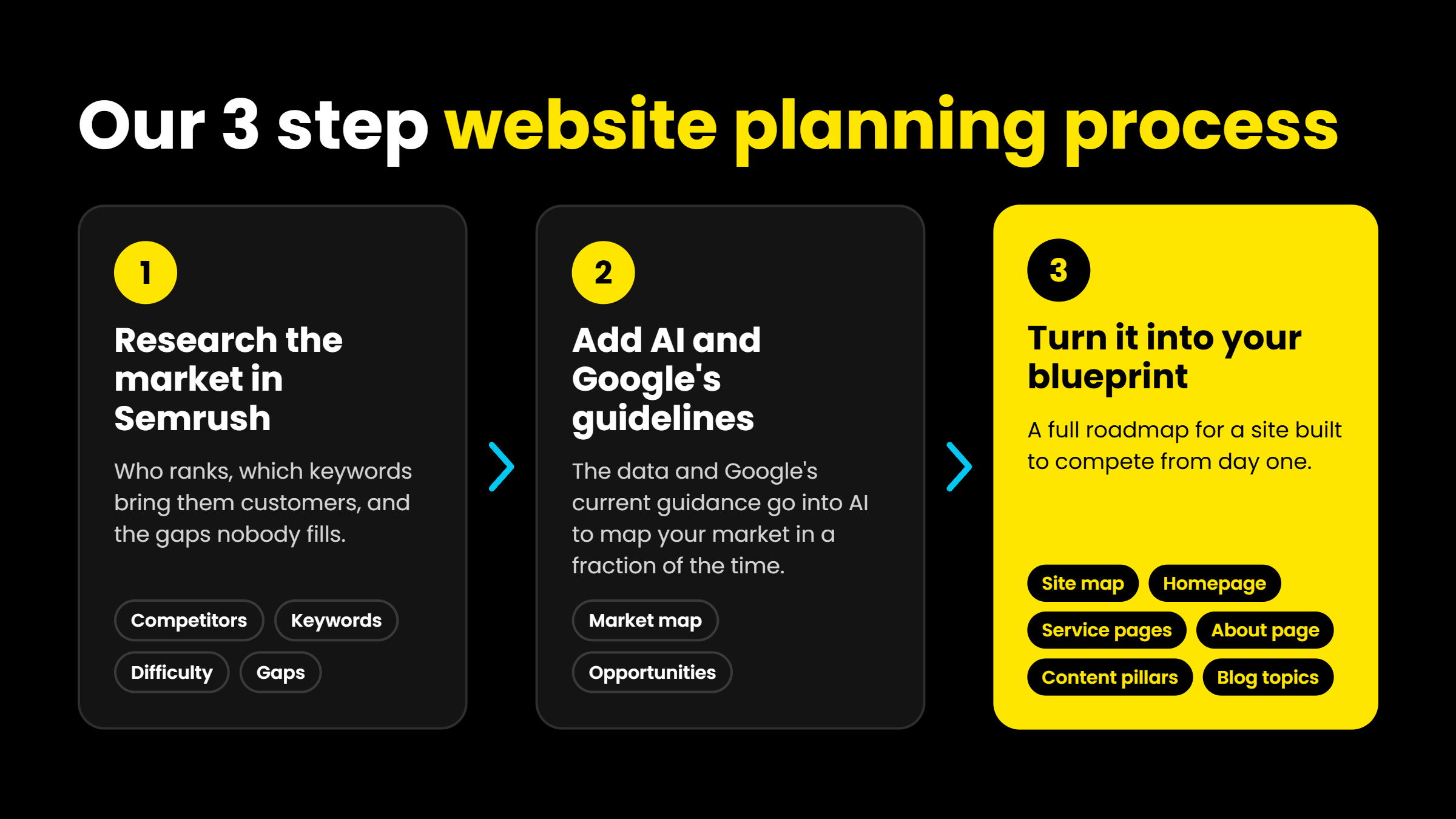
Step 1. Research the market in Semrush. We look at who ranks in your market, which keywords bring them customers, how competitive each keyword is, and the gaps nobody is filling.
Step 2. Give that data to AI with Google’s guidelines. We feed the Semrush data and Google’s current quality guidance into an AI model. It maps your market and your best opportunities in a fraction of the time that research once took.
Step 3. Turn it into a blueprint. We produce a site map, a homepage plan, service pages, an about page, and the content pillars and blog topics that build authority in your niche.
The result is a website planned around data instead of guesswork, which is the foundation of our SEO services, with keyword and market fit built in from day one. Strategy is only half the job, though. The build has to be executed properly, which we cover below.
You can run a quick test on your own business right now. Search for the main thing you sell plus your city and see where you appear. If the answer is page two, or nowhere, your site probably needs a stronger plan, and our strategy session shows you what that looks like.
Proof from two real Australian websites
We apply many of the methods in this article to our own clients’ websites, so we can show you what the results look like. These figures come from Semrush Domain Overview reports for the Australian database, generated on 24 November 2026.
| Measure | The Finn Group | Rafael’s Painting |
|---|---|---|
| Industry | Business brokerage and advisory | House painting in Sydney’s eastern suburbs |
| Estimated monthly organic visits | 3,400 | 453 |
| Organic keywords | 2,343 | 216 |
| Keywords ranking in Google’s top 10 | 301 | 15 |
| Share of traffic from non branded searches | 91.3% | 100% |
| Referring domains | 917 | 14 |
The Finn Group. The site ranks second in Australia for “business brokers” and for “business for sale in australia melbourne”, a search with about 4,400 monthly searches. More than half of its ranking keywords (54.9%) have transactional intent, which means the people searching are close to taking action. Over 91% of its organic traffic comes from searches that do not include the brand name, so the website is winning new customers who had not heard of the company before. Estimated organic traffic has more than doubled since early 2024, from roughly 1,500 monthly visits to 3,400. Read the full Finn Group case study.
Rafael’s Painting. This local painter appears in Google’s local map results for “painters coogee”, “painters eastern suburbs” and “painters randwick”, each with 210 to 320 monthly searches. Every visit comes from non-branded searches, and the site earns them with only 14 referring domains, which shows what a clear location-based structure can do. Estimated organic traffic has grown roughly fivefold since the start of 2025, from under 100 monthly visits to 453.
Semrush figures are estimates, so we treat them as a reliable guide to direction and scale.
Myth 4. Does AI replace your web designer or agency?
AI replaces slow, repetitive work. It does not replace the judgement that turns a website into a lead source.
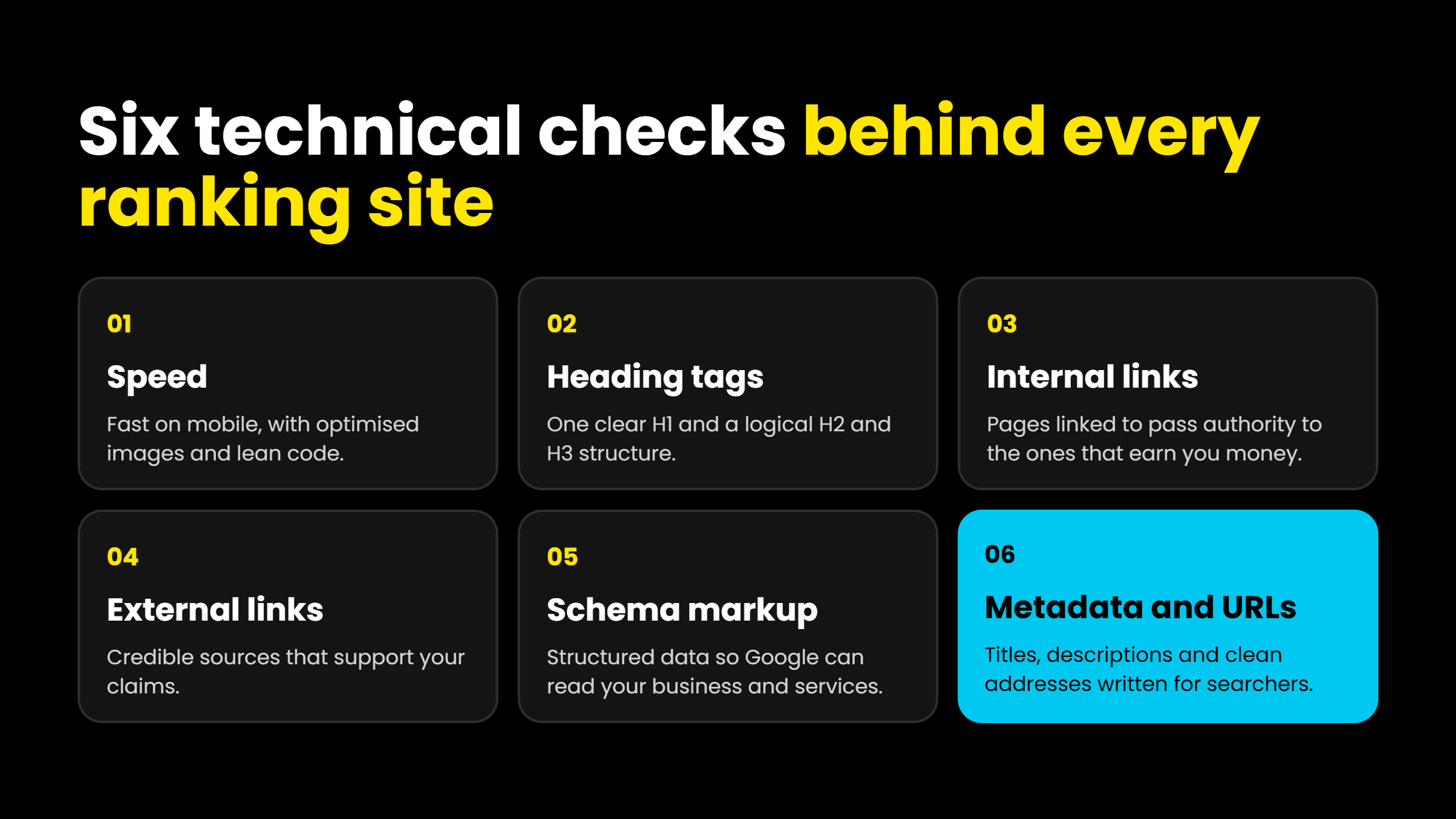
After the strategy comes the build, and the build matters as much as the plan. Even a perfect blueprint fails if the technical details are executed badly. When we build a WordPress site, we check each of these, and more.
- Speed. Fast loading on mobile, with optimised images and lean code.
- Heading tags. One clear H1 per page and a logical H2 and H3 structure that matches how people search.
- Internal links. Pages linked in a way that passes authority to the ones that earn you money.
- External links. Credible sources and relevant references that support your claims.
- Schema markup. Structured data so Google can read your business, services, reviews and FAQs.
- Metadata and URLs. Titles, descriptions and clean addresses written for both searchers and search engines.
People also supply the things AI cannot invent. These include your real project photos, your licences and credentials, honest customer reviews and the local knowledge that shows you are a genuine business. Google’s quality guidelines call this experience, expertise, authoritativeness and trust, or E-E-A-T, and it is the main reason an AI draft needs human review. Our article on UX and UI design that drives conversions shows how design choices affect enquiries too.
Google’s own people first content checklist asks whether a page shows first hand expertise and original information. Its ranking systems prioritise helpful, reliable content created to benefit people.
AI still earns its place after launch, and ongoing website maintenance keeps the technical side healthy. Used well, it speeds up content updates, keeps pages fresh and helps you act on what your search data says. The best results we see combine fast AI assistance with a team that checks every change.
Myth 5. Can you get your website to appear in AI results?
You can improve your chances, but nobody can guarantee a mention in Google’s AI features or in tools like ChatGPT and Perplexity. Anyone who promises otherwise is guessing. Google has said that the same SEO fundamentals apply to its AI search features, so the work below helps in both places.
Here is how to optimise your website for AI.
- Let the right crawlers in. Check that your robots.txt and security settings do not block search engines or the AI bots you want to be found by.
- Answer questions directly. Use headings that mirror real questions and give a clear answer in the first two sentences, then add detail.
- Show real experience and authorship. Name the people behind the content, add their credentials and include original photos, data and case studies.
- Add structured data. Schema for your organisation, services, reviews and FAQs helps machines understand what you offer.
- Build your wider footprint. Keep your Google Business Profile complete, collect genuine reviews and earn mentions on reputable Australian sites and directories.
- Keep content current. Update key pages when your services, prices or processes change, and show the date you last reviewed them.
Because AI tools draw on the same trusted sources that rank well in traditional search, a strong SEO foundation is the best starting point for both. For a deeper look, read our guide to AI visibility.
Frequently asked questions about AI website builders
How do I build a website with AI?
Start with research and finish with a human review. A reliable order is to research your keywords and competitors, give that data to an AI tool to plan your site map and pages, generate a first draft, build it on a platform you control, then check the technical SEO and facts before you publish.
How do I create a website using AI if I am not technical?
An all in one AI site builder is the simplest route for a basic site. If the website needs to generate leads from Google, ask an agency to handle the strategy and build, and use AI afterwards to keep content up to date.
Can AI build me a website, or can AI build you a website?
Both searches ask the same thing. AI can produce a working draft quickly, and it works best when a person supplies the strategy, the real business details and the final checks.
What AI can make me a website?
Many tools can, including general AI assistants and dedicated builders. We use Claude with WordPress and Elementor. Other tools suit other needs, so choose based on how much control you need over SEO and ownership of your site.
Which AI tool is best to build a website?
The best tool is the one that matches your goal. For a quick brochure site, an all in one builder may be enough. For a site that must rank and generate leads, an AI assisted WordPress build gives you far more control.
How can I tell if a website was built with AI?
Common signs include generic wording that could describe any business in the industry, stock style layouts and no named people or real project photos. Those same gaps weaken a site’s trust signals, which is why we add real proof to everything we build.
How do I optimise my website for AI?
Focus on clear question based headings, named authors, structured data, a complete Google Business Profile and genuine reviews. The Myth 5 section above covers the full list.
Does Mindesigns work with businesses outside Sydney and Cairns?
Yes. We work from offices in Sydney and Cairns and support Australian service based and B2B businesses nationwide.
Get a website plan built on real data
If you are planning a new website or a revamp, book a strategy session with our team. We will show you how your market looks in Semrush, where your competitors are weak and what a data-backed site map could look like for your business.
Businesses turning over $1 million or more a year receive the session free. Smaller businesses pay a small fee. While you decide, download our free AI era digital marketing strategy. Bring the name of the competitor who frustrates you most, and we will show you how to get ahead of them on Google Search.