For Marketing Leaders
Think about the last time you searched for a service or tool. There is a good chance you did not start by opening Google and clicking through a stack of websites. You asked a question instead. Maybe it was in ChatGPT, maybe Claude. Maybe it was another AI tool. You typed a specific prompt, waited a few seconds, and got a shortlist, a summary, or a direct recommendation. It feels like a small behavioural change, but it says a lot about how people now move through the web. This raises a very important question for companies – How to get recommended more by AI?
Search now carries a different expectation. A long list of links often feels like extra effort. But a strong answer feels useful straight away. People lean towards responses that save time, reduce friction, and quickly narrow the field. In many cases, the filtering happens before a website visit, which means the shape of the decision is already forming before the user lands on a page.
That changes how websites get assessed. AI tools often act as an early filter, so a website has to communicate its offer quickly, hold a clear position, and present enough supporting signals to justify inclusion. The sites that tend to surface are usually the ones with precise messaging, specific positioning, and a structure that is easy to interpret. The ones that miss out often blur their offer, dilute their relevance, or make classification harder than it should be.
We have seen this across our own website and across client websites and content that now get cited or recommended by AI tools. That is why this article treats AI visibility as a reverse-engineering problem. Rather than relying on vague advice about what an “AI-friendly” website should look like, it makes more sense to study how these systems appear to classify a site, match it to a prompt, test its credibility, and decide whether it belongs in the answer. Once that process is clearer, website strategy becomes far more deliberate.
Why Learning How to Get Recommended by AI is Vital
For years, website discovery followed a familiar pattern. Someone had a need, typed a few words into Google, scanned a page of results, and began clicking. That model still exists, but it no longer holds the same monopoly over attention. Discovery now spreads across platforms, each with its own role in the decision. Someone might spot a provider on LinkedIn, check reviews on Reddit, watch an explainer on YouTube, or ask ChatGPT to narrow the field. The path is less linear, and far more fragmented.
That fragmentation changes how people gather confidence. Google still plays a major role, especially for high-intent searches, but it now sits alongside a wider mix of tools and platforms that shape perception before a click happens. AI acts like a filter layer between the user and the open web, pulling in information, compressing options, and presenting a shortlist or direct answer. Instead of showing everything, it tries to decide what deserves attention first.
This has a direct consequence for websites. They are often being interpreted before they are visited. AI tools look at the available signals, form an early view of what a site is about, and decide whether it belongs in the answer set. If that interpretation feels weak, vague, or unsupported, the site can disappear from consideration before the user ever sees it. That is why broad advice about “optimising for AI” often falls flat. It stays too abstract to be useful.
A better response is to treat AI visibility as a sequence of decisions. If these systems are filtering websites before they surface them, then the real question becomes much more practical. What exactly are they checking, and in what order do those checks seem to happen?
Step 1 – AI Tries to Understand What Your Website Actually Does
Before AI can recommend a website, it has to understand what it is looking at. It needs a clear read on what the business offers, who it serves, where it operates, and what category it belongs to. This is where many websites lose ground. The homepage says one thing, the service pages say another, and the rest of the site leans on broad marketing language that could fit almost anyone. When the signals are blurred, AI has very little to hold onto.
That is a problem because recommendation starts with classification. If a website feels too broad, vague, or scattered, AI struggles to connect it to a real prompt. The sites that do this well usually make their offer clear on the homepage, explain services in plain language, speak to a defined audience, and use location or niche context where it helps. Those signals appear in the homepage, service pages, headings, metadata, and repeated patterns across the site. AI does not need perfect repetition, but it does need a website that points in one clear direction. Run this test:
Can AI Understand Your Website in 10 Seconds?
- Does your homepage clearly say what you do?
- Does it say who you help?
- Does it reflect a specific category or niche?
- Are your services described in plain language?
- Can someone unfamiliar with your business quickly understand your offer?
Once AI has a stable read on what your website is, the next challenge is fit. A clear site still needs to line up with the question a user is asking, and that is where search behaviour starts to shape what kind of content actually gets surfaced.
Step 2 – AI Matches Your Content to the Question Behind the Search
Once AI understands what your website is about, it starts looking at the content itself. This step is about whether your pages speak to the actual question behind the prompt. People now search with far more context. They describe their situation, goals, limitations, and preferences in one go. AI is trying to find content that responds to that full situation, not just pages that happen to mention the general topic.
“The way people search is changing. They are no longer just naming a service, they are describing the problem, the outcome they want, and the context behind it.” – Omer Bernstein Head of Marketing and Sales in Mindesigns
This is where generic content starts to lose ground. A broad service page may touch the topic, but it often falls short when the prompt becomes more specific. A page built around “Mortgage Broker Sydney” gives AI far less to work with than, for example, content built specifically for first home buyers with low deposits, grant questions, and borrowing concerns. FAQs, niche landing pages, problem-specific pages, and use-case content all help because they mirror the way people actually ask for help.
A strong match, though, still does not settle the issue on its own. A website can sound relevant and still leave room for doubt. Once AI sees a possible fit, it starts looking for signs that the site is coherent, credible, and stable enough to trust.
Step 3 – AI Uses Website Structure to Build Confidence
Once the content looks relevant, AI starts reading the structure around it. This step is less about the copy itself and more about how the website is built. AI is still a machine following signals, patterns, and directions. It needs a clean path through the site. That means the backend structure plays a huge role in this navigation and a messy website makes AI work harder to understand what each page is for, how pages connect, and which ones carry the most weight.
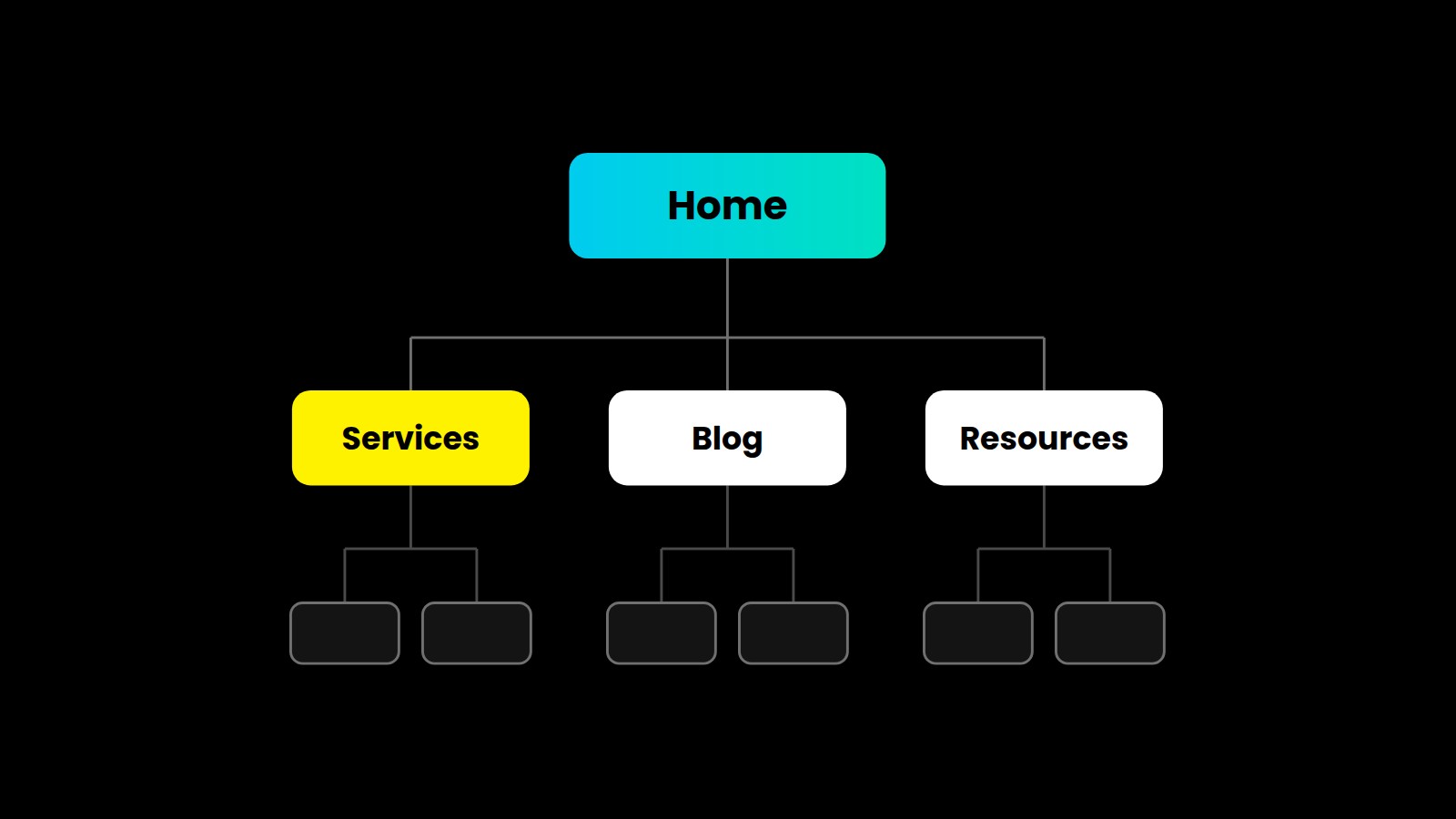
This is where technical structure starts doing real work. AI looks at how pages are grouped, how the sitemap is organised, how navigation guides movement across the site, and how headings help define the role of each page. In practical terms, structure creates context, and context is what generative AI relies on to interpret meaning. It uses those structural signals to build a mental model of the website, understand how information fits together, and judge what each page is meant to do. If that model feels messy, confidence drops. Even strong content can lose force when it sits inside a structure that feels confusing, bloated, or disconnected.
Technical Signals That Help AI Read a Website Clearly
- Logical sitemap structure
- Clear page hierarchy
- Proper heading use from H1 to H3
- Strong internal linking between related pages
- Crawlable, indexable core pages
- Focused navigation
- Minimal duplication across similar pages
- Metadata that supports page intent
Once that structure is clear, AI can look beyond the site and compare that picture with what the rest of the web says about the business.
Step 4 – AI Looks Beyond Your Website for Validation
Once a website presents a clear identity, AI starts checking whether the rest of the web tells the same story. It does not rely only on what a business says about itself but looks for outside references that help confirm the category, niche, location, and reputation attached to that site. This is where business listings, directories, review platforms, LinkedIn, Reddit, industry publications, and local citations come into play. Each one gives AI another point of comparison.
A website can describe itself well, but outside reinforcement still shapes how believable that picture feels. If there are no meaningful mentions, patchy listings, inconsistent business details, or very little footprint beyond the site itself, AI has less to work with. Strong validation looks very different. The business shows up across relevant platforms, the descriptions line up, and reviews or mentions support the same positioning the website presents.
For instance, if someone asks AI for a mortgage broker with plenty of Google reviews, the model may lean on the external signals it can find around that prompt. A broker with a strong review profile, consistent listings, and supporting mentions across the web is easier to reference than one with a polished website but almost no outside proof. That is why external validation does more than support credibility. It can directly shape whether your business gets surfaced at all.
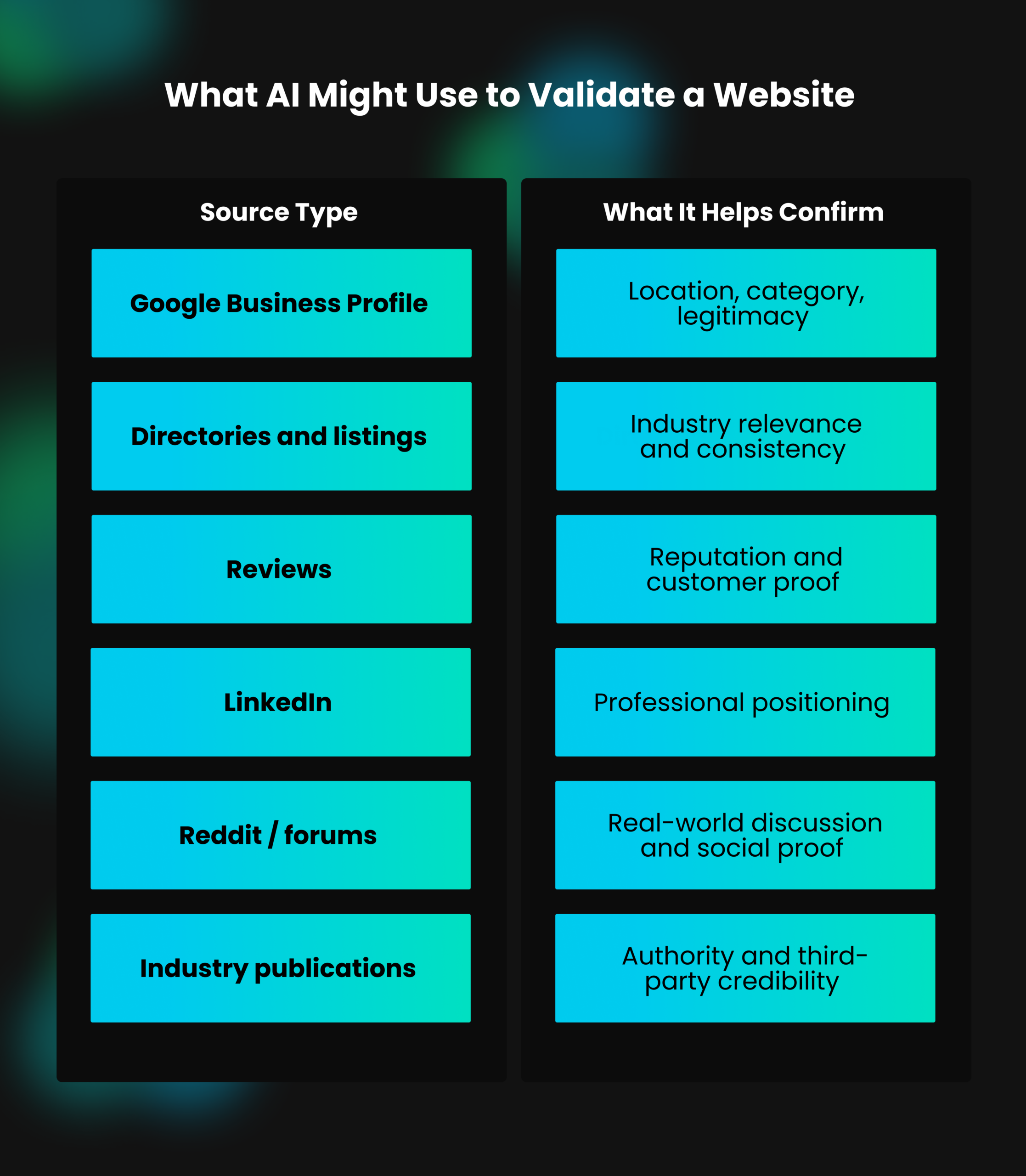
This is why a strong website can still be overlooked. Good on-site messaging helps AI understand you, but broader web signals help it believe you. Once those signals line up, AI has enough context to make the final call on whether your website deserves a place in the answer.
Step 5 – AI Makes the Recommendation, and Your Website Either Earns It or Misses It
By this point, AI has already done most of the heavy lifting. It has tried to understand what your website does, matched it to the question behind the search, checked whether the site holds together internally, and compared that picture against the broader web. Step five is where those signals come together. The recommendation is the outcome of cumulative confidence. That is why websites often miss out even when one part looks strong. A site can have solid design and decent content, but still lose ground because the offer feels vague, the positioning feels broad, or the supporting signals around the web feel too thin.
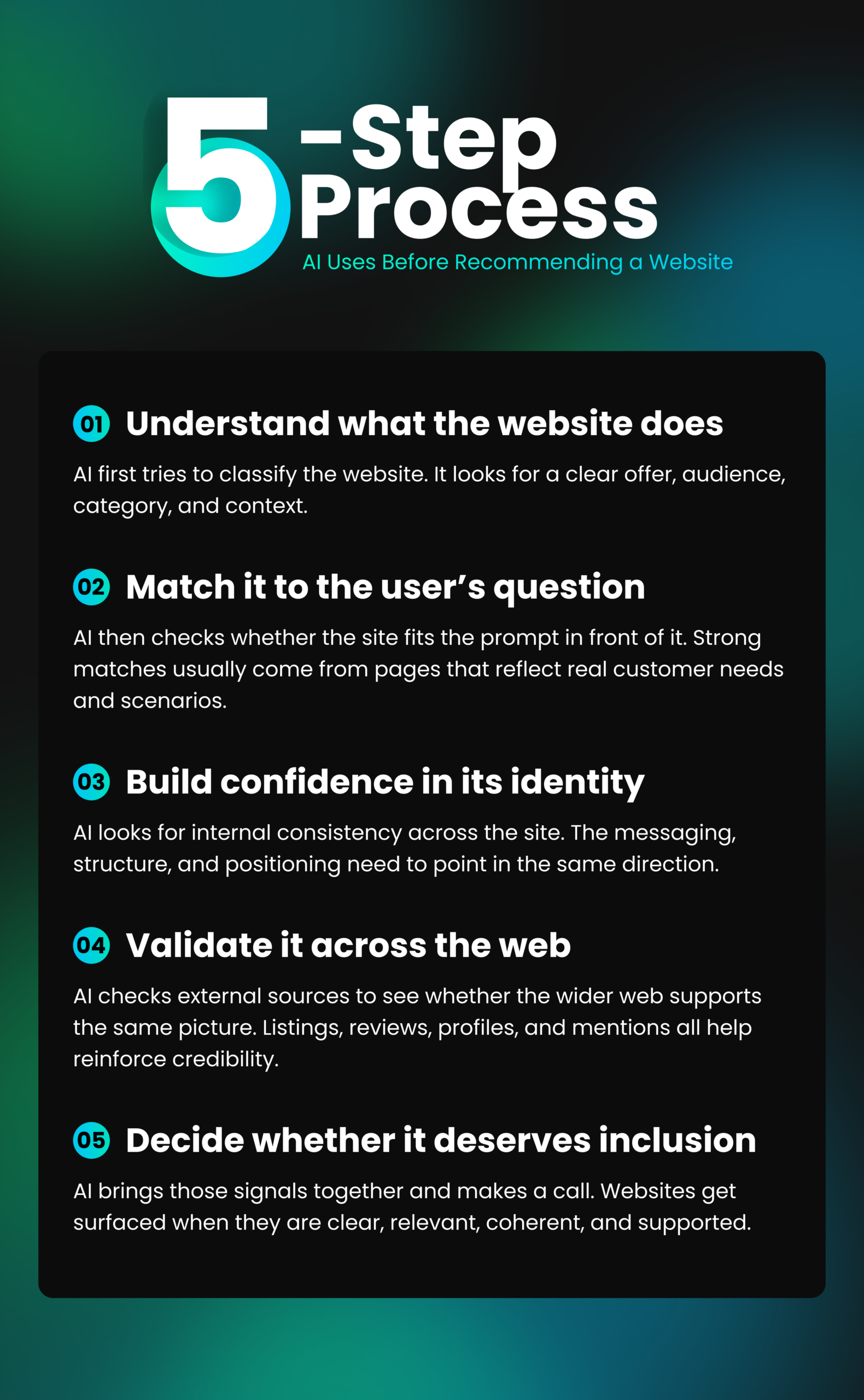
When you look at it through this lens, website optimisation becomes a much more strategic exercise. The job is to build a website that gives AI enough clarity, relevance, and confidence to surface it for the right prompt. That mindset usually leads to stronger decisions across the site, from messaging and structure to content and off-site signals.
If you want to build or refine a website with AI favourability in mind, we can help. Our websites are designed to communicate clearly, hold a strong position, and give AI better reasons to surface them. If you want a clearer view of how your current site performs across these five steps, or you are planning a new website built for stronger AI visibility from the ground up, contact us.
Reviewed: Santiago Parra Suarez