For Marketing Leaders
The Lever Most B2B Teams Refuse to Pull
Most B2B marketing teams have no lever to pull when leads slow down.
They’ve got an organic content calendar that took three weeks to plan, a LinkedIn company page nobody reads, a newsletter that goes out when it goes out, and a quiet hope that this quarter the algorithm will be kind. When the pipeline dips, and it always dips, they post more and hope for the best. They tweak the SEO. They book another podcast appearance. They wait.
That’s not a marketing strategy. That’s a prayer.
This is especially true in EdTech, higher education, and professional services. These are categories with long sales cycles, six-person buying committees, and unrealistic revenue targets. If you’re a Head of Marketing in one of these industries, the gap between what the board expects and what your channel mix can actually deliver isn’t a strategic puzzle. It’s a job security issue.
The Data Nobody Wants to Sit With
The lever exists. It’s paid ads. And the data quietly says the people refusing to pull it are losing the argument with their own pipeline. HubSpot’s 2026 Social Media Marketing Report found that 41% of B2B marketers can’t prove social ROI to their executives, while 69% are under more pressure to do exactly that. Read that twice.
The same teams who can’t show the board a return are the ones being asked to show one harder. The gap between “social influences pipeline” and “I need a number by Friday” is where most marketing careers quietly stall.
Organic Was Never Going to Scale Forever
Here’s the thing nobody wants to say out loud: organic was never going to scale forever. LinkedIn reach has been compressing for three years. Google’s AI overviews and LLMs are now answering most of the questions that used to drive traffic to your blog, eating away a big portion of the clicks you used to count on. The platforms aren’t punishing you. They’re rebalancing toward the business model that pays their bills. If your entire B2B lead engine depends on the goodwill of an algorithm whose entire incentive is to charge you, the strategy isn’t bold. It’s brittle.
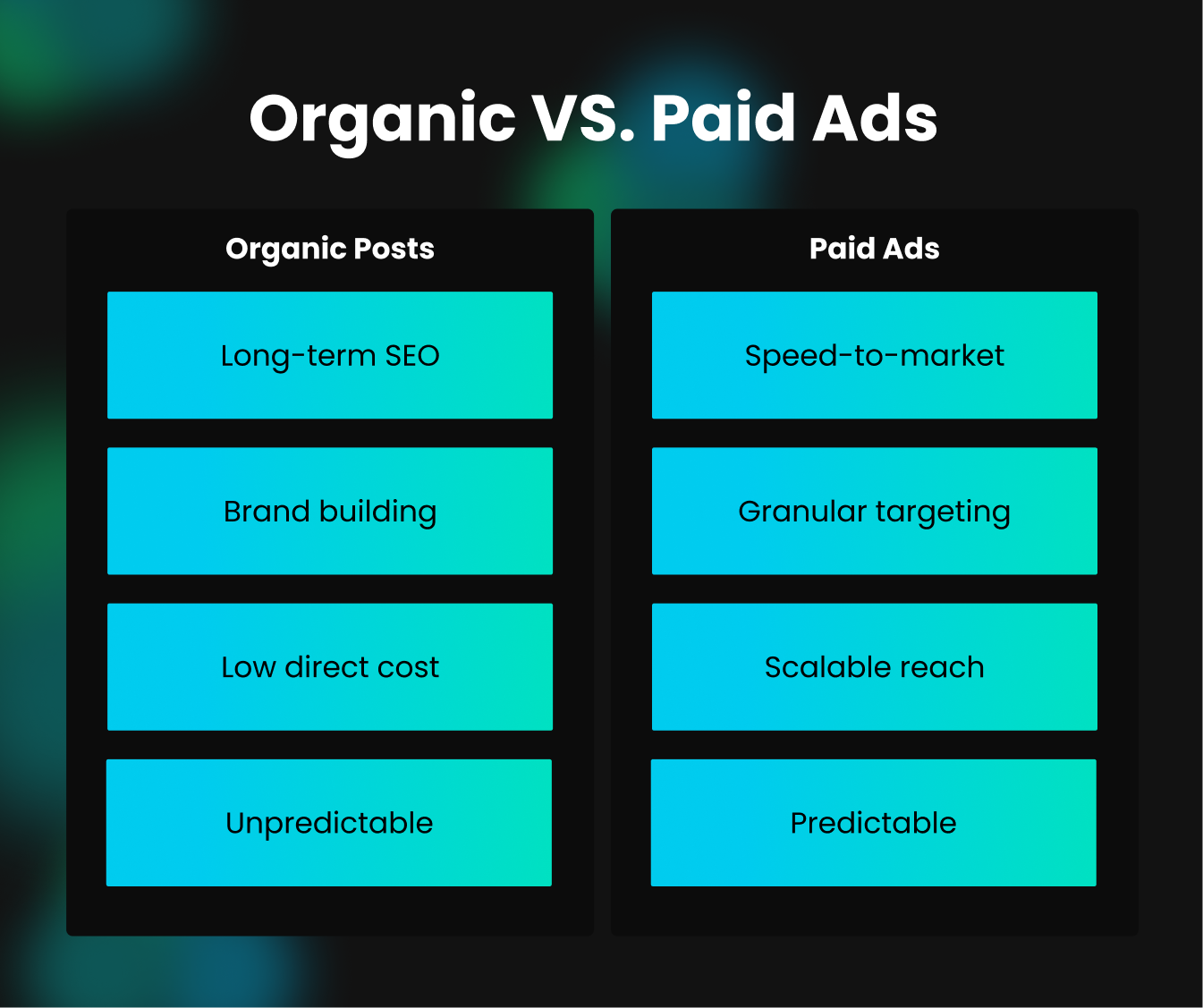
Paid ads are the counterbalance. Not the replacement for content, not the death of brand. The counterbalance. You build the content engine because it’s your asset. You run paid because it’s the lever you can pull on a Tuesday morning when sales says next quarter’s pipeline is light. One without the other is a business with no off switch and no on switch.
Why Most B2B Teams Are Bad at Paid (and It Isn’t Budget)
The reason most B2B teams are bad at paid isn’t budget. It’s that they treat paid like organic with a credit card attached. Same offer, same creative, same “thought leadership” angle, just boosted. That doesn’t work, and it never did. Paid in B2B works when you understand it as a different instrument entirely. One designed not to nurture but to manufacture demand attention, then hand that attention to a system (a webinar, a lead magnet, a sales team) that can convert it. That’s a craft. Most in-house teams don’t have it, and to be fair, it takes years to develop. The people who are genuinely good at it are rare.
Two Companies That Figured It Out
Which brings me to two companies that figured this out. One in your category, one deliberately not.
Take OES. They sell into a market where the buyer needs to be educated before they’re ready to talk to sales. Classic B2B problem, and one every higher ed and EdTech reader will recognise. The instinct most teams would have is to write more blog posts, hope they rank, and wait for inbound to do its slow magic. We did something different. We built on-demand webinars, proper ones, and ran paid ads to fill them.
Cost per lead came in at $20 to $30. For a business with margins like OES has, that’s not a marketing channel. That’s a printing press. The webinars did what organic content is supposed to do, except faster and on a schedule we controlled. A registrant who watched thirty minutes of an OES webinar walked into the sales conversation already half-sold. Sales didn’t have to educate. They had to qualify and close.

Now take GCB Doors and Windows. I’m pulling this one in deliberately, because the principle I want you to see has nothing to do with industry. When we picked them up, they had no paid ads at all. The whole business ran on SEO and word of mouth. Lovely on a good month. Terrifying on a bad one, because there was no lever to pull. No way to manufacture a pipeline.
No way to scale without waiting for Google or for a referral that may or may not come. If you’re a Head of Marketing reading this, you already know that feeling. It’s the one you get every quarter where the pipeline graph slopes the wrong way, and the only thing you can do is post more content and hope.
We built them paid. Different buyer (tradies, not CMOs), different offer (loyalty-based incentives for recurring trade purchases), but the same mechanical move. Identify the specific behaviour we wanted, design the offer around it, and run paid to manufacture it on demand. Leads came in at around $10 each, with the kind of buyer intent that justifies spending ten times over.

Two completely different businesses, two completely different audiences, same underlying principle. Paid ads aren’t a channel. They’re a system you wire to a specific buyer behaviour. Get the offer right, get the audience right, and the platform does what it’s paid to do.
The Real Reason “Paid Didn’t Work”
When someone tells me “we tried paid ads and it didn’t work,” nine times out of ten it’s one of two things. Either they hired an amateur who didn’t actually understand the craft and spent six months learning expensive lessons on the business’s dime. Or, more commonly, paid generated the leads and then nobody called them.
We worked with an educational institute that’s the textbook case of this. It took us a while to convince them paid would actually deliver enrolments, not just leads, provided they put a process in place to receive them. They didn’t. Their entire lead follow-up was a single email. 300 words long. No CTA. Sent whenever someone got around to it. Genuinely embarrassing.
We ended up doing what an agency really shouldn’t have to do, running sales consultations for their team, training their reps on how to handle an inbound enrolment, sitting in on calls. That fix, not the ads themselves, was what turned the business around.
This is the most expensive misunderstanding in B2B: paid ads generate leads, but they don’t close them. If you don’t have a system on the other side, a sales rep who calls within the hour, or at a minimum a nurture sequence that doesn’t read like spam, paid won’t save you. Nothing will.
The Three-Question Benchmark Before You Spend a Dollar
So if you’re a Head of Marketing reading this and the quarter is starting to wobble, don’t book another content sprint. Don’t audit your organic. Run yourself through this short benchmark first. It’ll tell you in twenty minutes whether you’re ready to pull the paid lever, or whether you’re about to waste six months and a budget you can’t afford to waste.
1. What is a qualified lead actually worth to you? Not what you think it should cost. What can you afford to pay, given your average deal size, close rate, and contribution margin? If you can’t answer this in a sentence, you’re not ready to spend a dollar on paid. The math is the strategy.
2. What happens to a lead inside your business in the first hour? Be honest. Is it a phone call from a rep who knows what they’re doing? Or is it a 300-word email with no CTA, sent whenever someone gets around to it? Paid amplifies whatever system you already have. If your system is broken, paid breaks it louder.
3. What’s your offer, and would a stranger care? Not your brand. Not your value prop. Your offer: the specific reason someone who has never heard of you would stop and click. If the answer is “schedule a demo” or “download our guide to digital transformation,” you don’t have an offer. You have a placeholder.
If you can’t answer all three, you need a strategy session where we can put the strategy in place for you.
The lever exists. Pull it or don’t. But stop pretending you can’t create one.