For Marketing Leaders
Can AI really be trusted with thousands of dollars of ad spend?
That was the question we kept coming back to since the AI boom began.
We’ve been using Google Ads for our own and our clients’ marketing campaigns, and it’s been moving quickly toward automation. Performance Max, AI Max, broad match, automated bidding, AI-generated assets, and auto-applied recommendations are now pushed heavily inside the platform. On paper, these features are designed to help advertisers improve performance. In practice, the question is more complicated.
A higher optimisation score does not always mean a stronger campaign. More clicks do not always mean better leads. More automation does not always mean smarter decisions.
So we tested the tools ourselves.
This article is based on our internal Google Ads workflows across lead-generation, local service, finance, and shopping campaigns. We looked at how tools like ChatGPT, Claude, Gemini, and Nano Banana could support search intent analysis, negative keyword research, campaign data review, reporting, and creative production.
The short version of what we learned is that we still would not hand the wheel over completely. Not to Google’s native automation, and not to any third-party AI tool.
But when AI is used in the right parts of the workflow, with human review behind every major decision, it can make campaigns faster to analyse, easier to refine, and sharper where it counts.
These are the tools we use, where they helped, where they fell short, and what we would warn advertisers about before trusting AI with their own Google Ads budget.
How AI Tools Are Reshaping Google Ads
One of the biggest shifts in Google Ads right now is the pressure to trust automation.
Advertisers are constantly pushed to improve their optimisation score, a platform metric Google uses to estimate how well an account is set up to perform. That can be useful, but it does not always reflect what matters most to the business: lead quality, pipeline strength, and commercial intent.
A campaign can look healthier inside Google Ads while becoming weaker for the business behind it.
Most optimisation recommendations push advertisers toward features like broad match, automated bidding, AI-generated assets, Performance Max, auto-applied recommendations, and AI Max.
These tools can help in the right context. We have seen automation improve efficiency, speed up testing, and uncover opportunities faster. But we have also seen it create more activity without improving the quality of traffic. Essentially, we know Google doesn’t mind sending us the wrong clicks because we pay for them.
In one recent campaign for Mindesigns, Google kept pushing us to turn on AI Max. The optimisation score lift was significant, so we tested it.
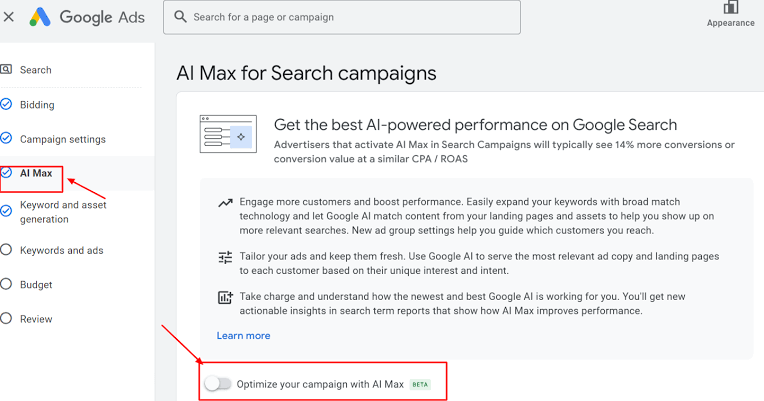
Within a few days, click volume increased. On the surface, that looked like progress. But once we reviewed the search terms and lead quality, the issue became clear. AI Max had started pulling in broader, lower-intent searches that were loosely related to the service but poorly aligned with the buyer we wanted to reach.
That is why we treat Google’s automated recommendations as suggestions to test, not instructions to follow.
For lead-generation campaigns, the real question is not whether Google can generate more activity. It is whether the campaign is reaching people who are more likely to become serious enquiries.
AI tools are not useless. Used properly, they can make campaign management faster and sharper. The real advantage comes from using automation to support strategic decision-making, especially when analysing intent, spotting wasted spend, improving creative workflows, and processing campaign data faster than we could manually.
That is where tools like Claude and ChatGPT began to become genuinely useful in our Google Ads workflows.
How We Use LLMs to Improve Google Ads Performance
Once we saw the limits of Google’s native automation, we started looking at where external AI tools could support the work without taking over the strategy.
The biggest value came from using each tool for a specific part of the Google Ads workflow. We did not use one AI tool for everything. Claude was stronger for search intent and reasoning. ChatGPT was stronger for campaign exports and performance summaries. Gemini was useful for working inside Google’s ecosystem. Nano Banana helped with creative production and visual mockups.
|
Tool |
Best use in Google Ads |
Needs human review for |
|
Claude |
Search intent grouping, funnel alignment, negative keyword reasoning |
Final keyword and exclusion decisions |
|
ChatGPT |
Campaign export analysis, trend summaries, anomaly spotting |
Strategic interpretation and next actions |
|
Gemini |
Google Ads research, campaign explanation, Google ecosystem support |
Recommendations that affect budget or targeting |
|
Nano Banana |
Product image cleanup, creative mockups, visual variations |
Brand accuracy, product accuracy, and final ad creative |
The point was not to let AI manage the campaigns for us. The point was to make the analysis faster, so our strategists could spend more time on the decisions that actually affect performance.
For example, AI can quickly group hundreds of search terms by intent. It can highlight repeated wasted spend patterns. It can summarise campaign exports that would take much longer to review manually. It can also help create first-pass visual concepts for ad creative.
But the final decision still needs a human strategist.
AI can tell us that a search term looks low intent. It cannot fully understand the client’s sales process, margin, local market, lead quality, or what the business can actually handle operationally. That context changes the decision.
This is where AI became genuinely useful for us: not as a replacement for campaign strategy, but as a faster way to surface the patterns our strategists need to review.
Identifying Search Intent and Funnel Alignment with Claude
One of the most useful ways we use Claude is for search intent analysis.
A Google Ads campaign can generate hundreds of search terms that look relevant at first glance. But relevance and buying intent are not the same. Some searches come from people ready to enquire. Some come from researchers. Some come from competitors, job seekers, students, or people looking for a completely different service.
Claude helps us sort those patterns faster.
For example, we can give Claude a search terms report and ask it to group the terms by intent:
Review this Google Ads search terms report. Group the terms into purchase-ready intent, comparison intent, research intent, competitor searches, irrelevant traffic, low commercial intent, and potential negative keywords. Explain why each group matters and flag any terms that need human review before exclusion.
Here is a simplified example from Sell Gold Sydney (one of our clients) keyword assessment of what that output might look like:
|
Search term |
AI category |
Human decision |
Action |
|
sell gold near me |
Purchase-ready intent |
Keep |
Send to high-intent landing page |
|
sell gold Sydney |
Purchase-ready intent |
Keep |
Prioritise in campaign |
|
gold price today |
Research intent |
Review |
Keep if supported by strong seller-focused messaging |
|
how much is my gold worth |
Comparison intent |
Keep |
Use educational ad copy and valuation-focused landing page |
|
buy gold bars Sydney |
Wrong intent |
Exclude |
Add as a negative keyword theme |
|
gold buyer jobs |
Irrelevant traffic |
Exclude |
Add job-related negatives |
|
gold jewellery repair |
Adjacent service |
Review |
Exclude if the client does not offer repairs |
The AI output is only the first layer. The strategist still needs to review the commercial context behind each term.
For example, a search like “gold price today” may look too informational at first. But for a gold buyer, it could also come from someone trying to assess an item’s value before selling. Removing that term too quickly could cut off a useful early-stage enquiry path.
That is why we use Claude to speed up the sorting process, then apply human judgement before making changes to the campaign. The tool helps us see the pattern faster. The strategist decides what the pattern actually means for the business.
Improve Shopping Ad Creatives with Nano Banana
We’ve worked with big, corporate clients like OES and Sekuro to smaller boutique businesses like GCB Doors and Windows, but whatever level of enterprise it is, producing a product photoshoot can be challenging to do. It can be a bottleneck when waiting for everything to be edited.
We use AI tools like Nano Banana as creative support, not creative replacement. We’re not generating finished ads from a prompt. We use it to make images more consistent in look, clean up existing imagery, and generate visual mockups.
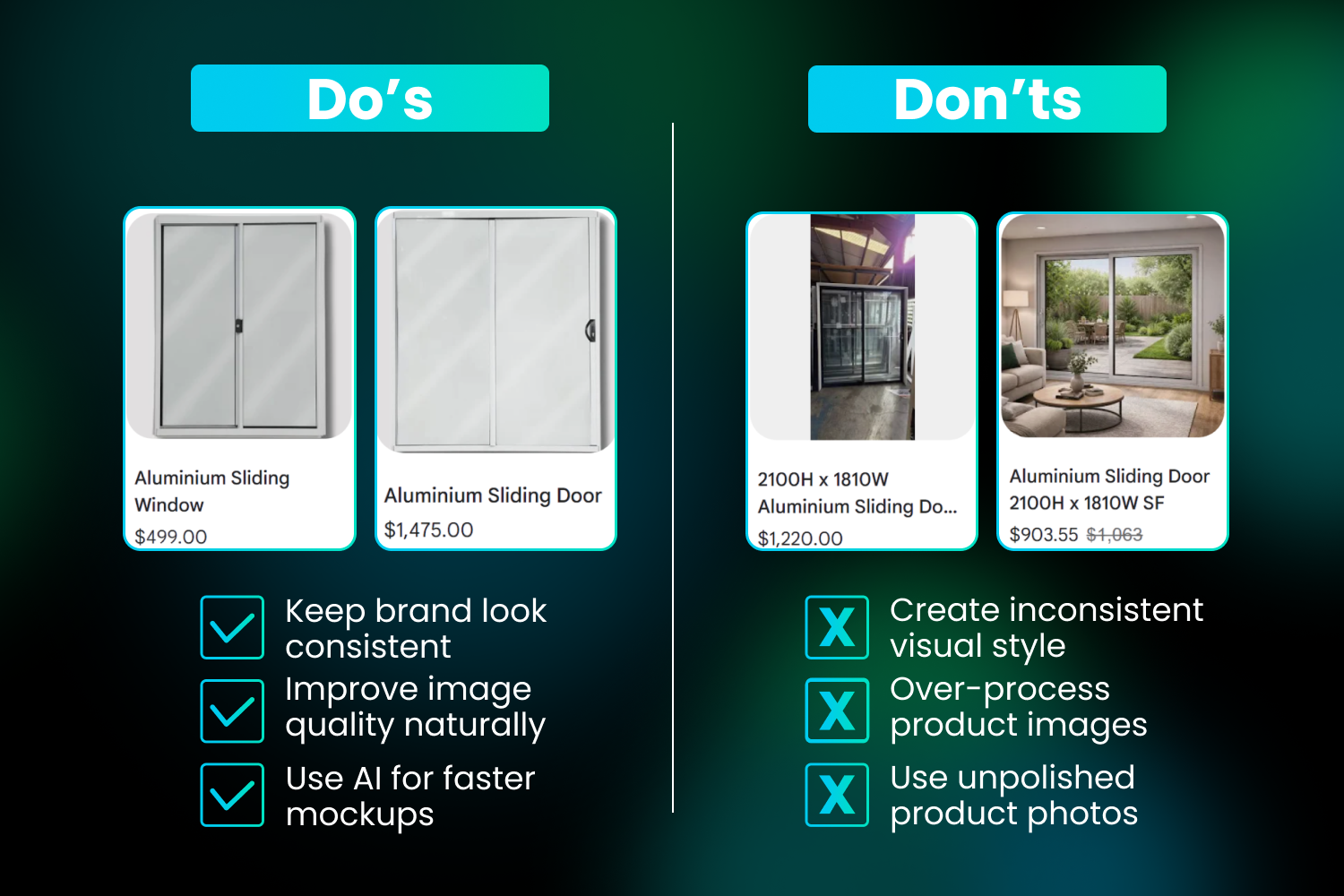
The ads still went through human creative review before launch, but the volume of variations we could test increased significantly. That made it easier to experiment with different layouts, backgrounds, compositions, and visual styles without dramatically increasing production time.
That said, human oversight still matters heavily here. One thing we noticed quickly is that overly AI-generated visuals tend to undermine credibility if they look artificial, over-processed, or disconnected from the actual product experience.
Analysing Campaign Data with ChatGPT
ChatGPT is the workhorse for anything data-heavy. Where Claude reasons, we found that ChatGPT is better at processing large spreadsheets of campaign data.
We’ll drop a campaign export into ChatGPT and ask it to summarise performance trends, flag anomalies in the search terms report, or identify keyword themes worth scaling. We never act on the output without manual validation. AI catches the data, but it doesn’t always catch the nuance.
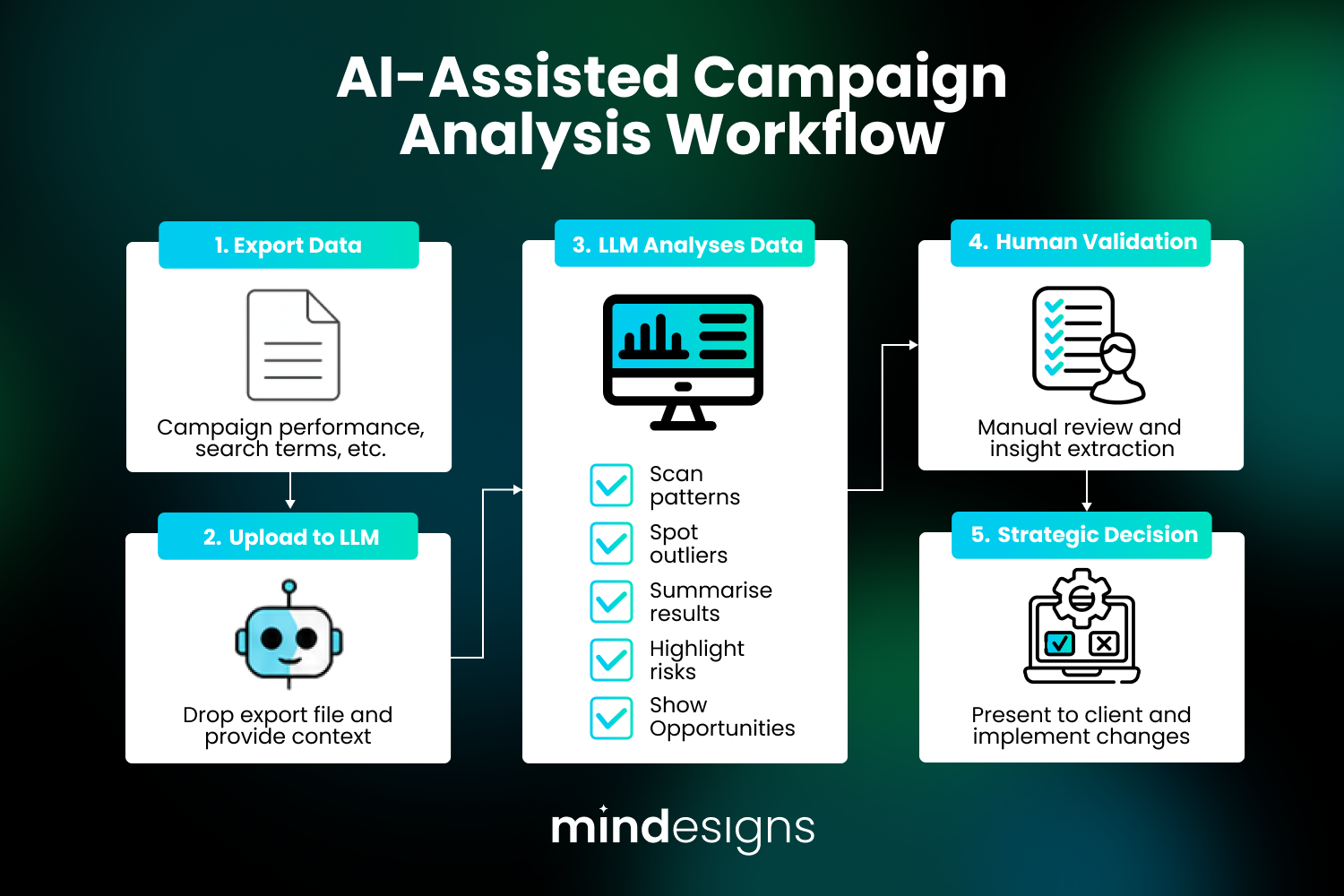
We used this kind of workflow heavily while managing campaigns for Eakins Finance, where campaign growth eventually became so strong that the team temporarily paused advertising because enquiry volume exceeded their operational capacity.
In that case, AI-assisted analysis helped us identify which search themes, messaging angles, and campaign segments were driving the highest-quality enquiries, allowing us to scale the areas performing best while reducing wasted spend elsewhere.
We still manually validate everything because AI is very good at spotting patterns in data, but it does not always understand the business nuance behind those patterns. Sometimes a keyword that appears statistically inefficient may still be strategically valuable, depending on the customer journey, sales cycle, or commercial intent behind the search.
What We Learned After Testing AI Across Campaigns
Testing these tools changed our perspective quite a bit.
Going into it, we expected AI to either massively outperform human workflows or completely fail to understand marketing properly. The reality ended up sitting somewhere in the middle.
Some parts were incredibly impressive, especially in terms of analysis speed, categorisation, and workflow efficiency. Other parts felt surprisingly disconnected from how real buying decisions actually happen.
That balance is probably the biggest takeaway for us. AI is becoming extremely useful for marketers, but the businesses seeing the strongest results are still the ones that combine automation with real strategic thinking rather than handing everything over blindly.
At Mindesigns, we use AI to support campaign analysis, search intent research, reporting, creative testing, and workflow efficiency. These are the parts of the job where speed and pattern-matching pay off. But the strategy behind every campaign is still guided by marketers who understand buyer psychology, lead quality, and how a B2B sales cycle actually works.
If your Google Ads account could use a second opinion, get in touch. We’ll show you what we’d change, and why.