For Marketing Leaders
Early in my sales career, one question kept bugging me: “How do you know when a prospect is actually ready to buy?” The answer isn’t instinct. It comes from having a real B2B sales process, one that shows you the signals most of us completely miss.
If you ask too early, you scare them off. If you wait too long, then the deal goes cold. For years, I treated it as guesswork, until I figured something that changed how our entire agency signs new clients.
“I realised that there’s actually a point that the prospect gives us an indication that they are interested, without even saying it. That’s how the whole methodology that we came up with is based around.”
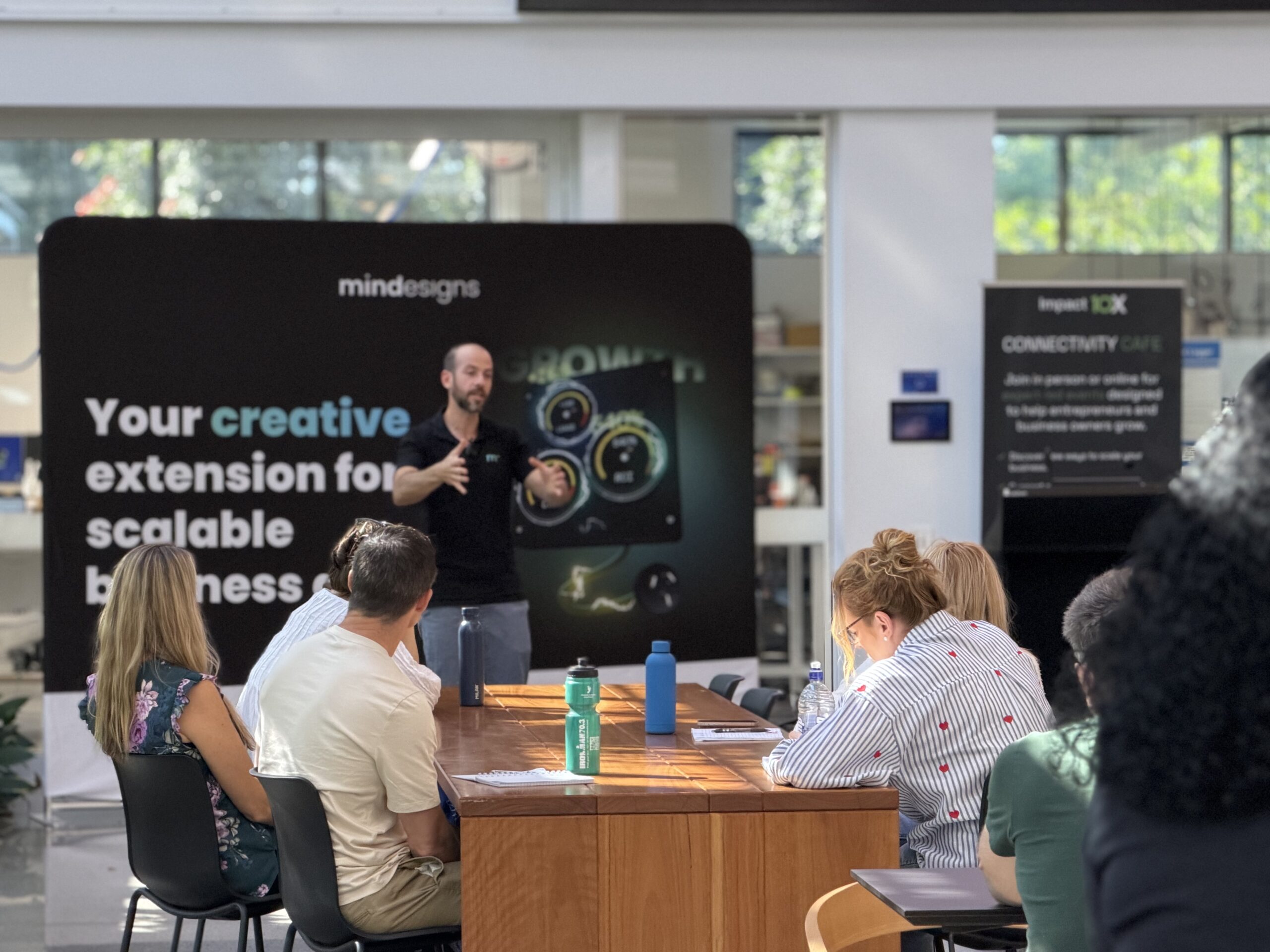
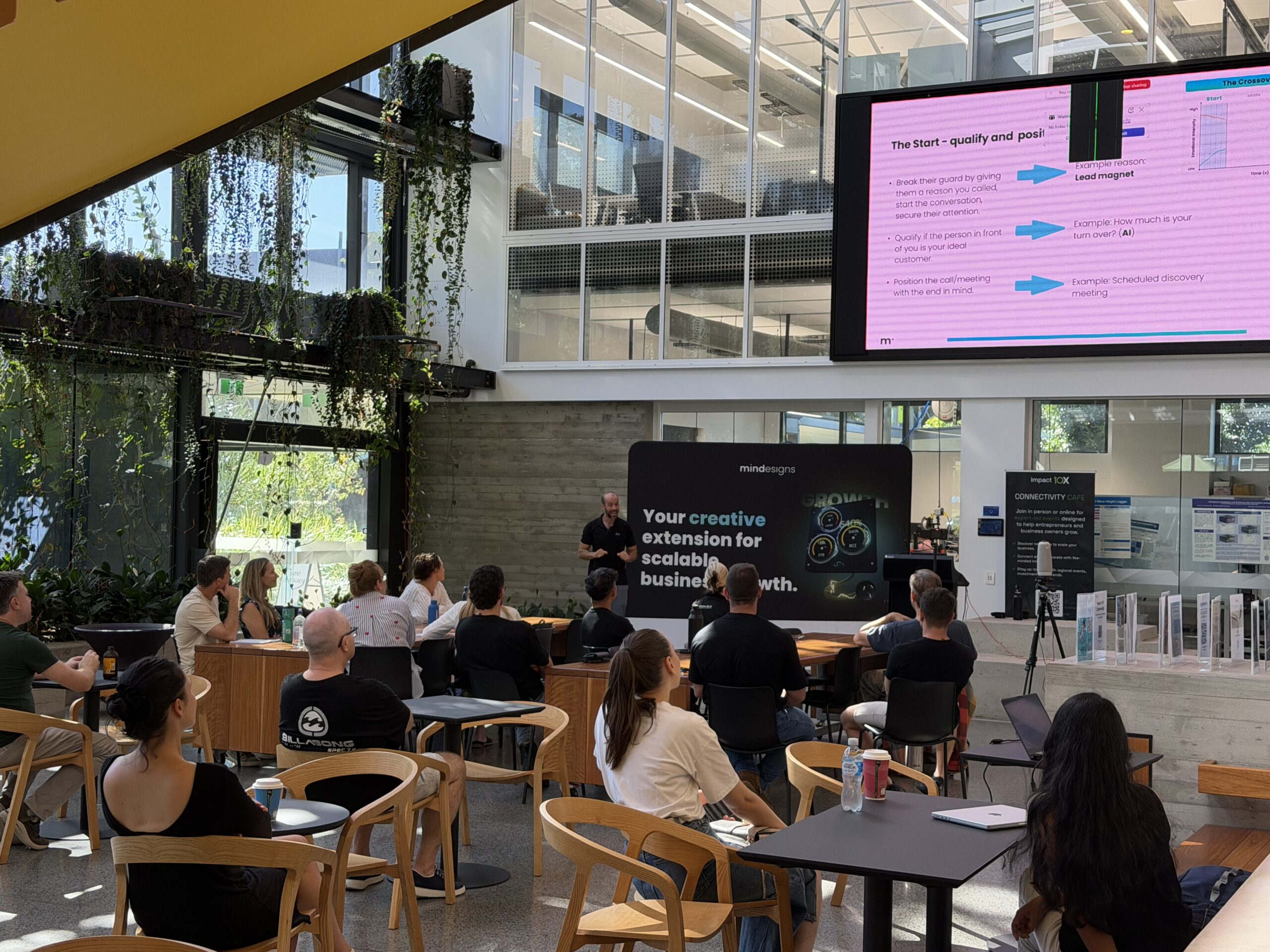
We call that moment the ‘Crossover Point’. Learning to spot it is the most valuable sales skill I’ve taught our team at Mindesigns. In this article, I’ll walk you through the full framework, the same one I presented at the Impact10X session, including the real example of how it helped us win a six-figure retainer with a financial services firm.
Want to watch the full session? Sign up here to get access to the complete recording.
Our three-stage B2B sales process
Buying signals are the behaviours a prospect shows when their interest shifts from curious to seriously considering. Some are obvious, like asking about pricing, timelines or start dates. While some are more subtle, like how much they talk with you, whether they compare you against competitors, and whether they start selling the idea internally to their own team.
The problem is that most salespeople either miss these signals entirely, or they see them and still don’t change their approach. It’s either they keep pitching to someone who has already decided, or they ask for the sale from someone who’s not interested.
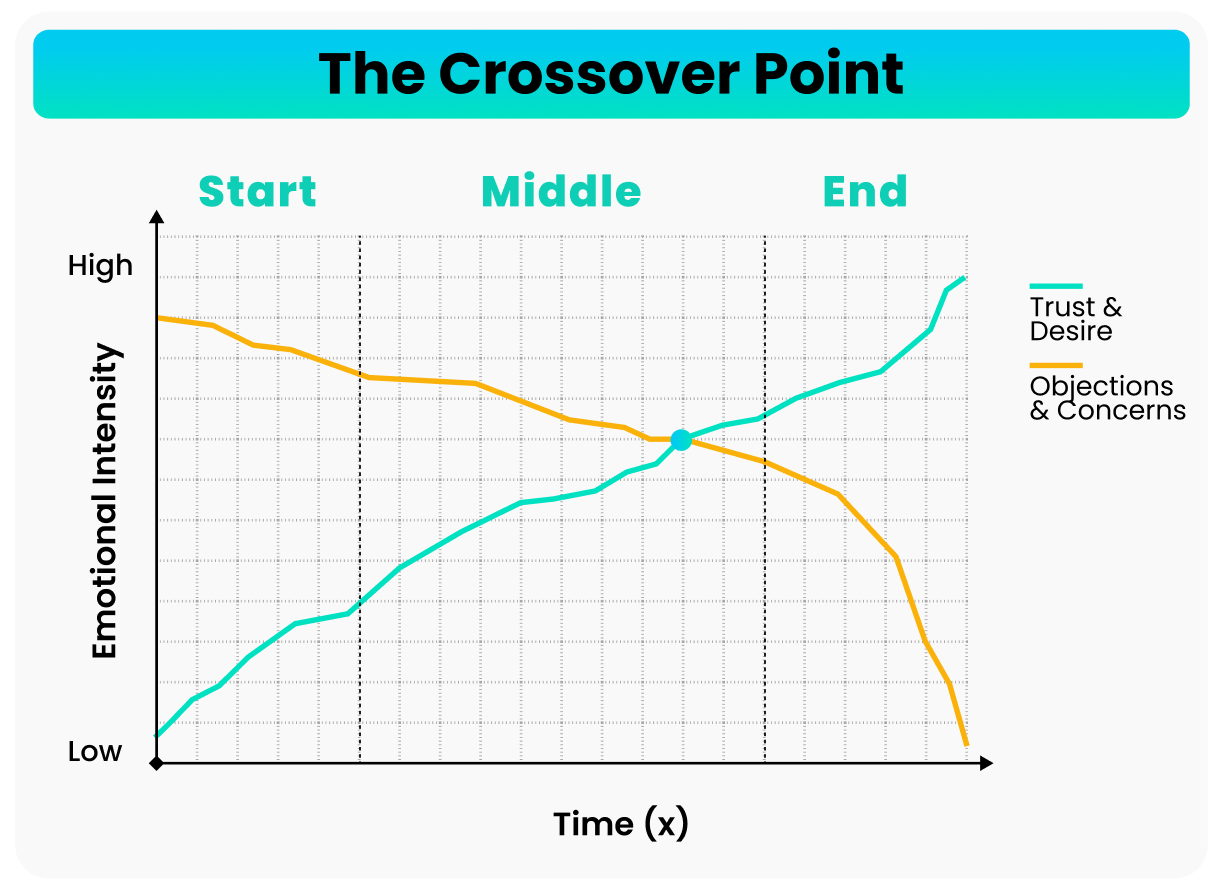
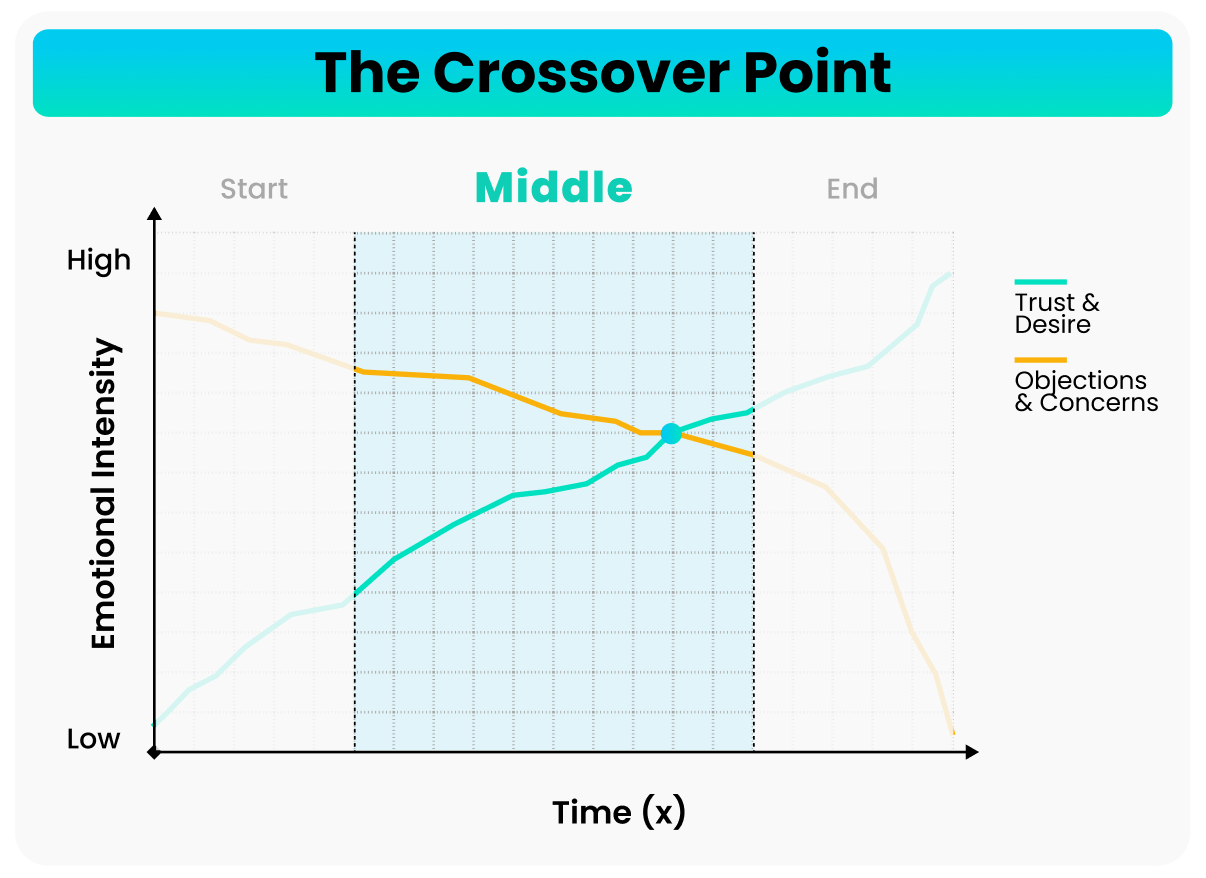
That’s why we map every deal against a simple three-stage B2B sales process: the start, the middle, and the end. The ‘Crossover Point’ is the stage where a potential customer begins to show stronger buying signals, and a good salesperson should be able to identify these signals throughout the process. It sits right in the middle of it all.
The Start: Open with a reason, not a pitch
At the start of every sales deal, especially with outbound calls, your prospect’s guard is already up. You’ve interrupted their day. The fastest way to lower that resistance is to open with a reason that has nothing to do with what you’re selling.
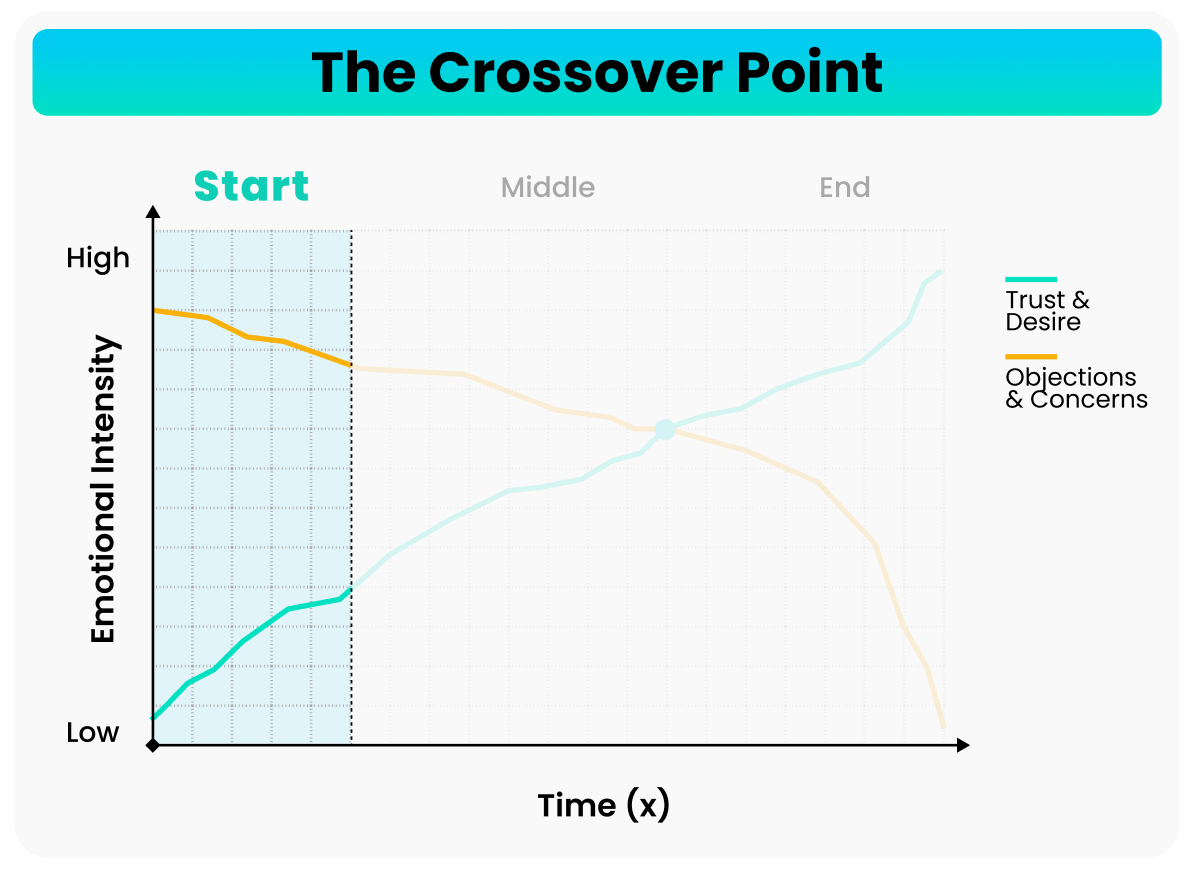
Here’s how it played out with a finance client we later signed on a $100,000+ retainer. My opening statement wasn’t “Hi, we’re a marketing agency”. Instead, it was:
“Hey Johnny, this is Omer from Mindesigns. I’m calling because you previously downloaded our digital marketing template. I’m calling to see how did you go with it. Was it helpful?”
See? No pitching, just a conversation with a genuine reason behind it. From there, I could qualify the prospect. “Was he the business owner?”, “Why did he download the template in the first place?”. And within a few minutes, I learned their website performance had dropped off the cliff six months earlier. They went from around 80 leads a month to almost nothing, and it was hurting a firm of 20 to 30 staff badly.
The goal of that first call was to break their guard with a reason, qualify if the person in front of you is your ideal client, and end the call with a meeting that addresses a pain point or a desire. Which we did.
“If your cold calls have a reason, even if you don’t know this person, if you have a good reason, then that is worth doing that cold call.”
One more thing we now do before we even dial: run an AI enrichment agent on the company. When someone submits their details through our website, our CRM research them automatically, their headcount, years in business, tech stack, and the typical challenges of their industry. So, by the time I pick up the phone, I already know who I’m talking to and can tailor the conversation from the first sentence.
Here’s a practical tip I shared at the session: build lead magnets that solve one small problem inside your client’s bigger challenge. They give every outbound call a warm, honest reason to exist.
The Middle: Find out if they’re thirsty
The middle is my favourite stage, because now you have their attention. It’s also where inbound leads enter the process. They’ve already seen your website, your case studies, and your reviews.
At the JCU session, I put it this way: imagine asking a room full of people, “Are you thirsty?” Some just had a glass of water; others haven’t drunk since yesterday and have a headache. Everyone answers differently, and your prospects are the same. Some have a mild problem they can live with, some are unaware at all, while others are in pain. Your job in the middle is to find out which one is in front of you and get them to say it out loud.
You do that with discovery questions that cover five things: their current state, their desired state, the size of the gap, why it hasn’t been fixed, and the cost of staying inactive.
These are the ones we train our team on:
- “Tell me a bit about your marketing so far. How long have you been with your current agency?”
- “What’s your involvement? Do you oversee it directly, do you get reports?”
- “You mentioned you went from 80 leads a month to almost none. What does that difference mean in monthly revenue?”
- “It’s been six months since the drop. What have you tried since then?”
- “What has staying in this situation cost you so far?”
Notice the pattern? You’re not pitching anything yet.
“Data has shown that the prospects that talk more than the sales rep in front of them will usually buy or have a higher chance to buy. You need to be a question master. That’s all your job is. You’re leading them to the water.”
That data is real, by the way. Gong analysed over 100,000 sales calls and found that in winning calls, the prospect does most of the talking, around 57% of the call, while deals where the rep dominates the conversation are the ones that fall through.
Aside from the pattern, there are two more things that happen in the middle. First, identify the decision maker. Not on the first call, but once rapport is built: “Let’s say you’re interested in working with us. Are you the one making that decision?” If not, your goal is to get the decision-maker into the next meeting rather than relying on your contact to sell for you.
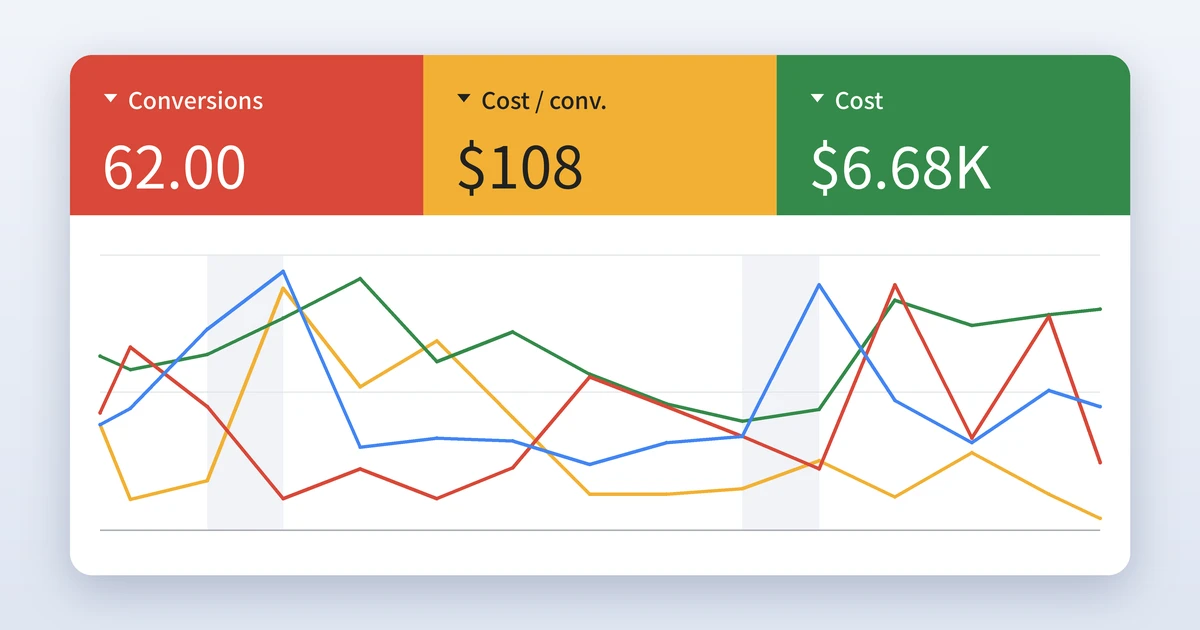
Second, when you present, don’t tell them, show them. With Johnny, I didn’t say “we know exactly what’s wrong with your SEO.” I showed anonymised case studies, real graphs and results from other finance clients we’d worked with. Proof builds trust. As I told the room: “Don’t say you will… show it.”
The Crossover Point: How to know a prospect is ready to buy
Here’s the moment everything changes, and the signal is easier to spot than you think.
The Crossover Point is when the prospect starts asking you the right questions.
“How long does implementation take?”, “Do you have examples from our industry?”, “How does onboarding work?”, “What does pricing look like?” When a prospect starts firing questions like this, they’ve mentally crossed over. They want to do business with you, but they just have objections and final concerns that need answering. Zig Ziglar made the same observation decades ago in Secrets of Closing the Sale: when a customer starts raising objections, it usually means they’re seriously considering the purchase. Answer them well, and your close rate jumps.
Some prospects arrive at your door already past the ‘Crossover Point’. A referral who’s read your case studies might bombard you with questions in the first ten minutes. Others need the full middle stage before they get there. The most important skill is recognising which side of the line they’re on, because it tells you exactly what to do next. Before the crossover, you’re the one asking the questions. After it, you’re the one answering them.
The End: Ask for the sale
Once the prospect runs out of questions, there’s usually an awkward silence. Most salespeople use that moment to retreat to the worst close in the business: “I’ll send you a proposal. Let me know what you think.” That’s not how you do it. You ask for the sale.
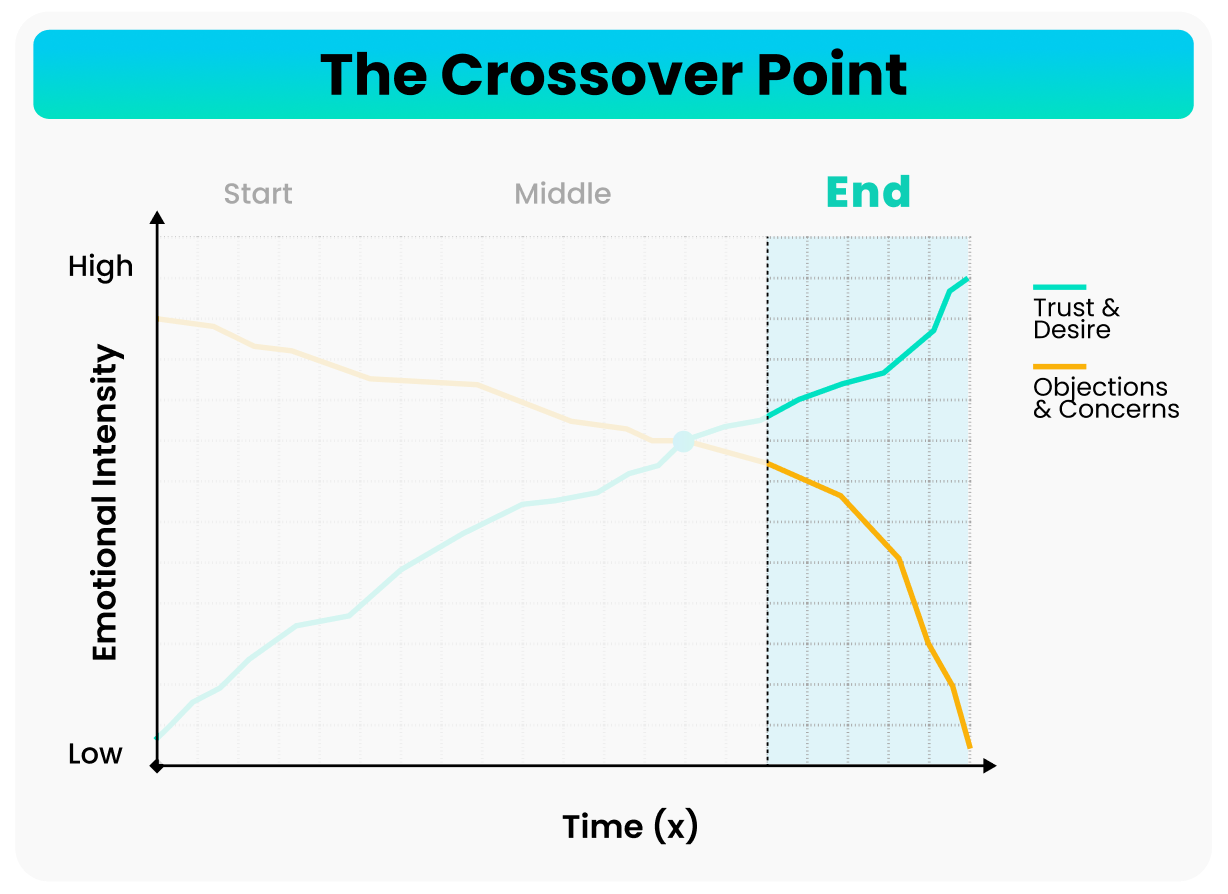
Instead of sending a proposal out of the blue, recap what you’ve shown and ask. With Johnny, our conversation was more like:
- “Now that I’ve shown you a few similar cases, what did you like most out of what I presented?”
- “Do you think this would be a valuable solution for you if we got the same results?”
- “Do you have any questions or concerns that would stop you from moving forward with us?”
- “Would you say it’s a smart idea to start this week or the next?”
That last line is the one I always remember: this week or the next. It’s direct without being pushy, and it surfaces any final objection immediately. If they say, “I need to think about it,” acknowledge it genuinely. It is a big decision, and it’s not easy to say yes to an investment. Clarify what they need to think about, so you can cover it and book the follow-up on the spot rather than leaving it open-ended.
Now, what if they’re stuck and can’t decide? Make their decision less risky. With big ticket services, prospects fear change more than they fear their current problem. So instead of our usual six or twelve-month retainer, I offered Johnny a three-month start, with a promise that if he wasn’t happy at the three-month mark, we’d work the next month for free to make things right.
That process, start to finish, is how a single template download became a $100,000+ retainer.
How we use AI in the B2B sales process
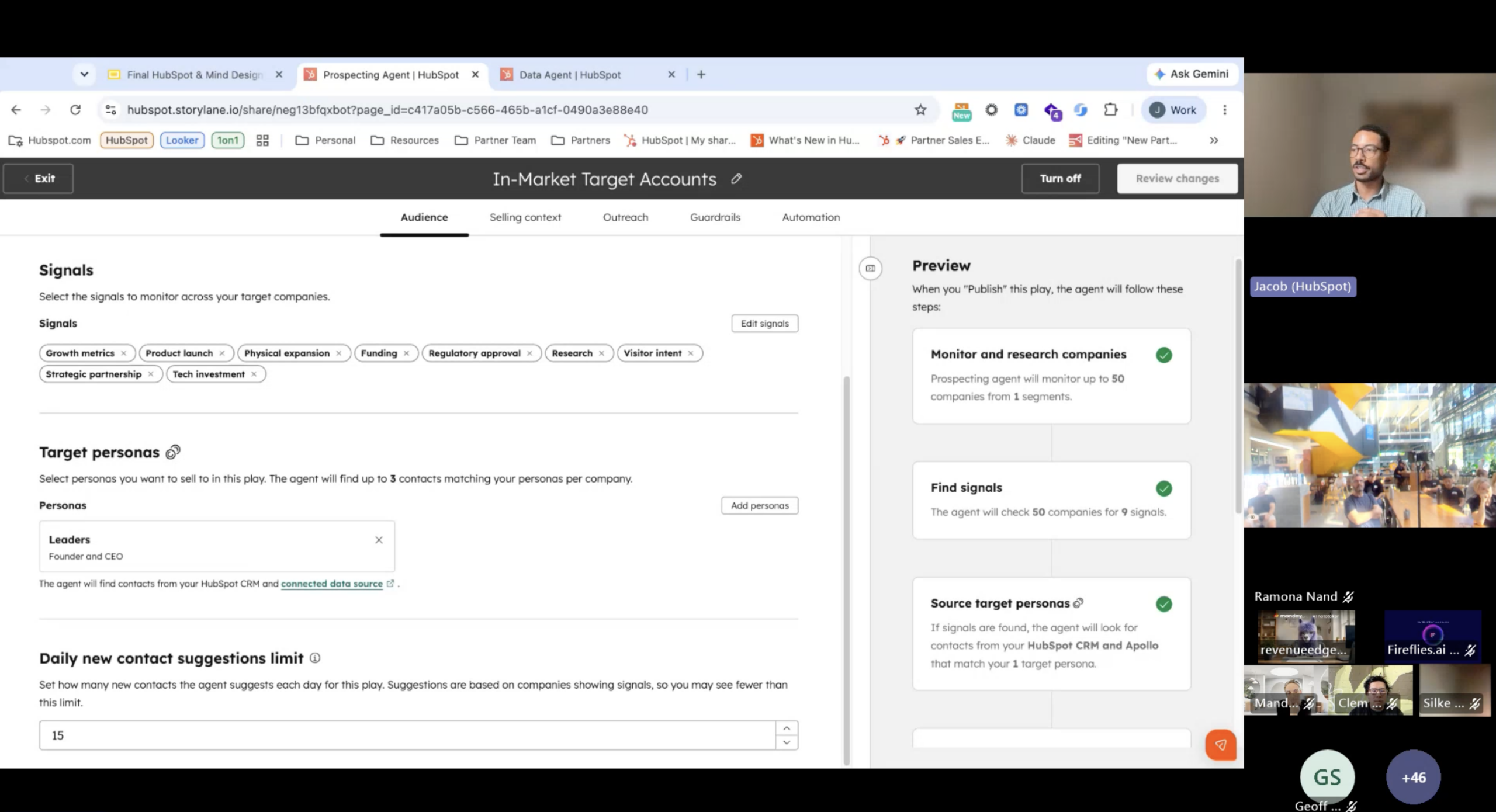
At the JCU session, I was joined by Jacob Todd, Partner Manager at HubSpot, who demonstrated how HubSpot’s AI Breeze tools support each stage of this exact framework. As a HubSpot partner agency, this is the stack we use ourselves and implement for clients.
As Jacob put it, Breeze is built into HubSpot “with the big idea that it’s AI that already knows your business.” Because your deals, contacts and customer conversations already live inside the CRM, Breeze works with full context from day one instead of starting from scratch like a generic AI tool.
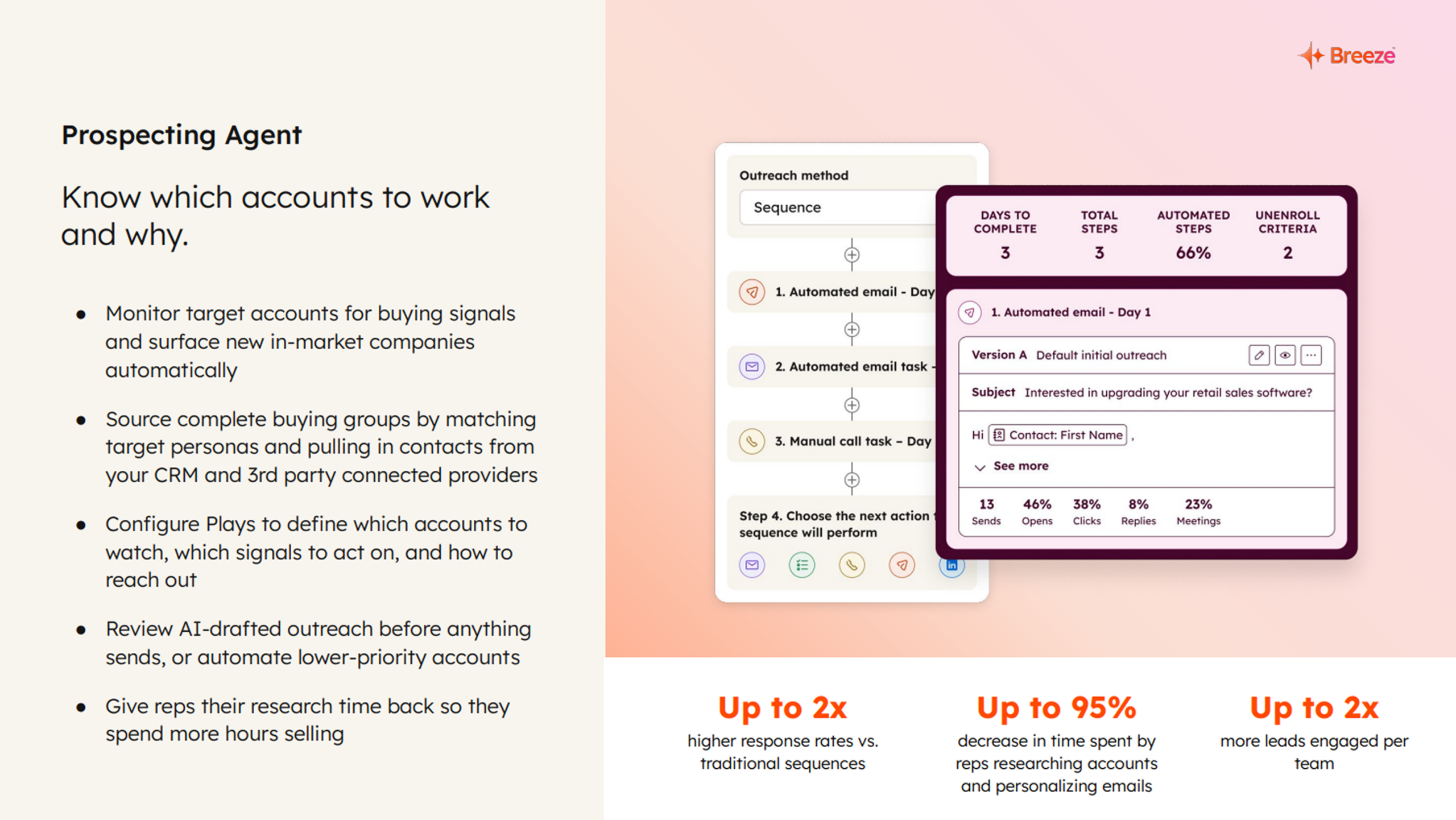
At the start, HubSpot’s prospecting agent acts like an always-on business development representative. It watches your target accounts for real buying signals, like funding rounds, hiring and product launches. Then, it surfaces the right contacts and drafts personalised outreach that a human representative reviews before anything is sent. Jacob shared that one HubSpot customer, RevenueWell, lifted meetings booked from 22% to 40% of outreach by using it, because every message went out with genuine context behind it.
“Fundamentally it’s giving your sales reps their research time back, so they can spend more time actually selling.” (Jacob Todd, HubSpot)
In the middle, we record strategy calls (with the prospect’s permission, as always) and let AI transcribe and summarise them. An hour-long discovery call contains details you will miss in the moment. The transcript catches the concerns you didn’t register, which makes every follow-up sharper. HubSpot’s data agent does the same job at scale. It pulls context from calls, emails, and external sources so the full picture is in the CRM before you even pick up the phone.
Here’s one honest caveat I gave the JCU audience, and I’ll repeat it here: not every business needs this. We see the most value when you have a sales team, or you’re the founder doing all the selling, and you want to hand that expertise to a growing team. That’s when putting a process and AI behind your sales becomes genuinely transformative.
Want a B2B sales process that actually closes?
Now, assess and think about where you are right now. If you’ve read this far and questions are already boiling inside your head, like how these discovery questions would sound in your industry, or whether AI tools would fit your setup, then you finally got the ‘point’.
This is the exact framework we train our own sales team on, the same one behind six-figure client wins in finance, education and cybersecurity. If you want help building a B2B sales process for your business, or implementing HubSpot’s AI tools as part of it, book a strategy session with our team. We’ll look at how you sell today, find the gaps, and show you, not tell you, how to close them.
Frequently asked questions
What are examples of buying signals in sales?
Asking about pricing, timelines, implementation or onboarding. Requesting case studies or references. Bringing other stakeholders into meetings. And the biggest one: any shift where the prospect starts asking you more questions than you’re asking them.
How do you know when a prospect is ready to buy?
Watch for the ‘Crossover Point’, the moment the prospect starts asking you questions instead of answering yours. Before that point, your job is discovery. After it, your job is handling objections and asking for the sale.
What are the best sales discovery questions?
Questions that establish where the prospect is now, where they want to be, and what the gap is costing them. For example, “What does that drop in leads mean in monthly revenue?” and “What has staying in this situation cost you so far?”
How do you ask for the sale without being pushy?
Recap what you’ve shown them, invite their feedback, surface remaining concerns, then ask directly: “Would you say it’s a smart idea to start this week or the next?”