For Marketing Leaders

Before I co-founded Mindesigns, I was an engineer. Engineers are trained to distrust black boxes, and that is exactly what most digital marketing packages are. You pay a fixed monthly fee, something happens behind the curtain, and a report arrives that tells you impressions went up.
After seven years of running an agency, reviewing hundreds of proposals our clients received from other providers, and building our own retainers for businesses like The Finn Group and Online Education Services, I want to open the box. This article explains what digital marketing packages in Australia actually include, what they cost in 2026, and how to tell a genuine growth engagement from a subscription that quietly does very little.
I will say upfront that the packages worth paying for are the ones with a visible process behind them. At Mindesigns, we work by the hour, we deliver as much quality as those hours allow, and we point them at the client’s priorities first, guided by our recommendations. That is a teaser of how we think, and it is the lens I will use through this whole article: if you can see the process, you can trust the package.
What a digital marketing package actually is
A package is a bundle of services delivered for a fixed monthly fee. Typically some combination of SEO, paid advertising management, content, social media, email marketing, and reporting. The packaging exists for a good reason: predictable pricing for you, predictable workload for the agency.
The problem is not the model. The problem is what hides inside it. Two packages can both be called “Growth” and cost $3,000 per month, while one buys you 25 hours of senior specialist time and the other buys you 6 hours of a junior following a template. The name and the price tell you almost nothing. The hours, seniority, and deliverables tell you everything, and that is exactly what we are going to cover.
One more thing worth knowing before we get to prices. Who does the work matters as much as what the work is. In large agencies, the senior people win your business and a junior team you never meet delivers it, following a process built for scale rather than for you. Boutique agencies flip that: the closer the people working on your account are to the founders, the more personal attention and accountability your business gets. Every business needs that personal touch. It is one of the quiet reasons results differ so much between agencies charging the same fee.
What packages cost in Australia in 2026
Based on the proposals we see when businesses come to us from other agencies, the Australian market roughly breaks into four tiers.
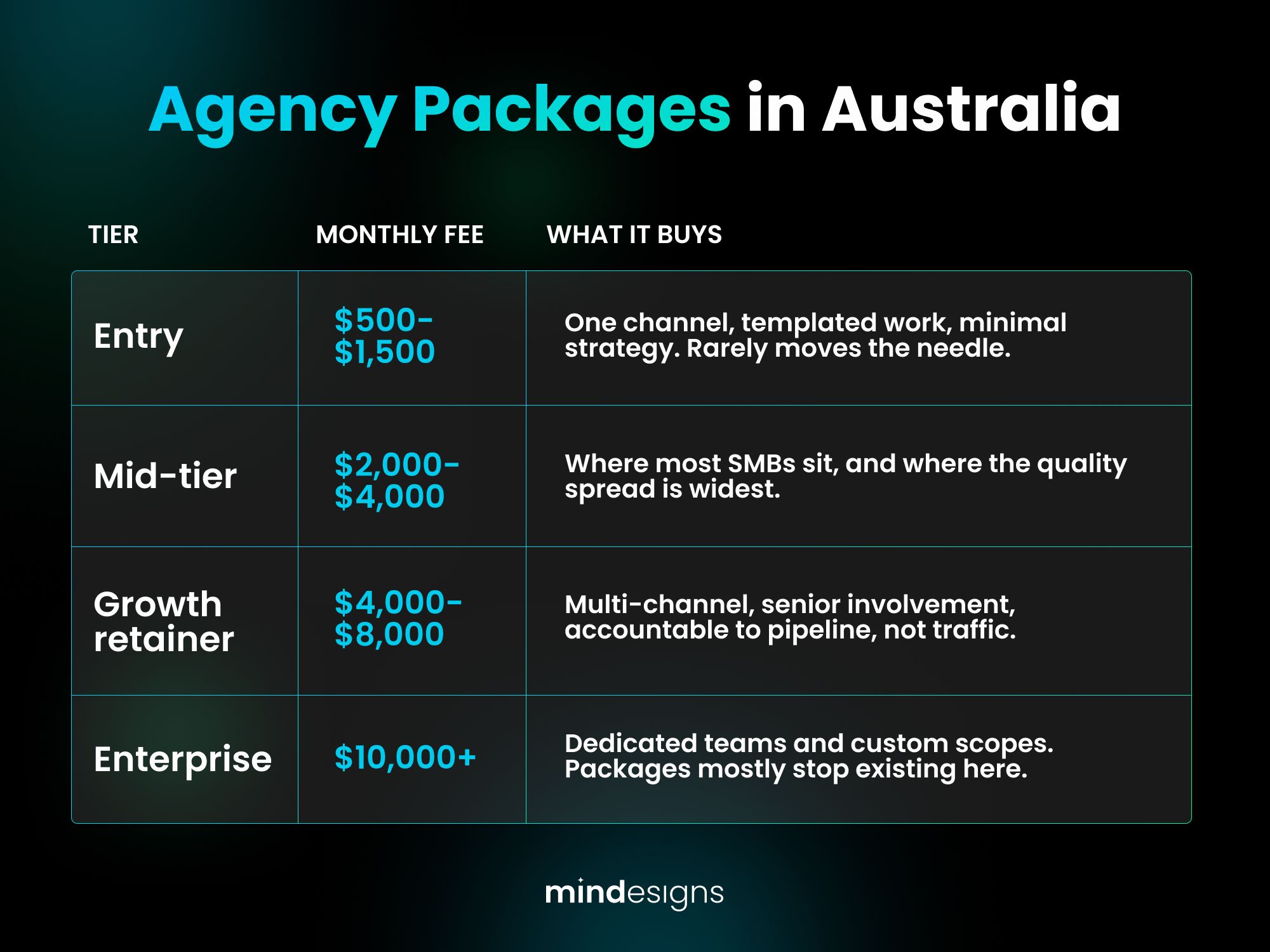
Entry packages, $500 to $1,500 per month. Usually a single channel, templated work, and minimal strategy. These suit very small local businesses with simple needs. The honest version of this tier keeps one channel tidy. The dishonest version spreads $800 across “SEO, social, content and email” which, at agency hourly rates, means almost no real work on any of them. In truth, this tier rarely moves the needle, and too often it is simply a money grab. You get what you pay for.
Mid-tier packages, $2,000 to $4,000 per month. This is where most established small and medium businesses sit, and where the quality spread is widest. A genuine engagement at this level includes a strategist who knows your business, monthly priorities that change based on results, and specialist execution. A weak one includes a dashboard.
Growth retainers, $4,000 to $8,000 per month. Multi-channel engagements with senior involvement, proper experimentation, and accountability to pipeline rather than traffic. For context, our own SEO retainers at Mindesigns sit between $3,000 and $6,000 per month, and our clients know exactly which hours go where. If an agency at this price cannot show you that breakdown, ask why.
Enterprise engagements, $10,000+ per month. Dedicated teams, custom scopes, and usually a contract to match. Packages in the productised sense mostly stop existing at this level.
What should be inside any package worth paying for
Whatever the tier, five things separate a real engagement from an expensive subscription.
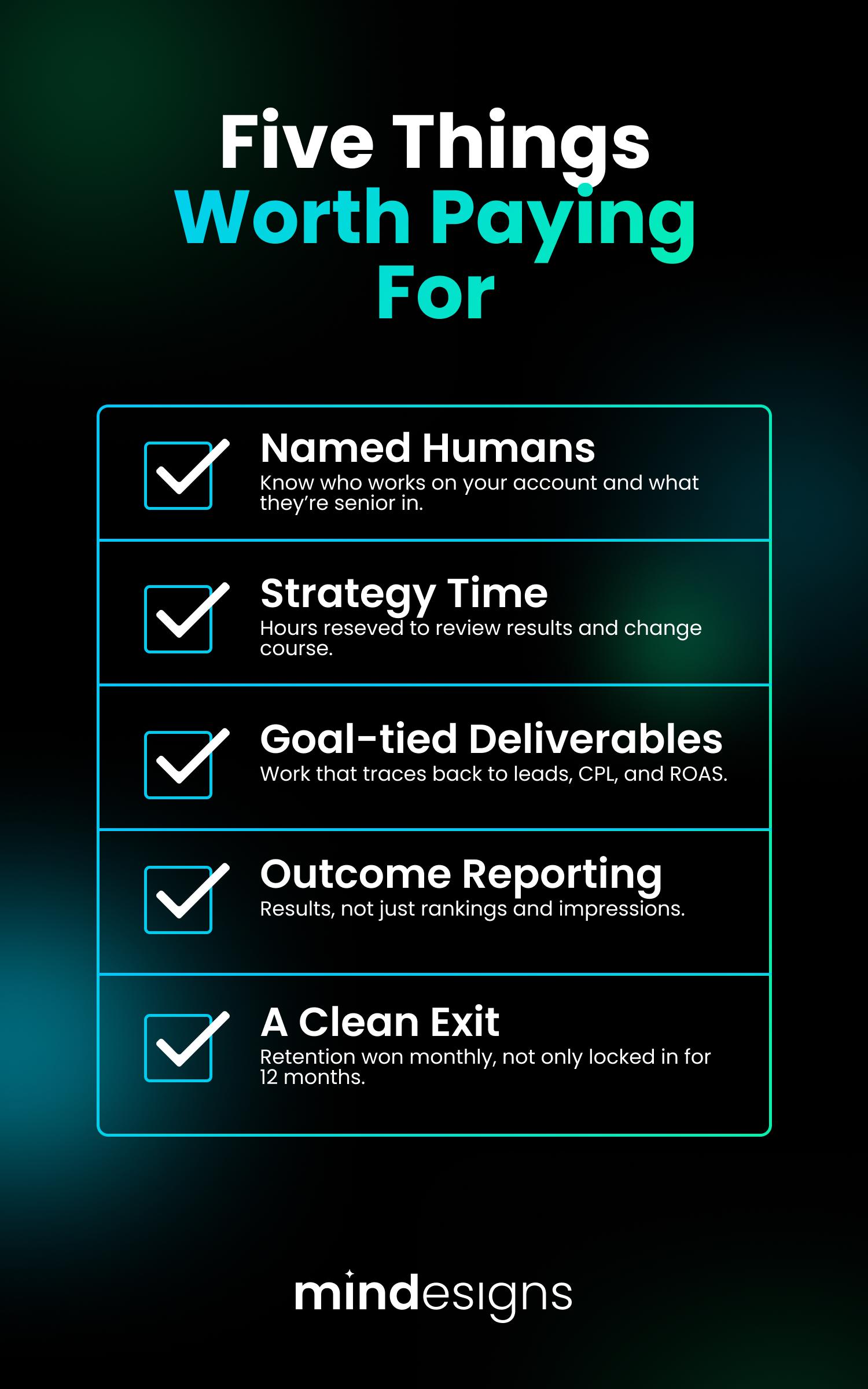
Named humans. You should know who works on your account and what they are senior in. “Our team of experts” is not an answer. At our agency, clients know that Ian runs their SEO and Omer oversees their paid media, because accountability requires names. You can meet our whole team here.
Strategy time, not just execution time. Execution is the doing: writing the ads, building the pages, publishing the content. Strategy is the checking: reviewing what the numbers say, deciding what to do more of, less of, or differently next month. A package that is 100% execution will keep producing the same work whether it is performing or not. You want a portion of your hours reserved for a senior person to look at results and change course, because that is where the actual growth decisions happen. Motion is not the same as progress.
Deliverables tied to your goals. A package that promises “4 blog posts and 8 social posts” regardless of whether you are a B2B firm with a 6-month sales cycle or an ecommerce store in December is a template, not a strategy. Deliverables should trace back to the KPIs most businesses actually run on: qualified leads, cost per lead, customer acquisition cost, pipeline value, and return on ad spend. When we scope a package, we start from which of those numbers the client needs to move, then work backwards to the deliverables, not the other way around.
Transparent reporting on outcomes. Impressions and rankings are diagnostics, not results, and it is worth being clear about the difference. A diagnostic tells you the machine is running: your visibility is up, your traffic is growing. A result is money-shaped: leads generated, cost per lead, pipeline created, revenue influenced. Diagnostics matter because they explain the results, but they cannot pay your staff. If a monthly report celebrates rankings without ever connecting them to enquiries or sales, you are being shown the dashboard instead of the destination. Insist on both layers, and insist the outcomes layer leads.
A clean exit. We typically start new engagements at Mindesigns without lock-in contracts, because we would rather prove our capabilities first and let the results argue for the relationship. Longer commitments have their place once trust is established and a bigger roadmap is agreed, but they should be earned, not demanded upfront. Be suspicious of any package that needs 12 months of your signature before it has delivered a single month of value. Retention should be won monthly. Ours sits at 95%, and starting without contracts is precisely why we work so hard to keep it there.
The red flags I see most often
The same patterns appear again and again in proposals our clients show us. Guaranteed rankings, which no honest agency offers because nobody controls Google and Google itself warns against anyone claiming otherwise. Packages priced impossibly low for their promised scope, where the arithmetic of hours simply does not work. Reports that arrive on time every month but never lead to a change in what is done. And “one size fits all industries” packages, which in practice means the agency has never gone deep on any industry.
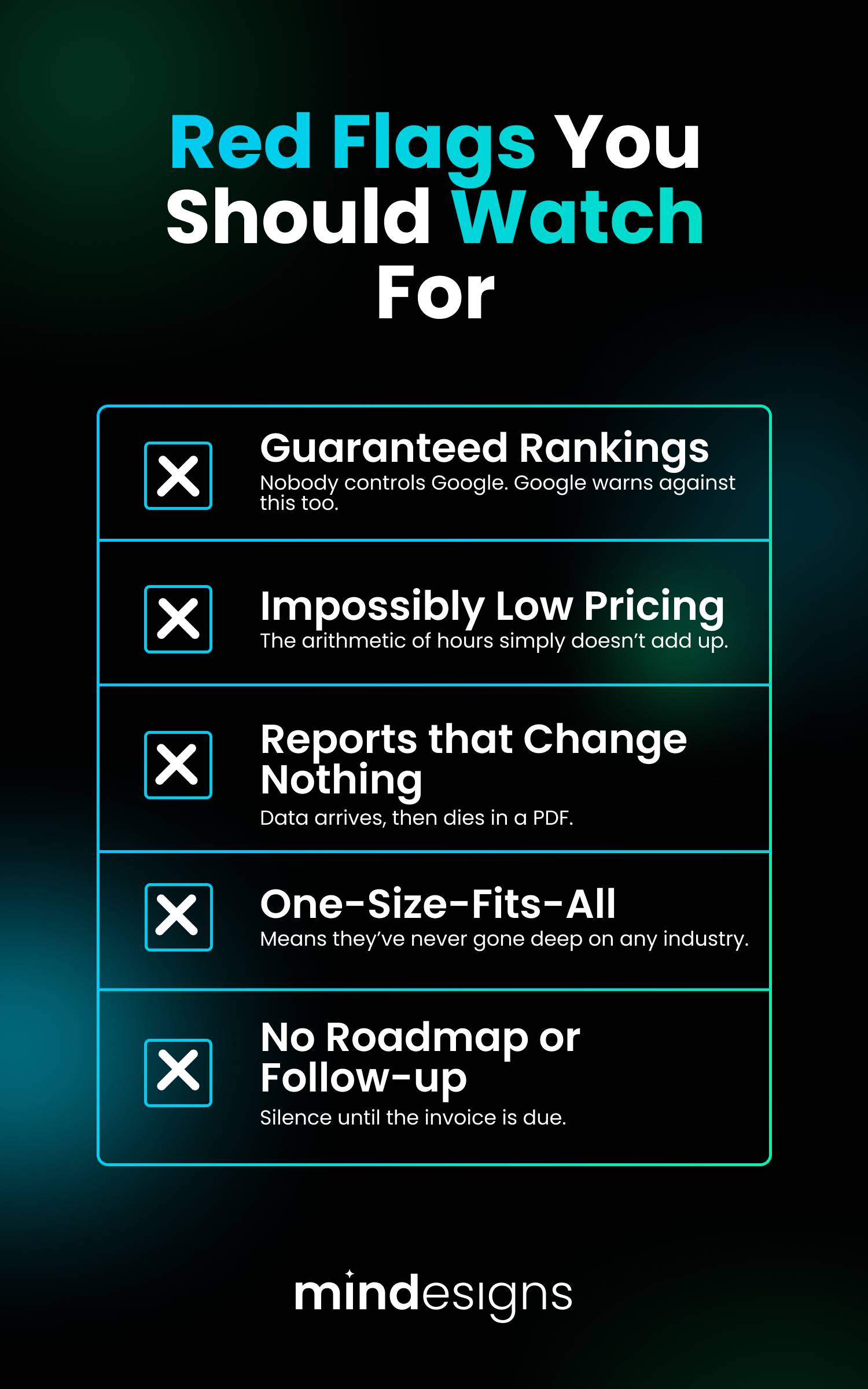
There is a second family of red flags that shows up after signing, and it is just as telling. No roadmap, so you never know what is planned beyond this month. No recommendations coming back from the results, so the data flows one way and dies in a PDF. And no follow-up: months pass without the agency picking up the phone unless an invoice is due. An invested agency behaves differently, because it understands a simple truth we live by: when our clients win, we win. That means regular engagement without overdoing it, and a willingness to pivot. Our own rule of thumb is that if a tactic shows no signal after roughly six weeks, depending on the strategy and the sales cycle, we change the approach rather than defend it. SEO needs longer horizons than paid ads, so the timeline flexes, but the principle does not: the plan serves the results, never the other way around.
None of these red flags mean the agency is malicious. Most mean the agency is stretched. But you are not paying to subsidise someone else’s capacity problem.
Questions to ask before signing anything
Take these into any sales conversation. How many hours does this package include, and how are they split between strategy and execution? Who exactly will work on my account, and can I meet them? What did you change for a client last quarter based on results? What happens if I want to leave in three months? And finally, what would you not do for a business like mine, because an agency that cannot answer that has not thought about you specifically.
An agency comfortable with those five questions is an agency you can probably trust. An agency that gets vague is telling you something too.
Where packages make sense, and where they do not
Packages work well when your needs are stable and the channel mix is known. They work poorly in the first three months of an engagement, when what you actually need is diagnosis: understanding your funnel, your data, your customers, and where growth is genuinely constrained. That is why we begin engagements with strategy before locking a monthly scope, and why our retainers are reviewed rather than renewed on autopilot.
The bigger question behind any package is whether outside help is the right structure at all. If you do not have marketing expertise in house, hiring a single in-house marketer rarely delivers the outcome people hope for, because modern marketing is not one skill. It is several specialists working together: strategy, SEO, paid media, design, UX, analytics. One person cannot outweigh a competitor’s whole team over the long run, no matter how talented. A good agency package gives you that full bench as an extension of your business for less than the cost of one senior hire, which is why it can be a great choice. But only if you choose well, and everything above is how you do that.
The best money you will spend on marketing is not the package itself. It is the thinking that decides what should be in it.