For Marketing Leaders
SEO for higher education now decides who gets discovered in two places at once. The first is Google, where a graduating student types “psychology degree Brisbane” and compares whatever ranks. And the second is inside AI tools like ChatGPT or Gemini, where that same student asks which, course is better and receives an answer your analytics could never record. That second search is already shaping enrolment decisions, and most educational institutions don’t yet know how to appear in it.
We’ve seen this shift firsthand through our work across the education ecosystem: a university (James Cook University), a SEEK-owned learning solutions provider (OES), and a global learning design firm (Construct Education). That experience taught us that higher education SEO is really two games played at once. Institutions compete to be discovered by students, and education vendors compete to be discovered by institutions.
If you lead marketing at a university, or you sell learning technology and services to one, this guide is for you. I’ll cover how students and university buyers search today, what worked for our three education clients, and how to become the source AI assistants cite when someone asks for the best online MBA in Australia.
How Students (and Universities) Search Now
An enrolment decision is never made by one person searching in one place. A Year 12 student checks TikTok for campus life, Googles entry requirements and fees, and asks an AI assistant to compare her shortlisted courses. Her parents run their own research on rankings, safety and graduate outcomes. If she’s an international student, the whole process happens from another country, on different platforms, with different trust signals. The Digital Education Council’s global survey found that 86% of students already use AI in their studies. The same habit now shapes where they study. If ChatGPT summarises a competitor’s course page instead of yours, you lose an applicant you never knew existed.
And there is a side of education search that almost nobody writes about. Universities are searchers too. Procurement teams and learning directors research LMS platforms, learning design partners and student support vendors long before they ever speak to a salesperson. Buying for a university is a business-to-business purchase, and Gartner research shows the pattern: 70 to 80% of the journey happens through independent research before anyone contacts a vendor. If you sell to universities, your visibility during that quiet research window decides whether you make the shortlist.
One SEO strategy cannot serve both audiences, and the first step is knowing which side you are on.
The Two Sides of Higher Education SEO
Most articles about SEO for higher education are written only for universities, and that misses half of the education sector. Behind every institution sits a network of edtech platforms, learning design firms and online program providers, all competing to be found by the universities themselves. Each side searches differently, buys differently and trusts differently, so the strategy for each must be different too. Here is how both sides win.
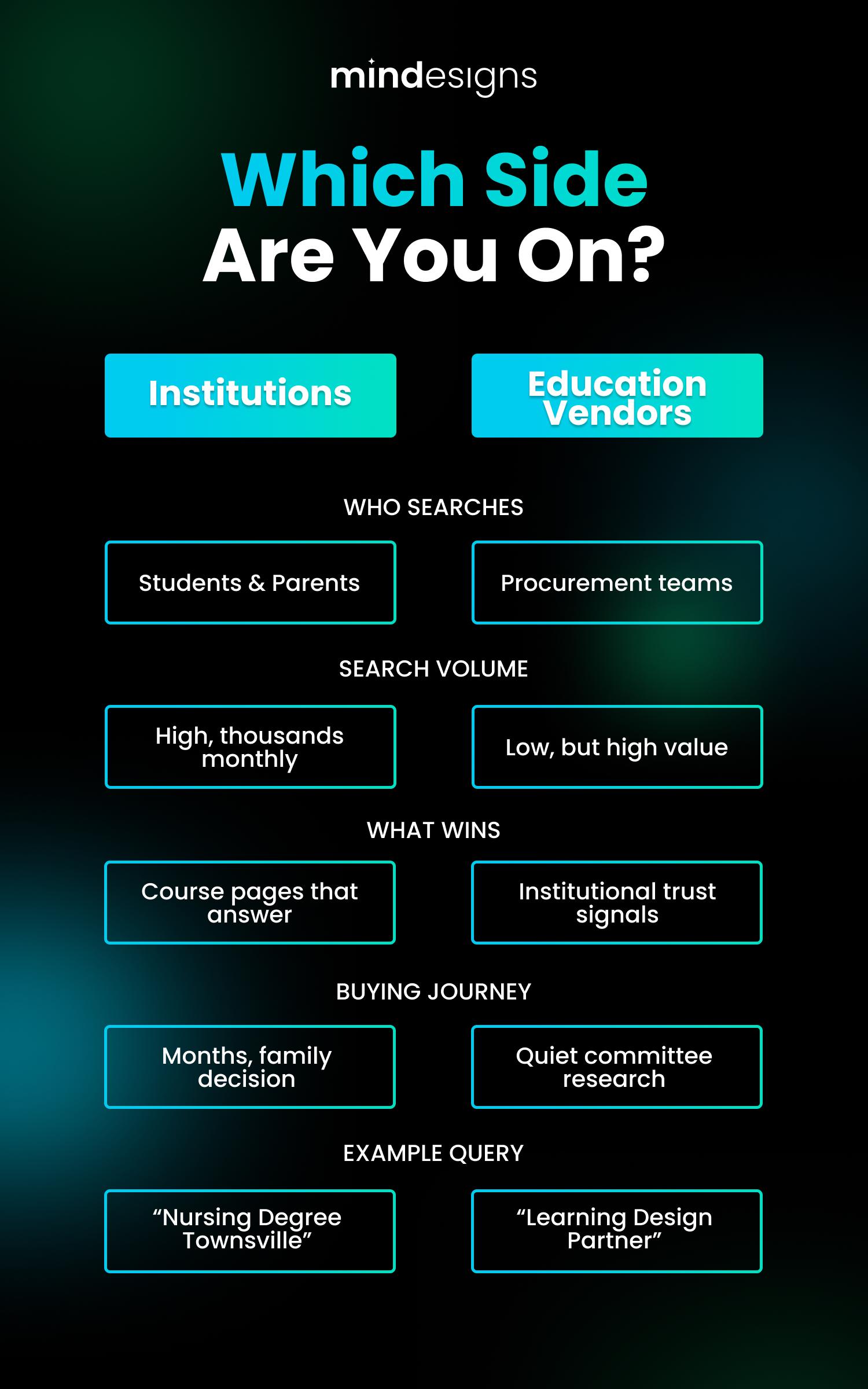
For institutions: course pages that answer real questions
For universities and colleges, SEO performance lives or dies on course pages. Ruffalo Noel Levitz research found that 70% of Google searches for graduate education don’t include an institution name at all. Students search for the program, the level, the format and the location, not your brand, and that makes every course page a front door. Each one needs to answer what a student is looking for, like entry requirements, duration, fees, career outcomes, and how the course compares to alternatives. A page that reads like a brochure will lose to a page that reads like an answer.
Around the course pages sit three supporting layerslocal SEO, international SEO and structured data. Local SEO captures students searching by city or region, like “nursing degree Townsville.” International SEO reaches overseas markets, where students research in their own language and weigh credibility differently. Structured data helps Google and AI tools read your courses as entities, with clear fields for fees, duration and intake dates.
For education vendors: being found by the buying committee
If you are an edtech company, learning design firm or online program provider, your SEO plays by different rules. Search volumes are small, but a single contract can be worth years of revenue. Ranking for hundreds of keywords matters far less than being the credible answer when a university team quietly researches learning design partners.
In practice, that means content written in the language procurement teams actually use, case studies from inside institutions, and trust signals a risk averse committee will accept. A university buyer is not impulsive. Every one we’ve dealt with shortlists the vendors who have clearly done this before.
We saw this firsthand when working with OES.
How OES Grew Their Organic Visits with SEO
When OES, a SEEK subsidiary, approached us, the problem wasn’t reputation. Years of delivering learning solutions for universities and TAFEs had built plenty of that. The problem was that their website couldn’t prove it. Organic visibility was poor, the site was hard to update, and nothing was tracked. No analytics, no conversion data, no way to tell which marketing was working. That meant the university teams they needed to reach could barely find them, and OES had no way of knowing it.
So we rebuilt the foundation. We migrated their site to WordPress, implemented Google Analytics, Google Tag Manager and the Meta Pixel, and refined the landing pages where university partners and prospective students arrive first. Only after fixing the foundation did we invest in monthly SEO work, optimising pages and building content around real keyword research.
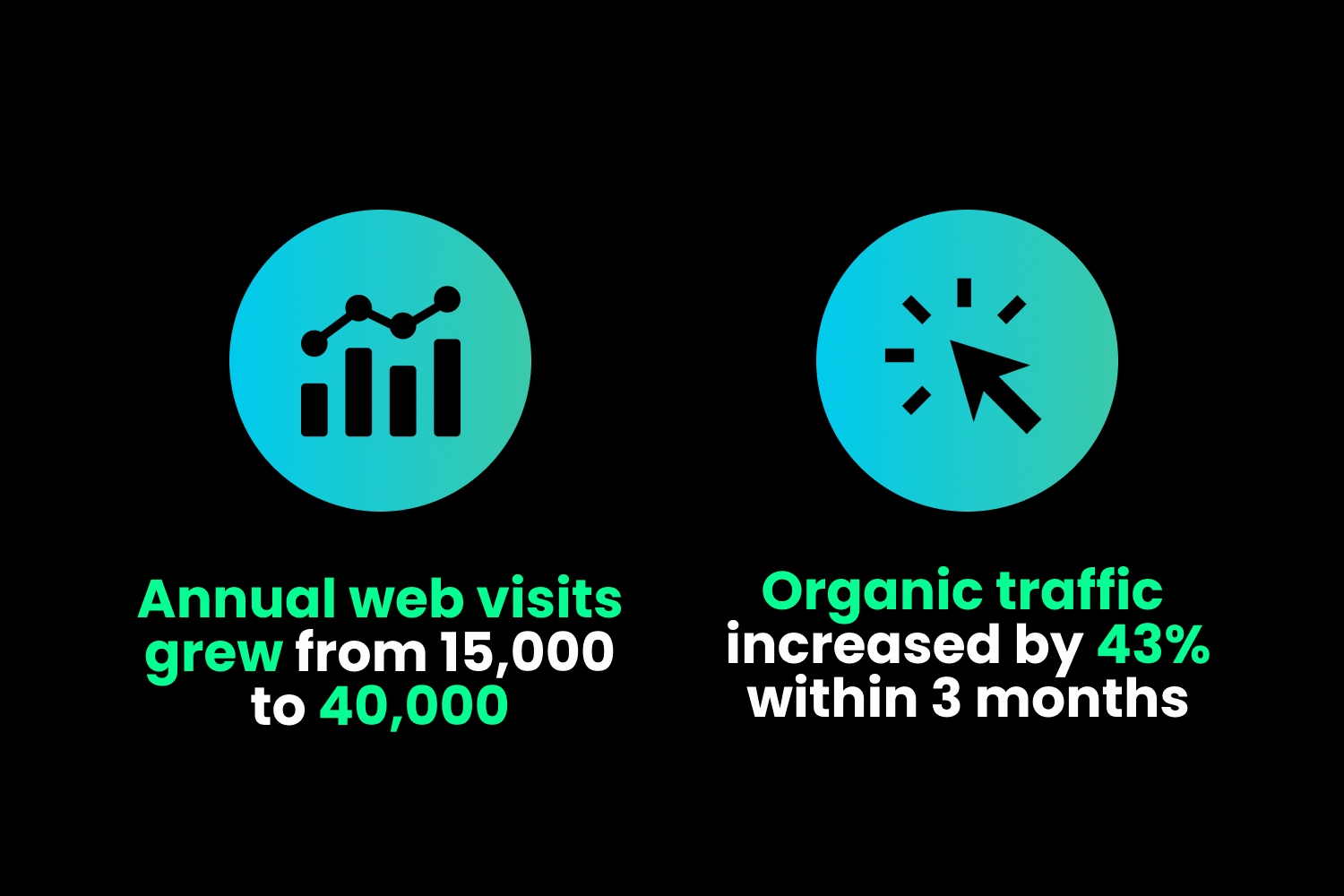
That groundwork paid off fast. Organic traffic grew 43% within three months, and annual site visits climbed from 15,000 to 40,000. More importantly for a B2B education provider, OES could finally see where their enquiries came from and which pages drove them.
As Kealey Nutt, Strategic Advisor for Communications, Advocacy and Engagement at OES, shared: “The Team at Mindesigns are some of the most helpful and attentive people I’ve worked with as an agent client, and I’ve worked with a lot of agencies!”
How We Co-Created Impact10X with James Cook University
Our work with James Cook University (JCU) shows a different side of education marketing. In late 2023, after winning a Regional Enablers Grant from the Queensland Government, we partnered with JCU to build Impact10X, a start-up simulator and venture builder for emerging entrepreneurs in Far North Queensland. There was no brand, no platform and no blueprint. Together with JCU’s Innovation Hub, we developed the program itself, created the brand identity, built the digital platform, and managed the paid advertising that promoted it.
Within months of launching the campaigns, every stage of the program reached full capacity, and our community events attracted more than three times the audience we expected. Our SEO work also paid off. Impact10X now sits at the top of Australian search results for its own name, so students, mentors, investors and government stakeholders all find the official site the moment they google it, and the program ranks on top for competitive terms like “venture builder Cairns.” For a brand that didn’t exist before this project, owning its search results is what makes every other marketing channel work.
This project taught us something no SEO audit can, which is how universities work from the inside. Programs like Impact10X move through stakeholders, approvals and shared decision making, and marketing partners who can’t navigate that structure slow everything down. As Samantha Horseman, Director of the JCU Innovation Hub, put it: “Mindesigns are a rare find with a fantastic ability to listen and co-create.”
Universities don’t need another agency that waits for a brief. They need a partner who can sit inside the institution and co-create with them. You can see the full story in our Impact10X case study.
How SEO Helped Construct Education Grow Their Google Visibility
If I had to pick one client that proves visibility and expertise are two different things, it would be Construct Education. They’re a global learning design firm that builds online courses for universities. After our SEO work, their Google impressions rose 1,371% and clicks grew 1,430%.
To be clear about those numbers, Construct started from a very low search baseline. Their learning design work was world class, but Google barely knew they existed, so almost none of their potential university clients ever found them. We fixed the technical foundations, then built content around what those buyers search for, and the gap between their expertise and their visibility closed fast. It’s a pattern we see across education vendors: the specialists with the deepest expertise are often the least visible, because they’ve grown through reputation and referrals rather than search.
Getting Cited by ChatGPT, Gemini and AI Overviews
Ranking in Google is no longer the whole job. When a student asks an AI assistant to compare courses, the assistant answers from the sources it can read and trust. From our research, EAB’s survey found that 18% of students removed an institution from consideration based on information surfaced through AI search results, and a third discovered an institution they hadn’t considered. AI is quietly adding names to shortlists and deleting others, and most institutions never see it happen.
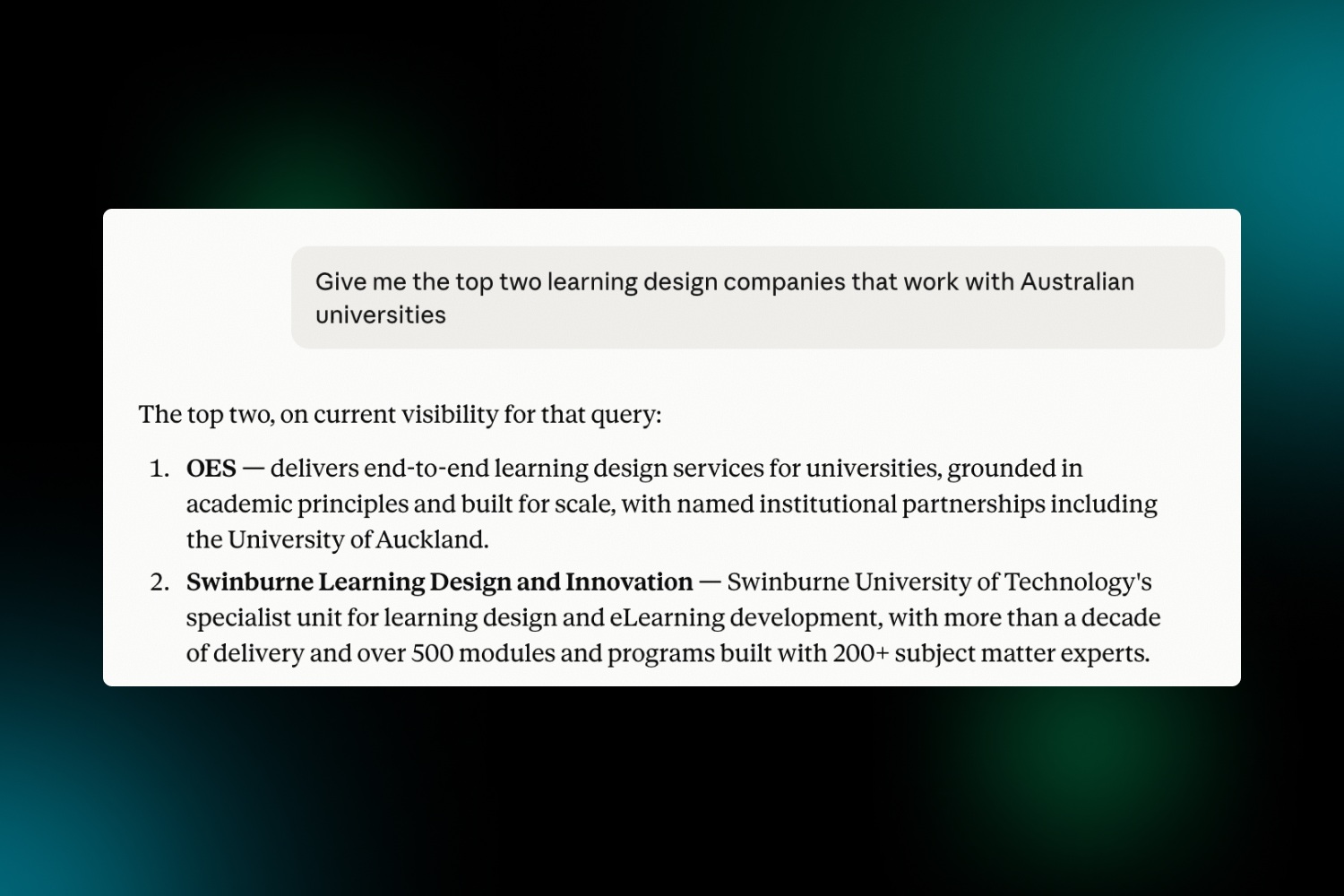
The good news is that AI visibility is built from the same foundations as strong SEO. Course pages need structured data so AI tools can read fees, duration and intake dates as facts rather than prose. Structured FAQs on course pages give assistants clean answers to quote. Authoritative signals, from your .edu.au domain to consistent information across your website, directories and LinkedIn, help AI systems identify your institution with confidence. The goal is to be the source AI quotes when a student asks for the best online MBA in Australia, not the name it forgets.
Want the complete playbook? Read our guide to building websites for AI visibility.
Our SEO for Higher Education Framework
Everything we’ve covered so far, the OES foundation work, the JCU co-creation, the Construct visibility turnaround, follows the same process. This is how we at Mindesigns approach every education client, whether institution or vendor, because the steps stay constant while the targets change. Skipping to content while the foundation is broken is the most common mistake we see in education marketing.
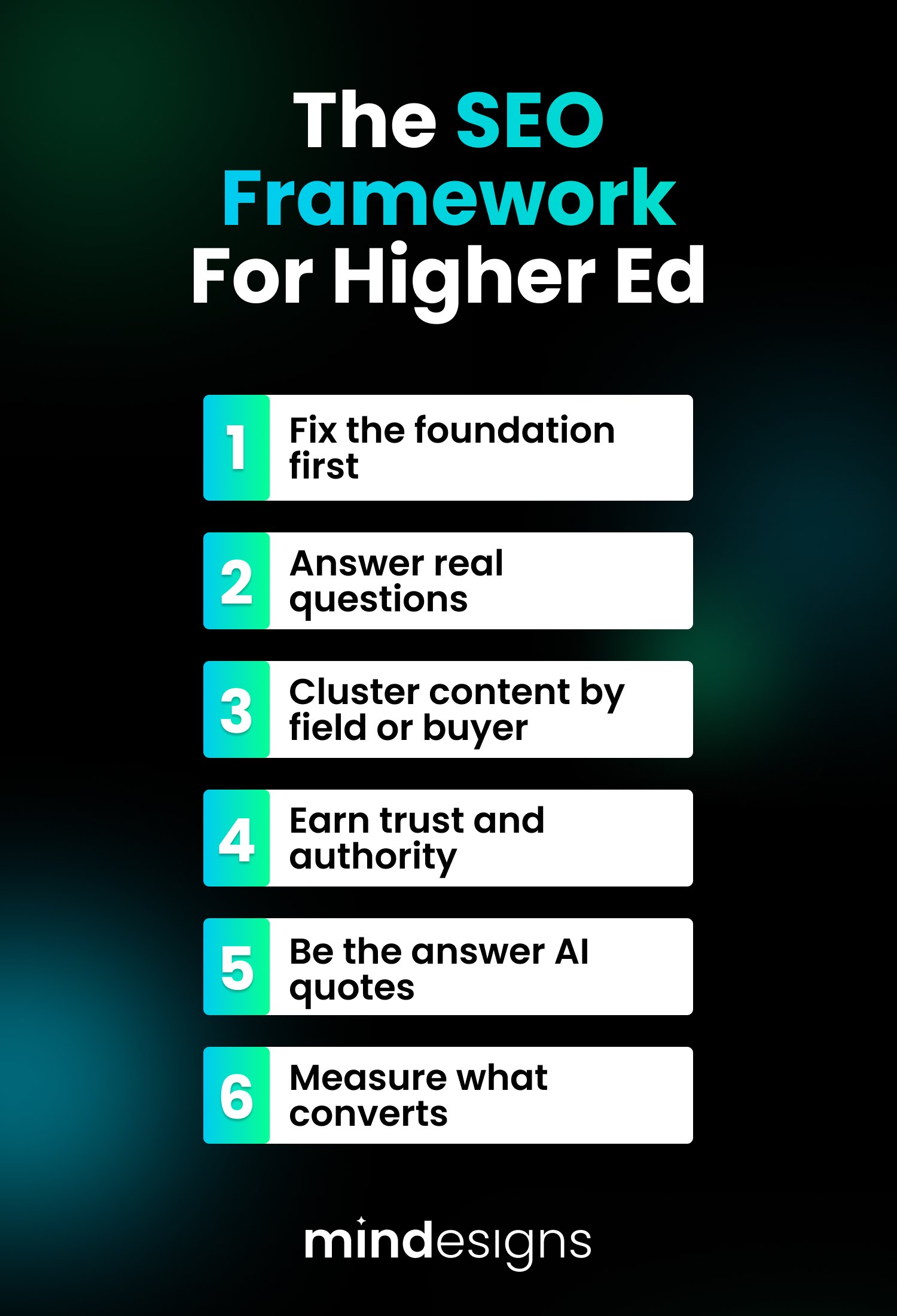
- Technical audit. Every engagement starts with a full site review, because nothing else works on a broken foundation. This is where OES began.
- Page templates that answer real questions. Course pages for institutions, service pages for vendors, each built around what students or university buyers actually ask.
- Content clusters. For universities, organised by field of study. For vendors, organised by buyer problem, the questions a procurement team types before they know your name.
- Authority building. Mentions, reviews and consistent entity signals across your website, directories and LinkedIn, so both Google and AI systems can identify and trust you.
- The AI visibility layer. Structured data and FAQs that make your pages quotable to AI tools.
- Measurement. Analytics that connect visibility to enquiries and applications, because as OES learned, you can’t grow what you can’t see.
Ready to Be Found by Students or Universities?
Education is one of the few sectors where both sides of the market genuinely search. Students compare courses every day, and university teams research vendors before ever making contact. Every one of those searches is either found by you or won by a competitor. We’ve helped OES, James Cook University and Construct Education win their share.
As a Semrush Agency Partner, when we first get started, we provide an in-depth SEO and competitor analysis for education providers. It benchmarks your website against key competitors across visibility, content, technical performance and conversion opportunities, and shows where trust signals are missing and where untapped opportunities exist in organic and AI search. Most importantly, whether you have a strong foundation first.
If you believe SEO is a strategy that has been neglected too long in your company, Book a free strategy session with us to get a free SEO audit from one of our experts
FAQs
Can the same agency really serve both universities and education vendors?
It’s rare, and it’s the reason we wrote this article. The two sides need different strategies, but the experience compounds, because working inside JCU taught us how institutional buyers think, which is exactly what our vendor clients like OES and Construct Education need to reach them.
How do you measure whether SEO is actually working?
By connecting visibility to actions, not just traffic. With proper analytics in place, like the setup we built for OES, you can track which pages drive enquiries, applications and partner conversations, and attribute them back to organic search.
Do AI chatbots really influence where students study?
Yes, measurably. EAB’s survey of more than 5,000 students found 46% use AI in their study search, 18% removed an institution based on AI results, and a third discovered one they hadn’t considered. If AI tools misread your website, that influence works against you.