Marketers & Business Owners

B2B business marketing operates very differently compared to B2C marketing. In B2C, decisions are often fast, emotional, and low risk. A consumer may see a social ad, compare prices, and make a purchase within minutes. The buyer is typically an individual, and the product or service costs are low. Therefore, the consequences of getting it wrong are minimal.
By contrast, B2B transactions are typically high-value and higher risk. Organisations do not make impulsive decisions when choosing a software provider or professional services firm. These purchases involve multiple decision-makers, formal evaluation processes, and extended timeframes before a business is even shortlisted.
This is why B2B marketing focuses on relationships and repeated exposure. A buyer may encounter a brand through a referral, an industry event, a capability statement, and several conversations before engaging. Way, way before engaging. Typically, the process from awareness to customer is much longer than in B2C.
This article examines B2B business marketing through how buying decisions are made, highlighting why the journey rarely follows a straight line and which strategies are most effective at yielding high-value outcomes.
The B2B Marketing Process
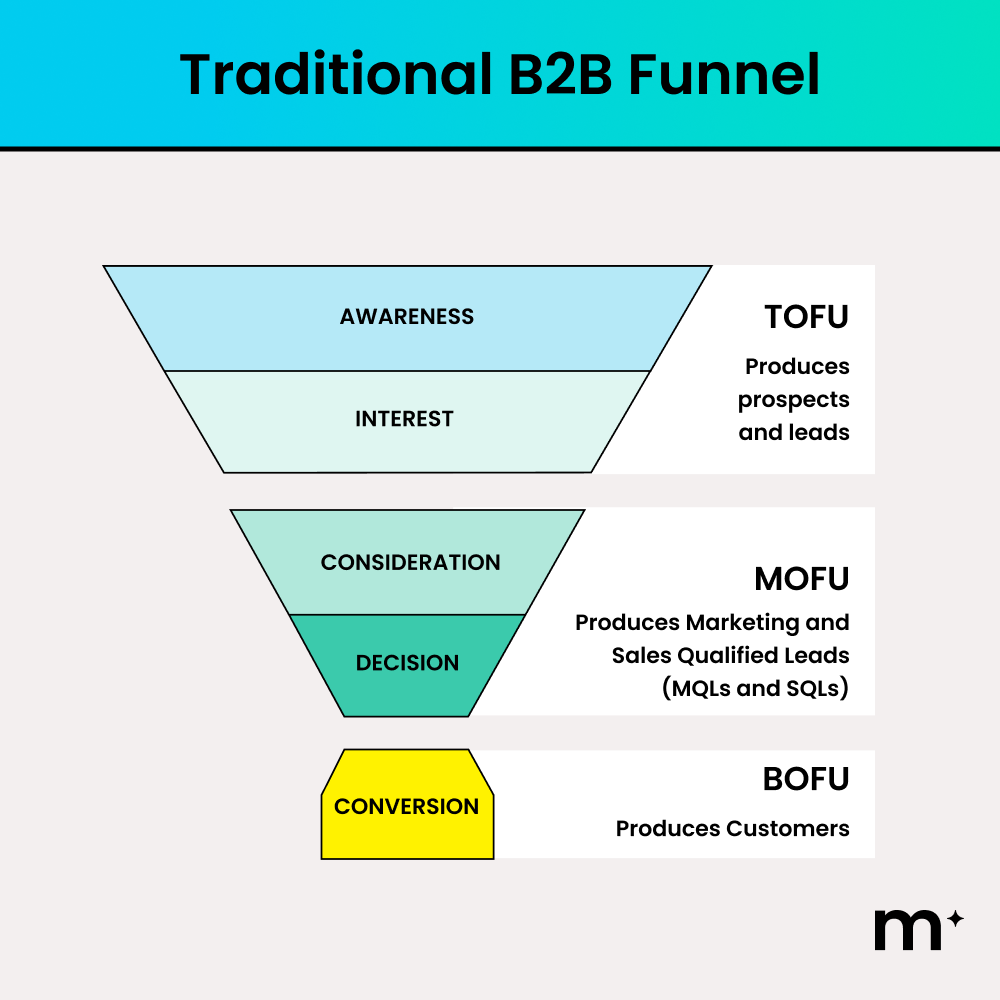
Traditionally, B2B marketing is often presented as a linear funnel designed to guide prospects from awareness to conversion. This funnel is useful for understanding pipeline stages and sales forecasting. However, it assumes buyers move forward in a predictable, one-directional way.
In reality, modern B2B buying behaves more like a connected web. Research indicates that an average of 10 to 12 stakeholders now influence a single B2B purchase, often engaging at different stages and through different channels. This could include the director, a board member, the general manager, or the marketing lead, each with their own perspective.
As a result, these stakeholders rarely fit neatly into a single stage of a traditional sales funnel. Instead, they interact with a brand at various points, sometimes moving forward, sometimes stepping back, and often re-entering the process through new touchpoints in the overall purchase cycle.
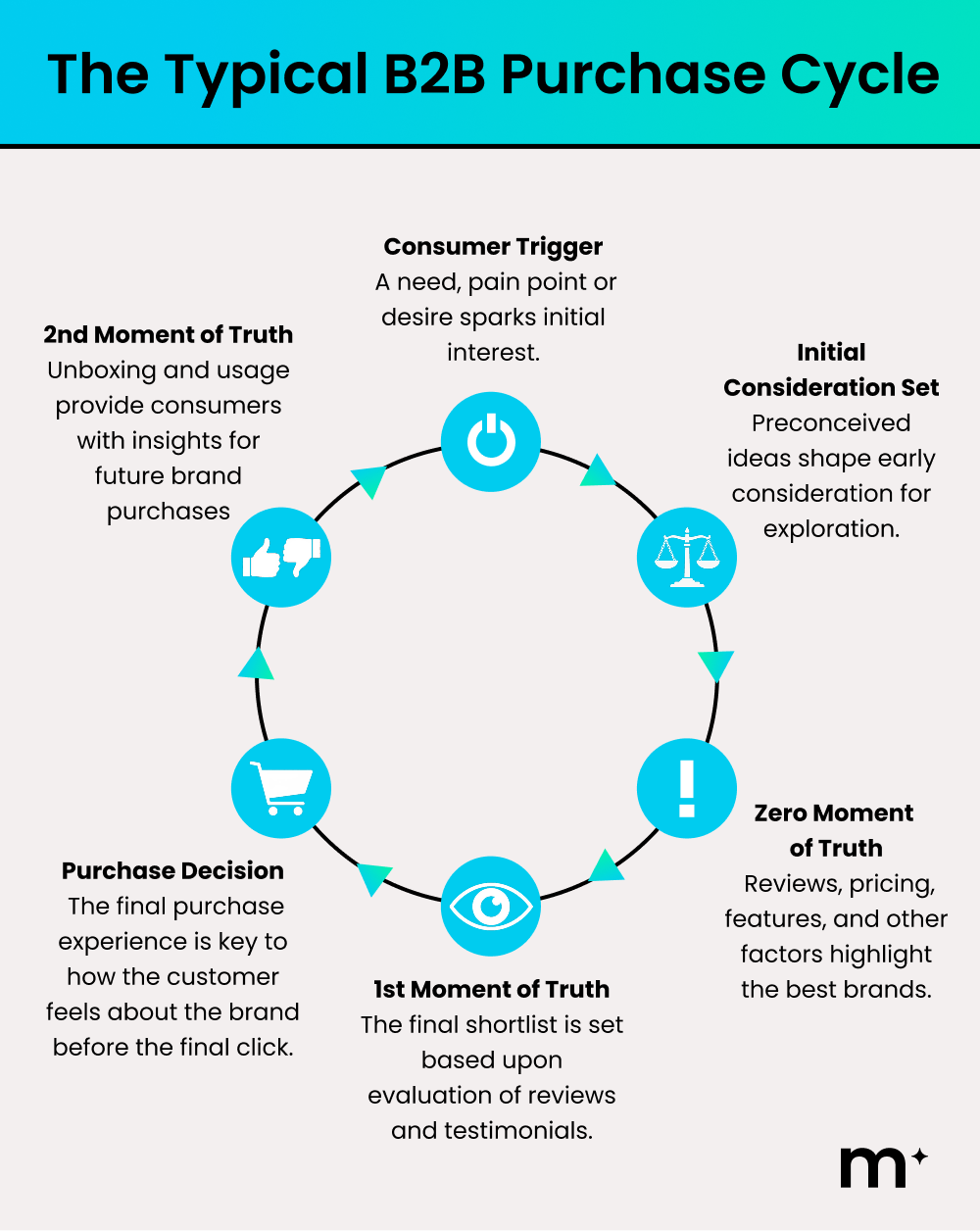
Understanding both models matters. The traditional funnel helps track outcomes, while the web explains how demand is built and sustained over time. Regardless of which model you use, if there were one principle to maximise a company’s chances of success, it would be to hold every piece of content across the entire marketing funnel to the highest possible standard. We will explore this in more detail shortly.
Core B2B Marketing Channels
Effective B2B marketing is layered. Each channel supports a different part of the buyer’s evaluation process, and together they form the foundation of a balanced strategy. Let’s expand on both digital and conventional channels and their key differences.
Relationship and Referral Marketing
Relationship marketing focuses on building long-term brand growth by understanding, nurturing, and leveraging trusted networks. In B2B environments, relationships reduce perceived risk more quickly than advertising can. Buyers are accountable for their decisions, which means they look for reassurance from credible sources before progressing.
There are multiple ways to build and activate relationships, and each delivers a different strategic benefit. Some create reach, others create authority, and others directly influence revenue. Together, they form a trust ecosystem that compounds over time.
| Channel | How It Works in Practice |
| Influencer Marketing | Extends credibility by borrowing trust from respected industry voices. |
| Partner Marketing | Generates qualified opportunities through aligned commercial relationships. |
| Affiliate Marketing | Creates performance-driven growth with measurable outcomes. |
| Referral Marketing | Converts at higher rates due to pre-existing trust transfer. |
| Employee Advocacy | Amplifies visibility through authentic, peer-based networks |
Referral marketing works because trust is transferred rather than created from scratch. With 92% of B2B buyers giving most trust to peer reviews, referral-driven introductions, and visible social proof often determine who makes the shortlist long before formal sales conversations begin.
Networking Events and Industry Conferences
Industry-specific events and conferences are among the fastest ways to build trust in B2B environments. Face-to-face interaction allows buyers to assess credibility, expertise, and communication style in real time, which is difficult to replicate through digital channels alone.
In practice, this trust-building most commonly occurs through
- Industry conferences and summits
- Trade shows and expos
- Professional association events
- Invitation-only roundtables and forums
- Supplier or partner-hosted events
Beyond the conversations themselves, these environments act as powerful social proof. Since event organisers typically vet speakers, exhibitors, and sponsors, being present signals that your business meets a baseline level of legitimacy, relevance, or expertise, reducing perceived risk for attendees before any direct interaction.
Print and Physical Marketing Assets
Despite the growth of digital channels, billboard advertising continues to play a strategic role in B2B marketing, particularly for brand credibility and visibility at scale.
In B2B environments, outdoor advertising is rarely about direct response. Instead, it signals that a business is established, invested in, and operating at a serious commercial level.
For high-value B2B decisions, repeated exposure matters. Seeing a brand consistently in prominent locations such as business districts, industrial zones, or near major transport routes creates familiarity long before a sales conversation.
Public Relations and Industry Authority
Public relations plays a critical role in positioning a business as a category authority rather than simply a service provider. In B2B markets, media coverage, industry research, awards, and keynote presentations act as independent signals that a business is credible, relevant, and trusted.

A strong example is Culture Amp. Rather than relying solely on product marketing, Culture Amp built its authority through original research into employee engagement and workplace culture. By publishing these data-backed reports, the company positioned itself as a voice on the future of work, not just a software vendor. This research was then cited in business media, discussed at conferences, and referenced in industry conversations, reinforcing credibility far beyond traditional advertising.
Online Channels
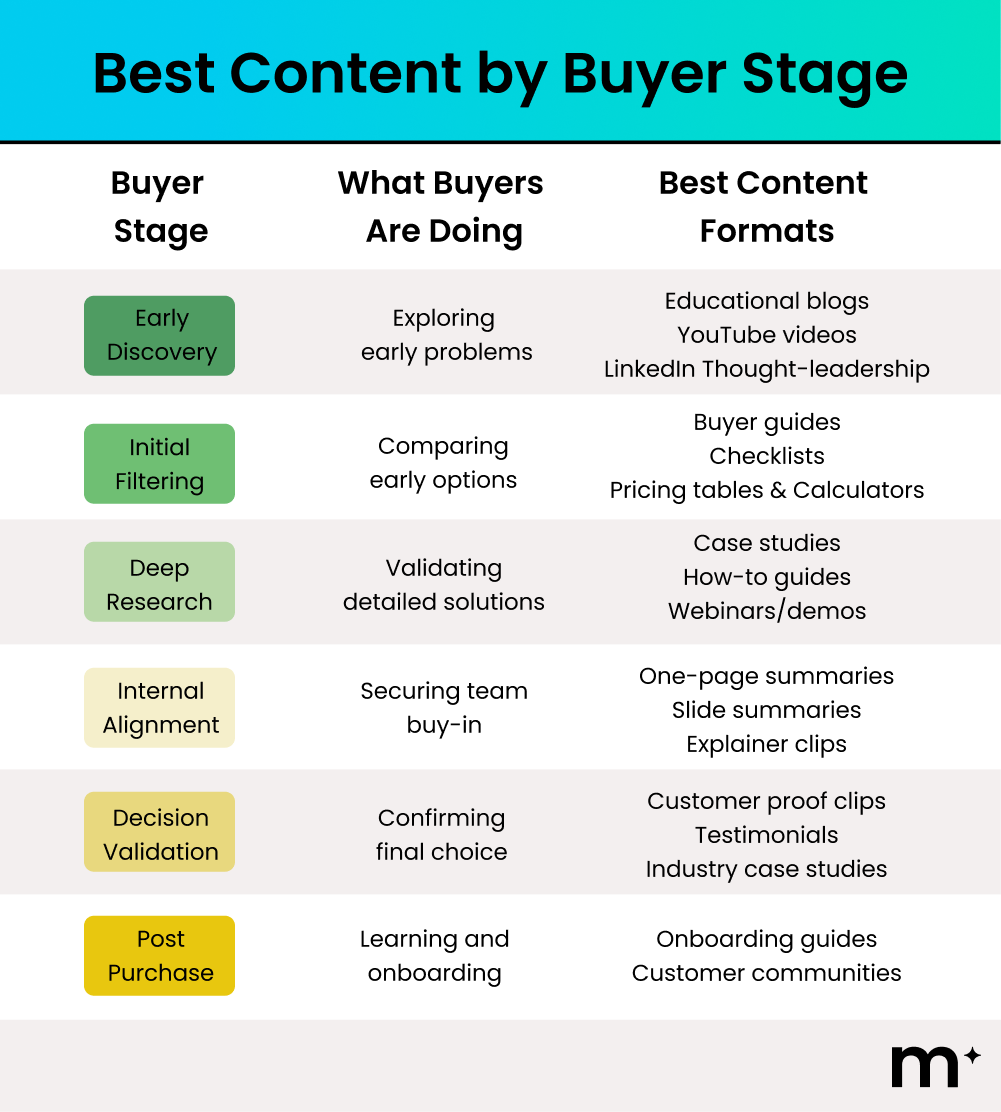
B2B content marketing is often misunderstood as being limited to a website and a blog. In reality, effective B2B strategies are built around a broader content ecosystem that supports buyers at different stages of their decision-making process.
This is why relying solely on blog posts or landing pages is rarely sufficient. Strong B2B marketing ensures the right content exists across this entire journey, not just at the point of initial interest.
The framework below illustrates how different types of content align with buyer behaviour across the journey. Rather than treating content as isolated pieces, strong B2B marketing ensures that the right format appears at the right time, across the right channels.
Given how central these channels have become in shaping perception and validation, it is worth examining how B2B online marketing works in its own right, and how it supports complex buying journeys over time.
Account-Based Marketing VS. Traditional Marketing
Traditional marketing often focuses on casting a wide net. Broad campaigns, general messaging, and large audiences are designed to generate awareness at scale. While this approach plays an important role in building visibility, it is not efficient in B2B marketing.
Account-based marketing is especially effective for mid-market and enterprise-focused businesses. Rather than casting a wide net, this approach concentrates effort on a defined list of high-value organisations, tailoring messaging and engagement around their specific context.
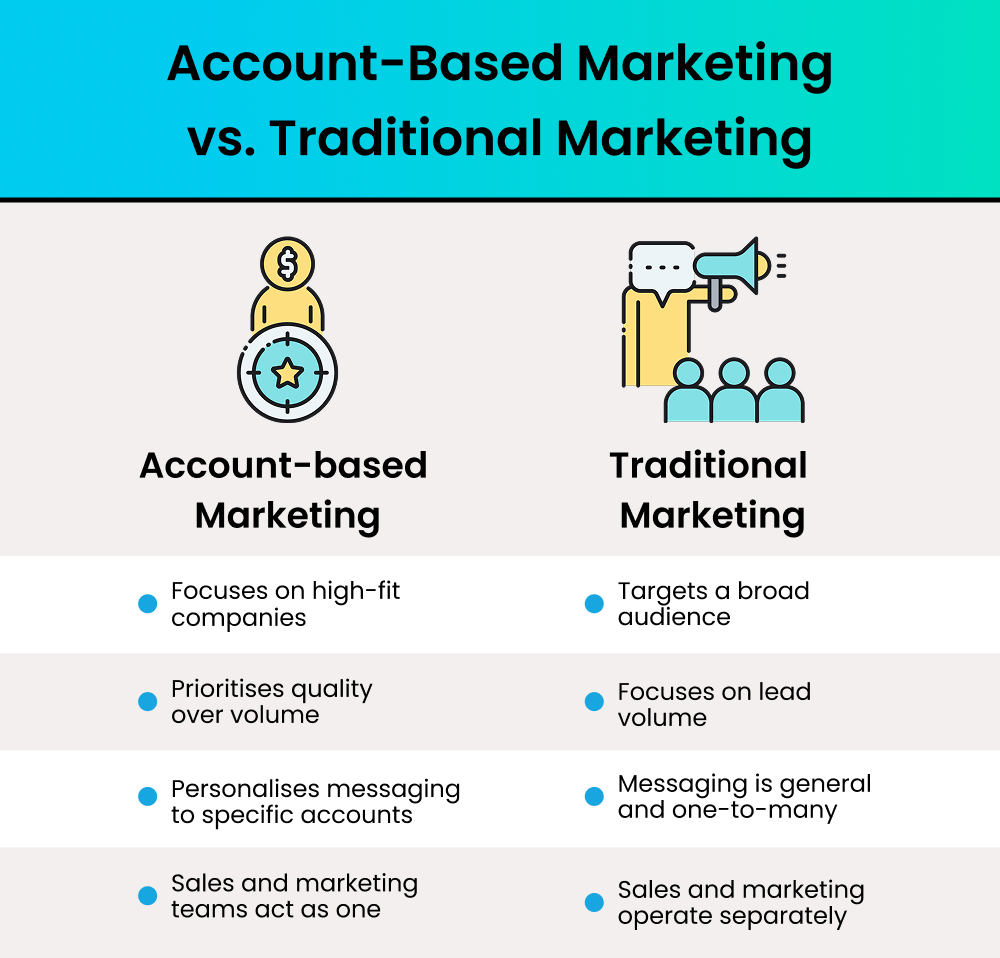
Personalised conversations allow businesses to address specific operational challenges, procurement concerns, technical requirements, and executive priorities that broad marketing activity cannot resolve. This is where credibility is tested, and trust is strengthened.
How to Build a Balanced B2B Business Marketing Strategy
The first step is not choosing channels or producing content. It is setting a clear strategic foundation that ensures every marketing effort supports measurable commercial outcomes.
Set the Strategic Foundation
A balanced B2B business marketing strategy starts with clarity, not channels. For SaaS companies, for example, growth is rarely constrained by visibility. It is constrained by focus, positioning, and the ability to support complex buying decisions over time.
| Strategic Focus | How It Works in Practice |
| Define the goal | Align marketing to revenue, not just lead volume |
| Choose the segment | Focus on one high-value industry or use case |
| Lock the ideal customer profile | Define who you want and who you exclude |
| Clarify positioning | Articulate the core problem you solve |
| Map decision-makers | Address user, buyer, and risk concerns |
| Build proof assets | Prepare case studies and buying validation |
| Assign channel roles | Decide which channels create, validate, and convert demand |
| Measure meaningful progress | Track pipeline quality and deal movement |
This framework provides a practical structure for doing exactly that. By defining who the business is for and how it creates value, teams can avoid common pitfalls such as broad targeting, weak positioning, or disconnected tactics. Over time, it also shifts measurement away from surface-level activity toward pipeline quality and long-term growth.
Choose Channels That Build Trust and Visibility
In B2B marketing, channels should be selected based on the specific role they play in building confidence. Different channels answer different buyer questions, and clarity comes from knowing exactly what each channel is responsible for.
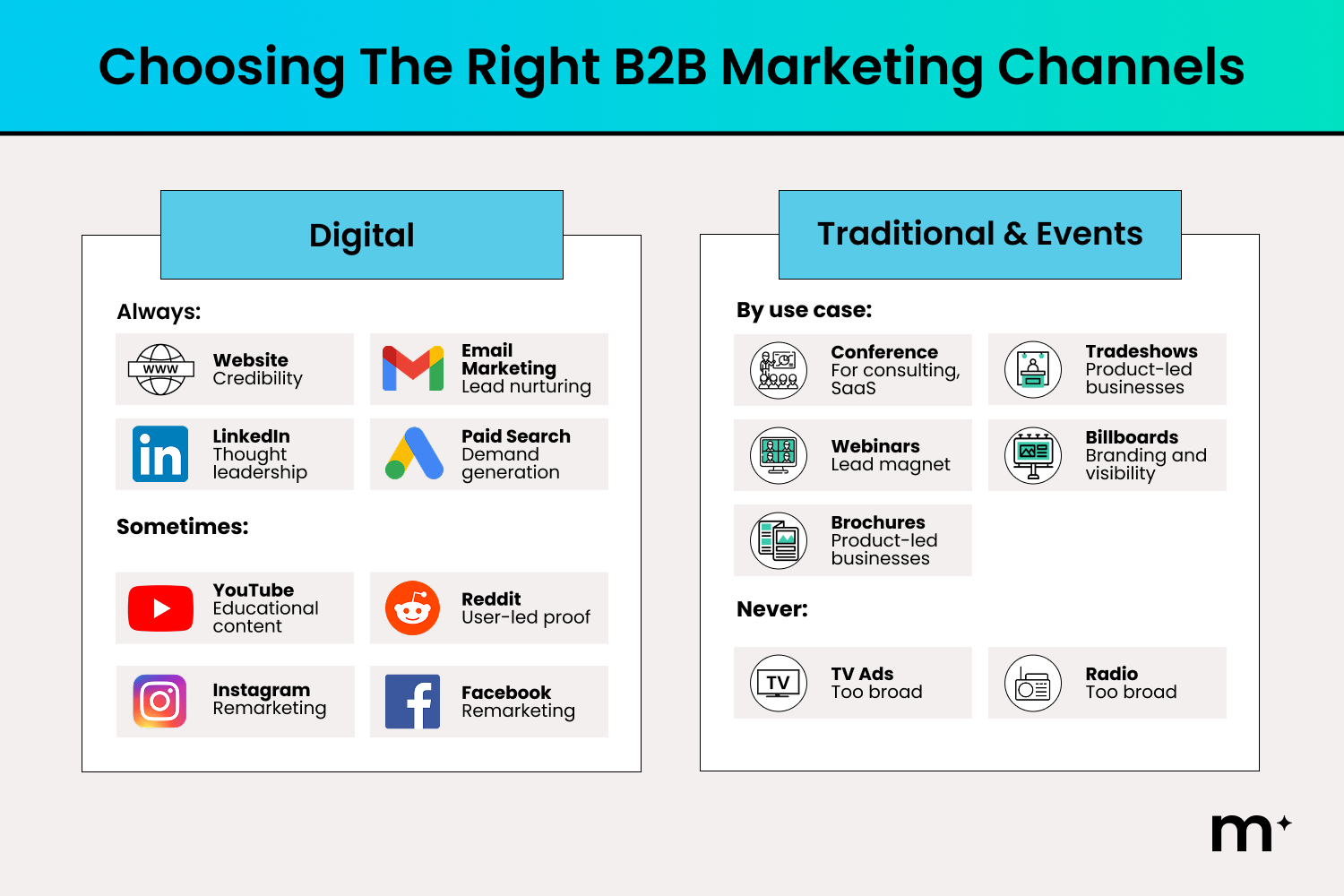
The goal is not to be everywhere, but to be present in the places buyers naturally use to validate trust. B2B businesses should choose channels by asking three questions:
- Where do buyers go to check if we are credible?
- Which channels help reduce perceived risk?
- What will buyers share internally to justify the decision?
Channels that clearly answer at least one of these questions earn priority. Everything else is optional.
Break Down Silos With Integrated Marketing
In B2B marketing, silos form when offline and online activities are planned and measured separately, creating fragmented experiences for buyers who naturally move between channels. Integrated marketing addresses this by ensuring each touchpoint connects logically, guiding prospects forward rather than restarting the conversation.
Silos create internal inefficiencies that spill into the buyer experience. Teams duplicate outreach, data is fragmented, and follow-up lacks context. What could have been a progressive sequence becomes a series of disconnected interactions, each starting from zero rather than building forward.
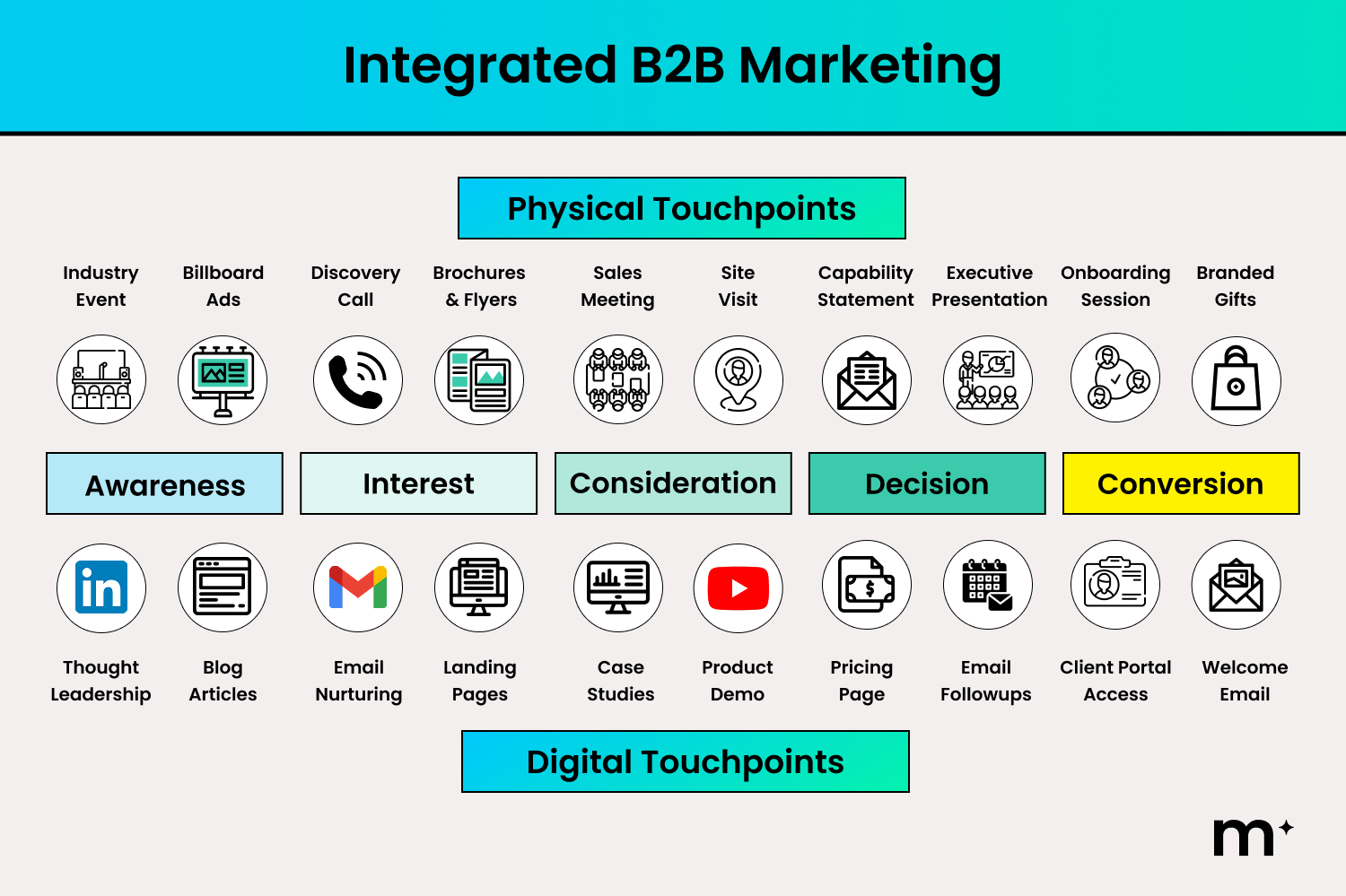
When each touchpoint builds on the last interaction, trust compounds, and momentum is far more likely to continue.
Measure What Matters and Refine Over Time
In B2B marketing, success cannot be judged by lead volume alone. Measuring what matters requires focusing on indicators that show whether trust is building and deals are progressing, not just whether activity is happening.
Instead of relying on surface-level metrics, effective B2B teams track a combination of pipeline, relationship, and revenue indicators, such as
| Metric | Why It Matters | How It Is Measured |
| Pipeline Value | Indicates future revenue potential and deal quality | Total value of active opportunities in CRM |
| Conversion Rates | Reveals how effectively interest turns into opportunity and revenue | Percentage movement between funnel stages |
| Average Sales Cycle Length | Shows buying complexity and friction | Average days from first touch to close |
| Win Rate by Channel | Identifies which channels produce revenue, not just leads | Closed-won deals divided by opportunities per source |
| Average Deal Size | Reflects positioning strength and perceived value | Total revenue divided by number of closed deals |
| Repeat Engagement | Signals growing trust and ongoing interest | Returning website visits, event re-attendance, multi-touch interactions |
| Customer Lifetime Value | Measures long-term commercial impact | Average revenue per customer over retention period |
| Expansion Revenue | Indicates post-sale success and relationship strength | Upsell and cross-sell revenue from existing clients |
Because attribution in B2B is rarely linear, refinement should be ongoing rather than reactive. Reviewing these metrics together helps identify where momentum builds, where it stalls, and which channels genuinely support long-term growth. Over time, this insight allows the strategy to evolve with buyer behaviour, leading to more predictable and sustainable outcomes.
From Strategy to Execution
Understanding B2B business marketing is one thing. Applying it consistently across targeting, channels, sales alignment, and measurement is another. Many businesses know they need better integration and clearer strategy, but struggle to translate theory into a practical, repeatable system.
That is exactly why we created The Sticky Fix Digital Strategy Template. It is designed to help B2B businesses clarify their positioning, define priority segments, assign roles to each channel, and align marketing activity directly with revenue outcomes. Rather than offering surface-level tactics, it provides a structured framework that connects trust-building, demand generation, and deal progression into one cohesive strategy.
If you are looking to apply these actions within a broader, integrated strategy, Mindesigns can help. We work with B2B businesses to build marketing systems that connect channels, support long sales cycles, and deliver sustainable growth. Get in touch to explore how a more deliberate approach can strengthen your results.