Marketers & Business Owners

Understanding what is adaptive software development starts with a simple reality. Software projects rarely run a smooth straight line. Requirements change, user behaviour is unpredictable, and external factors such as regulation or technology shifts introduce new constraints along the way.
In these uncertain environments, development approaches that assume stability often struggle. Adaptive Software Development emerged as a response, offering a flexible, learning-driven way to build software that evolves as new information becomes available.
While ASD offers clear advantages, it is not a universal solution. It relies on strong collaboration, trust, and experienced leadership to be effective.
What Is Adaptive Software Development?
Adaptive Software Development is a flexible, learning-focused approach to building software that embraces uncertainty and continuous change rather than trying to define everything upfront.
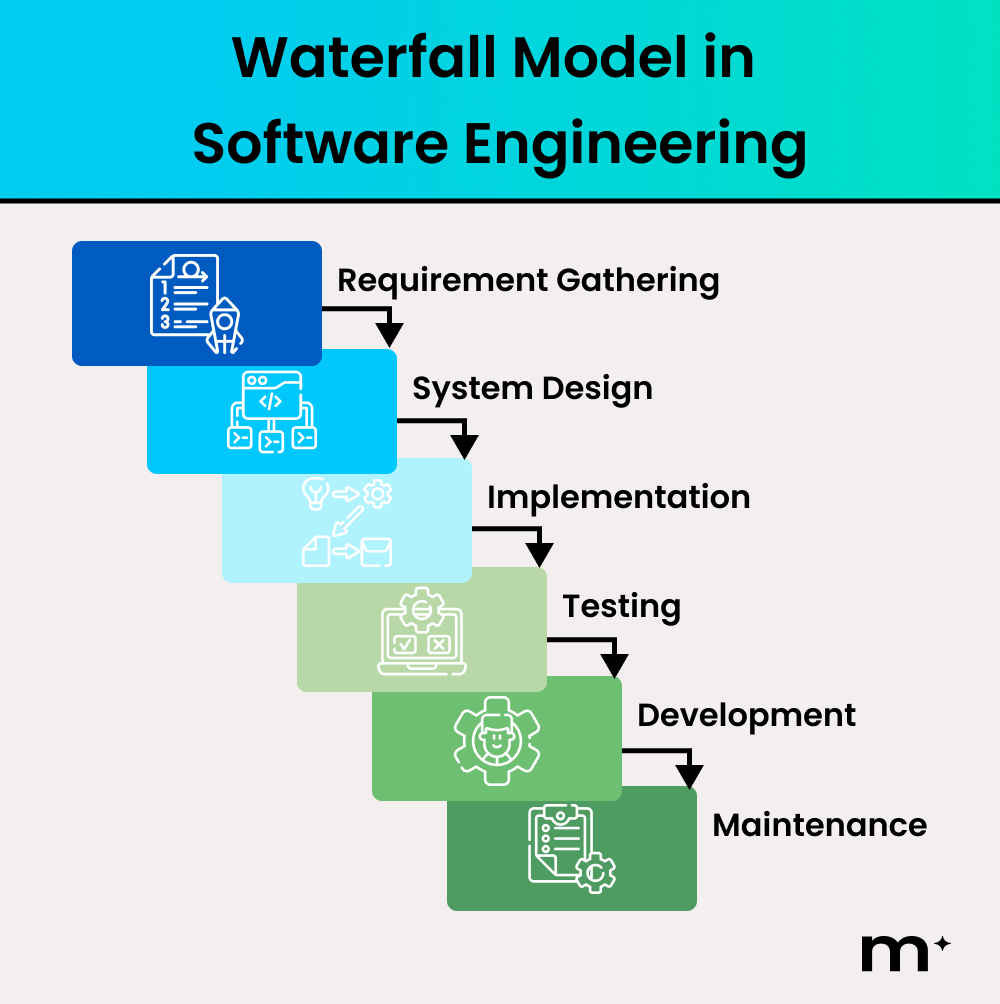
ASD is not a rigid methodology. It is best understood as a mindset and management framework designed to move beyond the limitations of traditional waterfall development, where work follows fixed, linear phases.
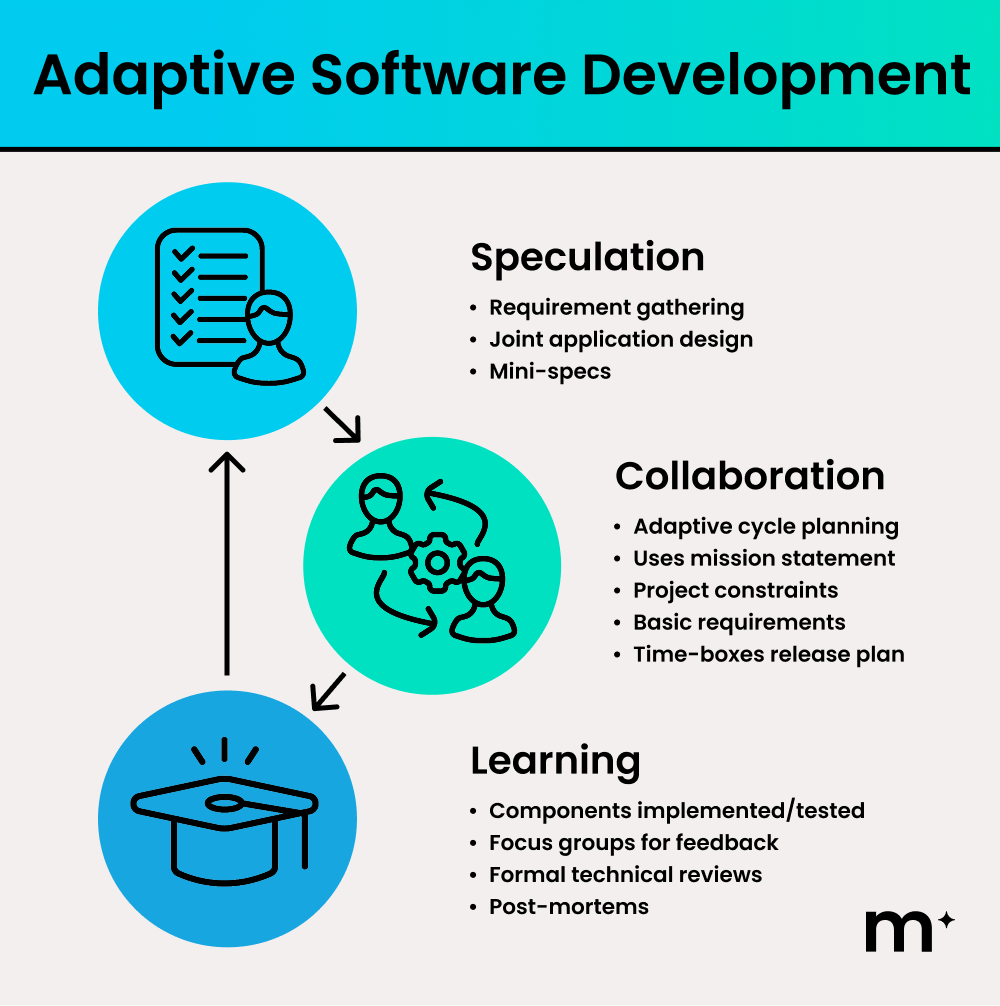
Instead of linear delivery, ASD operates through a repeating cycle of speculate, collaborate, and learn. These activities often happen in parallel, reflecting how real software projects evolve as new insights emerge and priorities shift.
The principles of ASD are deeply embedded in modern development practices. Scrum uses short iterations and regular reviews. Lean focuses on validated learning and reducing waste. DevOps encourages continuous feedback between development and operations. All of these are ASD principles. Many hybrid Agile frameworks combine these ideas. In practice, many teams already work adaptively, even if they do not explicitly call their approach Adaptive Software Development.
The Main Characteristics of Adaptive Software Development
Adaptive Software Development is defined less by rigid rules and more by a set of guiding characteristics that shape how teams plan, build, and make decisions.
This is increasingly important in AI-driven environments, where capabilities, requirements, and performance can change rapidly as systems learn and evolve. In these conditions, development approaches that assume stability struggle to keep pace. The characteristics of ASD help teams stay aligned with business value by supporting continuous learning and informed adjustment in environments where change is constant.
These characteristics help teams stay aligned with business value in environments where change is constant.
Mission-Focused
Adaptive Software Development starts with a shared mission rather than a fixed list of features. Teams align on outcomes such as improving retention, reducing churn, or increasing successful user actions. This mission becomes the decision-making filter throughout the project.
When trade-offs arise, the question is not “Does this match the original scope?” but “Does this move us closer to the outcome we want?” This keeps effort focused on value rather than completeness. Pivoting and making slight adjustments are encouraged, rather than being frowned upon.
Iterative Delivery
Work is delivered in short, repeatable cycles. Each cycle produces something usable, even if it is incomplete. Real customer behaviour, usage data, and feedback shape what happens next.
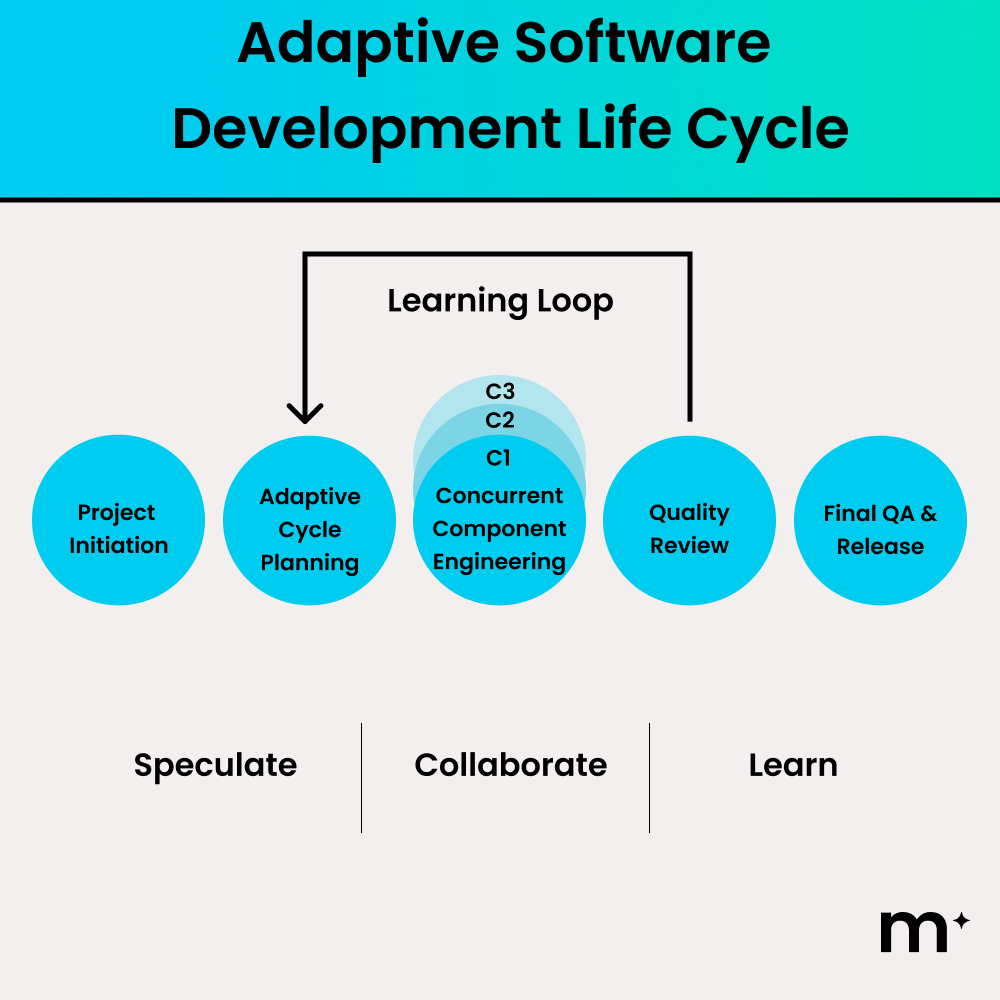
Instead of assuming requirements are correct upfront, teams treat each release as a learning opportunity. This allows products to evolve naturally as insights emerge.
Defined Cycles
Adaptive teams work within defined timeframes. Timeboxing means committing to a fixed period of work rather than a fixed set of outputs. Teams decide how long they will work before stopping to review, learn, and adjust, regardless of whether every planned task is completed.
This structure changes how decisions are made. Instead of trying to finish everything at all costs, teams focus on delivering the most valuable work within the available time. If something proves more complex than expected, the team can reassess priorities at the end of the cycle instead of pushing delays downstream.
Timeboxing creates momentum while still allowing priorities to change. At the same time, it creates space for learning because each cycle ends with a deliberate pause to evaluate results.
Feature-Based
Feature-based development means building software progressively, one piece of usable functionality at a time. Instead of trying to deliver everything in a single release, the team delivers features step by step, with each addition expanding what the software can actually do.
For example, a basic workflow may be delivered first, followed by improvements, refinements, or supporting functionality in later cycles. This allows the product to grow in a controlled way, while remaining usable throughout development.
By progressing feature by feature, teams can observe how each addition is used before deciding what to build next. This reduces unnecessary complexity, limits wasted effort, and keeps development focused on functionality that clearly adds value.
Change-Tolerant
Change is expected, not resisted. When new insights emerge, such as usability issues or unexpected user behaviour, priorities shift without restarting the project or redefining success.
Having tolerance for change allows teams to adapt continuously without losing direction, turning uncertainty into a competitive advantage rather than a risk.
Adaptive Software Development vs. Other Development Frameworks
Before exploring the advantages and challenges in detail, it helps to see how Adaptive Software Development compares with more traditional delivery models.
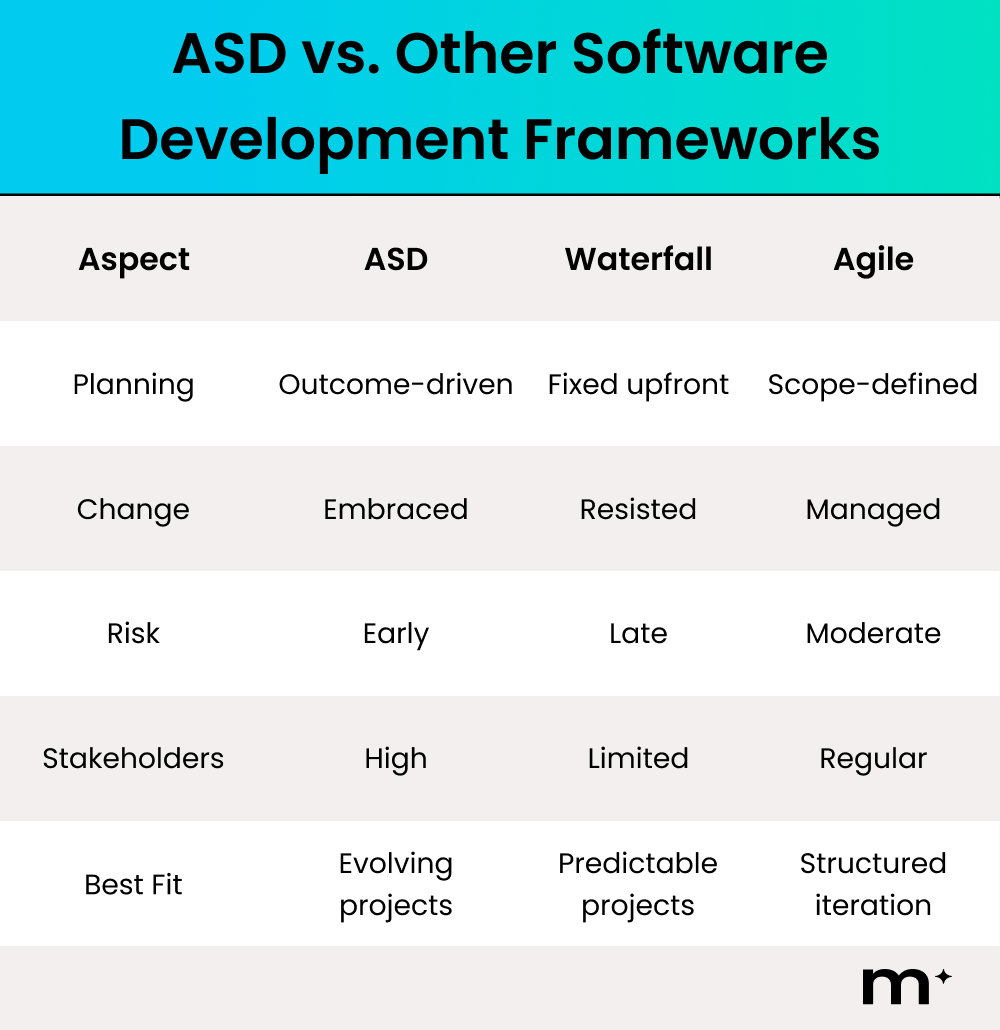
Adaptive Software Development offers clear advantages in fast-changing environments, particularly where learning, flexibility, and alignment with business outcomes matter more than rigid plans. At the same time, it places higher demands on collaboration, leadership, and decision-making. The value of ASD lies not in replacing all other models, but in choosing it deliberately when its strengths align with the nature of the project and the organisation’s ability to support adaptive ways of working.
When (and When Not) to Choose Adaptive Software Development
Adaptive Software Development is a powerful approach, but its effectiveness depends on context. The nature of the project, the level of uncertainty involved, and the organisation’s ability to support ongoing collaboration all influence whether an adaptive approach will add value or introduce unnecessary risk. Understanding when ASD is appropriate, and when it is not, helps businesses choose a delivery model that aligns with both their goals and constraints.
Choose Adaptive Software Development When
Adaptive Software Development is a strong fit when change is expected and learning is critical to success. It works best in situations where requirements are unclear at the outset or likely to evolve as the product is used in the real world. In these environments, the ability to adapt quickly is more valuable than committing to detailed plans early.
This approach is particularly effective when business outcomes matter more than delivering a fixed set of features. ASD is recommended for projects if early releases, fast feedback, and continuous improvement provide a competitive advantage, as it allows teams to respond without delay. It is well suited to strategic or long-term systems, where success depends on ongoing refinement rather than a single delivery milestone.
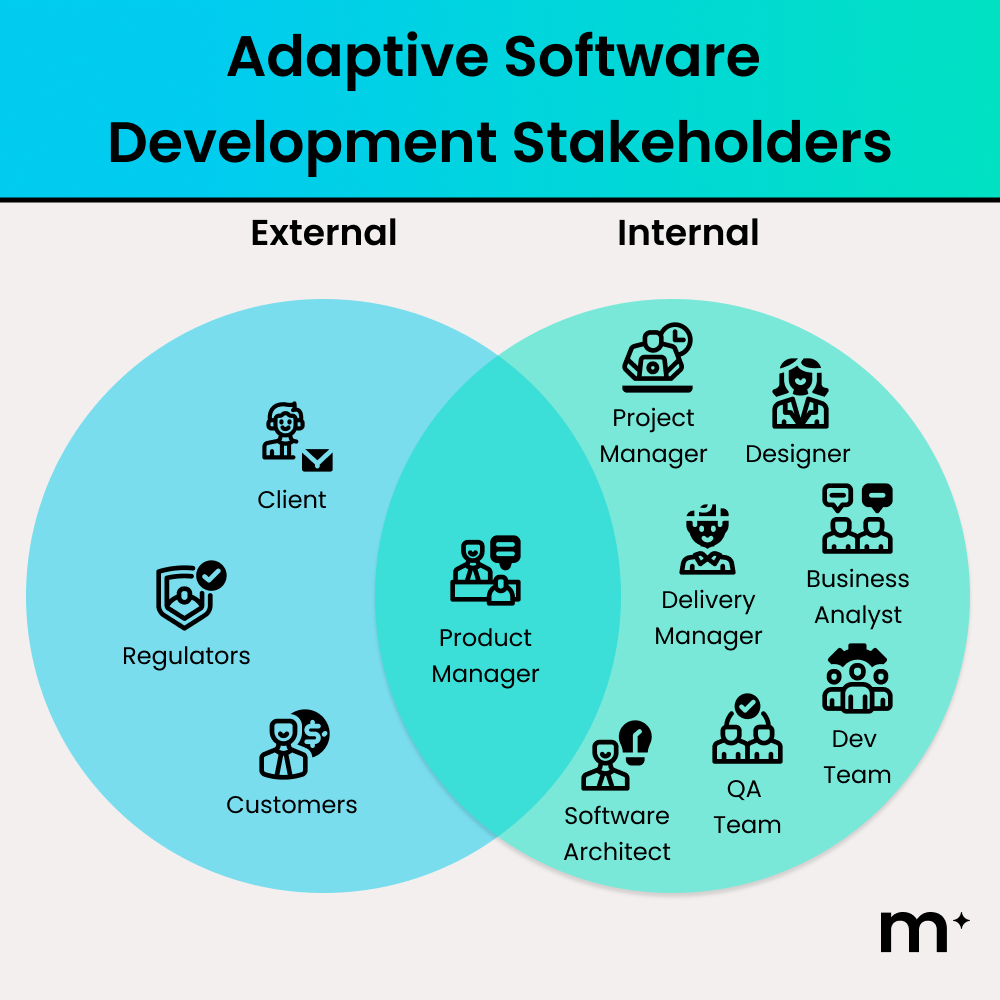
For Adaptive Software Development to be successful, organisations must also support regular collaboration. Stakeholders need to be available to review progress, interpret insights, and make timely decisions. When this level of engagement is possible, adaptive teams can stay aligned with business goals while responding to change confidently.
Avoid Adaptive Software Development When
Adaptive Software Development is not a good fit when predictability is the primary requirement. Projects that demand fixed scope, budget, and timelines upfront often benefit from more structured delivery models, particularly when contractual or operational certainty is non-negotiable. Commonly, these are the case for:
- Government or public sector projects
- Fixed-price client engagements
- Large enterprise system rollouts with locked milestones
In these cases, flexibility can conflict with delivery obligations.
ASD is also less suitable for compliance-heavy or highly regulated environments, where change is constrained by external requirements. This includes organisations such as
- Financial institutions and payment providers
- Healthcare systems and medical software vendors
- Safety-critical or regulated product manufacturers
When documentation, validation, and formal approvals must be defined in advance, the freedom to adapt during delivery is often limited or impractical.
Designing Software for Uncertainty
Designing software for uncertainty is less about choosing a process and more about accepting how software actually behaves once it meets the real world. This is becoming even more pronounced as AI is embedded into modern products. Since AI-driven systems are constantly evolving, no amount of upfront planning can account for how users will interact with intelligent systems over time.
Adaptive approaches are well-suited to this reality because they assume clarity arrives late. As AI capabilities improve, edge cases emerge, and expectations shift, teams must be able to adjust without overcorrecting or rebuilding from scratch. Designing for uncertainty means creating space for learning, allowing decisions to evolve, and avoiding structures that lock teams into early assumptions about how a system should behave.
Looking ahead, software development is likely to become less about delivering static functionality and more about managing systems that learn, adapt, and change in production. In that context, the advantage shifts from precision to resilience. Organisations that design software with uncertainty in mind will be better positioned to refine, extend, and sustain their products as AI capabilities and user expectations continue to evolve. Adaptive Software Development, in this sense, is not just a response to current complexity, but a foundation for how software will be built in the future.
If you are interested in how technology and marketing intersect, explore the rest of our blog for more insights on building, scaling, and optimising digital products.