Marketers & Business Owners

The cost for SEO has always been difficult to justify. Pricing varies widely, results take time, and the link between effort and real business growth is not always clear. That challenge has intensified as Google rolls out AI-powered search experiences, including Search Generative Experience (SGE), which changes how visibility is earned and measured.
Today, many businesses are questioning whether they are overpaying for SEO that no longer delivers, or underinvesting while competitors adapt faster. The reality is that SEO is now both cheaper and more expensive than ever. AI tools have reduced the cost of basic production, but meaningful visibility now requires deeper expertise, stronger authority signals, and broader exposure across multiple search surfaces.
SEO has never delivered instant gratification. Results still compound over time, but they are never guaranteed. For many marketers and business owners, this waiting period creates real anxiety, especially when progress feels invisible month to month.
That uncertainty has intensified as search engines roll out new AI features at an accelerating pace. These AI-driven results often cannibalise clicks by answering questions directly within the search experience, reducing the need for users to visit websites at all.
When approached strategically, SEO remains one of the most cost-effective long-term growth channels available to businesses. This guide breaks down what actually drives SEO costs today, and how AI and SGE are reshaping its value without diminishing its impact.
What Goes Into the Cost for SEO
SEO is not a single task or deliverable. It is a combination of technical, creative, and strategic activities that work together to improve visibility, authority, and demand over time. Each component contributes differently to overall performance and cost, depending on your industry, competition, and growth goals.
At Mindesigns, every campaign is built on seven core elements. These are essential. They reflect what Google actively evaluates when deciding which websites earn visibility and which are left behind.
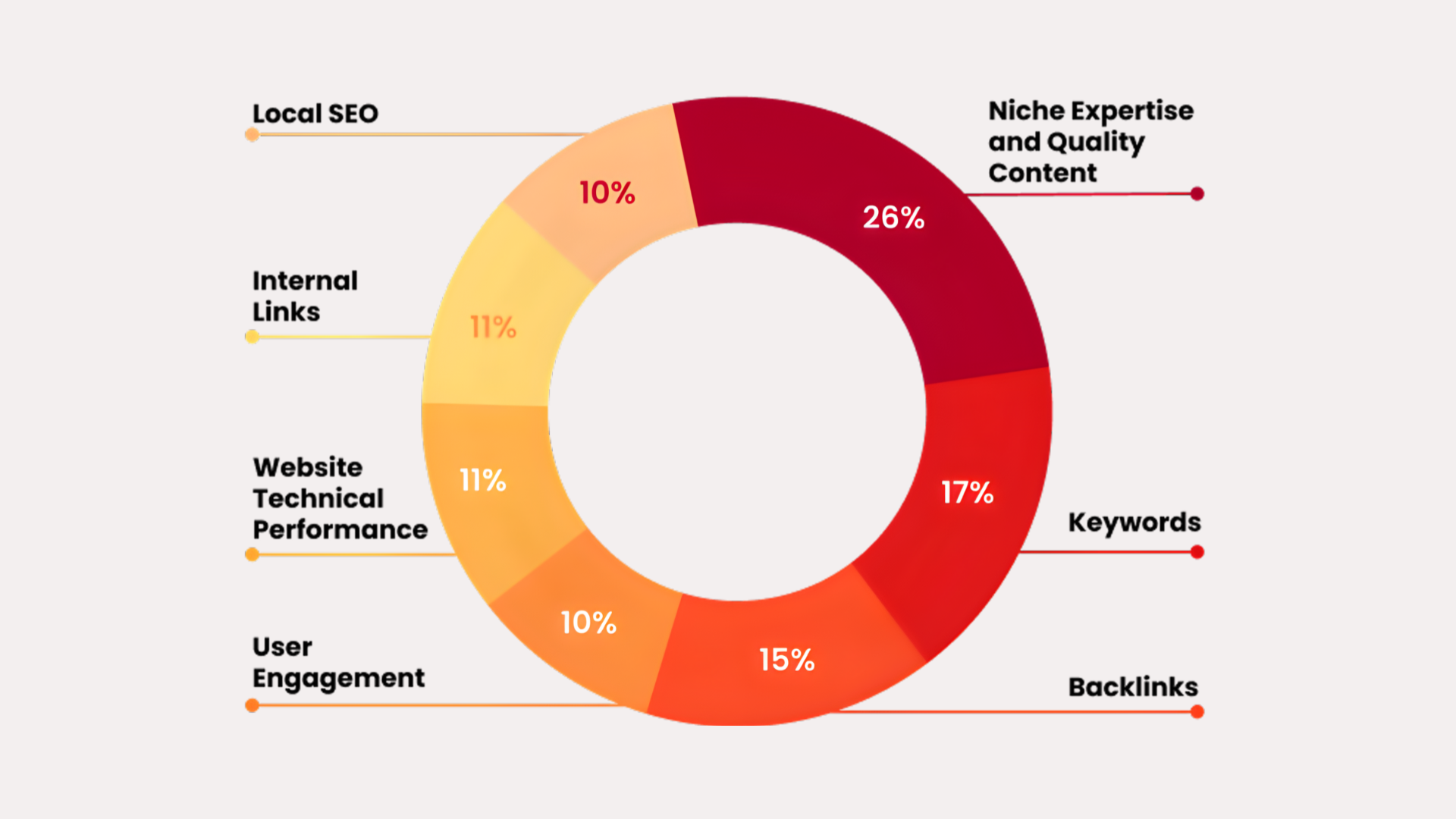
These elements work together as a system. Each one supports a different signal that Google uses to assess relevance, authority, and trust. To understand how SEO cost is built up in practice, it helps to break these elements down one by one.
On-Page SEO
On-page SEO focuses on optimising everything within your website to align with search intent and deliver a strong user experience. This includes:
- Metadata optimisation
- Heading structure and content hierarchy
- Keyword alignment
- Search intent targeting
- Internal linking and crawl efficiency
- URL structure and page organisation
- Conversion optimisation
The cost for on-page SEO increases with site size and complexity. For example, a service business operating across Sydney, Brisbane, and the Gold Coast needs carefully structured pages for each location. Without this, search engines can struggle to understand which page should rank, leading to avoid keyword cannibalisation, where multiple pages compete against each other and weaken overall performance..
On-page SEO is rarely a one-off cost. Pages must evolve as competitors improve, algorithms change, and user expectations shift.
Off-Page SEO
Off-page SEO focuses on authority building through high-quality backlinks, brand mentions, and digital PR. This requires manual outreach, relationship building, and content assets that provide genuine value.
Backlinks still play a critical role in SEO, but they are harder than ever to earn properly. Paid or manipulative links are increasingly flagged by Google, making shortcuts risky and expensive to undo.
Because organic backlinks take time, expertise, and consistent effort, off-page SEO often represents one of the largest components of ongoing SEO investment.
Local SEO
Local SEO is essential for Australian businesses targeting specific service areas. It includes Google Business Profile optimisation, review strategies, local citations, and location-specific content.
For example, a trades business targeting multiple suburbs must compete on proximity, relevance, and trust signals. Ongoing optimisation is required because competitors can outrank you through stronger reviews, improved engagement, or better local relevance.
Local SEO adds to cost, but it also delivers some of the highest intent traffic available.
Content Strategy and Creation
High-performing SEO content goes beyond basic blog posts. It includes service and location pages, FAQs, supporting articles, and content designed to perform within AI-driven search results.
Effective content demonstrates niche expertise, local relevance, and real-world experience. In competitive markets, a single service page often needs deep supporting content to maintain visibility.
Social media also plays a growing supporting role. While not a direct ranking factor, strong engagement and reach increase branded searches and content visibility, reinforcing authority signals that search engines and AI systems increasingly rely on.
Supporting Components That Influence SEO Cost
While on-page, off-page, and content execution make up the visible side of SEO, there are supporting components that heavily influence both cost and performance. These elements sit behind the scenes but are useful for shaping the direction of the entire effort.
Research and Strategy
Effective SEO starts with deliberate research. This includes keyword analysis, competitor benchmarking, search intent mapping, and identifying gaps competitors have missed. This work defines what to prioritise, where to compete, and how to invest effort for the strongest return.
Higher quality SEO providers treat research and strategy as foundational. Lower-cost SEO often shortcuts this step, leading to generic tactics that struggle in competitive markets.
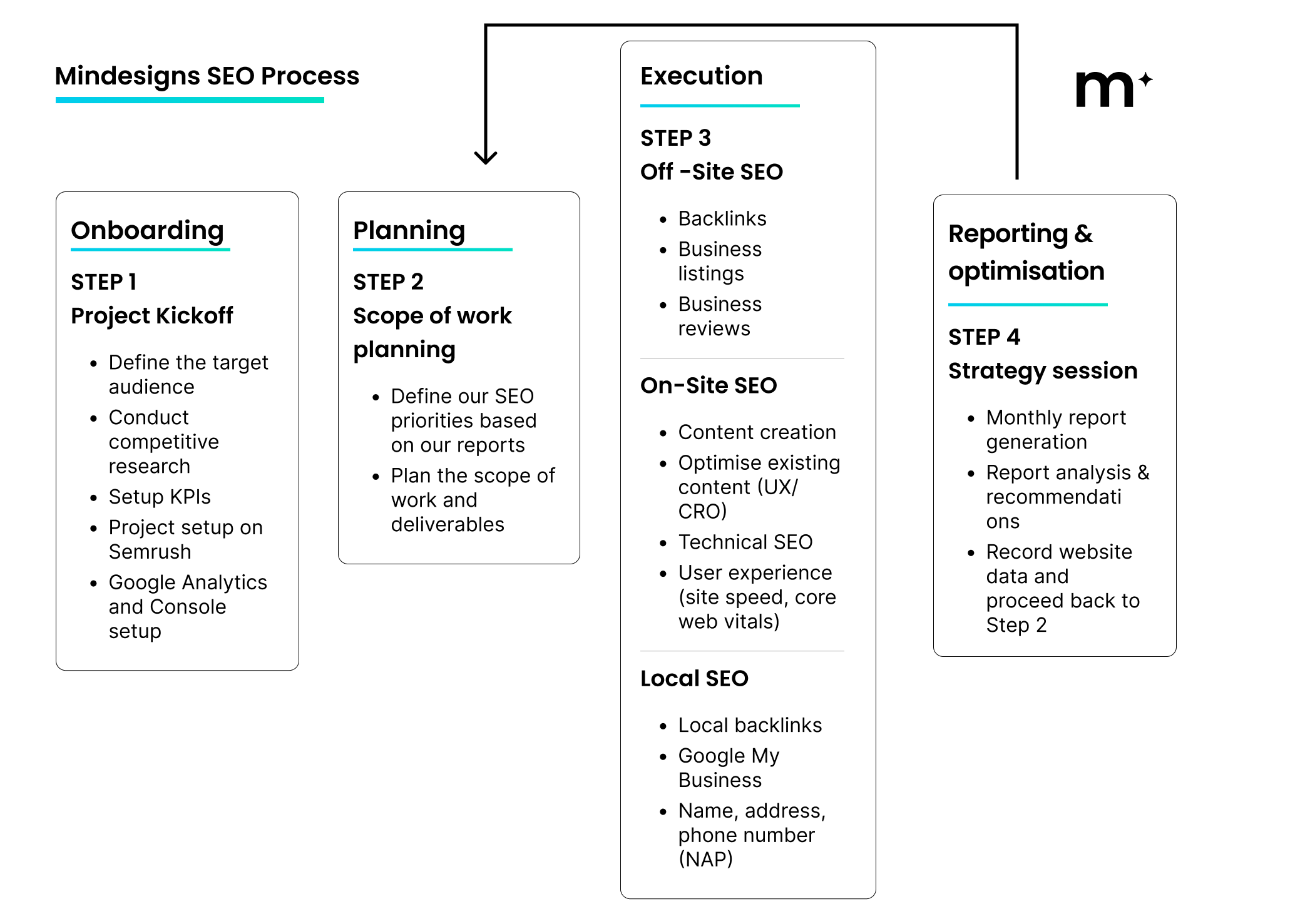
At Mindesigns, SEO is delivered through a continuous, cyclical process, not a set-and-forget approach. Campaigns run in monthly sprints covering planning, execution, reporting, and optimisation, allowing us to measure impact, adjust quickly, and stay aligned with commercial goals as search behaviour and algorithms evolve.
Analytics and Reporting
Analytics and reporting are ongoing components of SEO that ensure your investment is tied to real business outcomes, not just surface-level metrics. Effective reporting is built around marketing KPIs, showing how organic search contributes to conversions, enquiries, and revenue, not just rankings and traffic.
At a practical level, this includes identifying how many conversions originate from organic traffic, which pages drive the highest quality leads, and where users drop off before converting. We also track engagement-based marketing KPIs such as time on page, scroll depth, and user pathways to understand how content supports decision making, not just visibility.
Transparent reporting helps businesses understand progress beyond rankings alone, especially as AI search changes how visibility is measured.
How Much Does SEO Cost in Australia?
While pricing varies by industry and competition, typical Australian SEO pricing looks like this:
| SEO Pricing Model | Typical Cost Range |
| Monthly Retainers | $1,500 to $5,000 per month |
| Project-Based SEO | $2,500 to $15,000, depending on scope |
| Hourly SEO Services | $120 to $250 per hour |
Monthly retainers are designed for businesses that want steady, long-term growth. This model supports continuous optimisation across content, technical performance, and authority building. Retainers suit competitive markets where rankings must be defended and improved over time.
Project-based SEO works best when there is a clear, contained objective. This includes audits, technical clean-ups, migrations, or initial on-page optimisation. It is useful for establishing a strong foundation or fixing specific problems. It is not built to sustain performance once competitors begin adapting or search behaviour shifts.
At Mindesigns, project-based SEO is delivered with full transparency. We record how hours are allocated across tasks, giving clients clear visibility into where effort is focused and why.
Hourly SEO is most effective for targeted support. This model fits situations where you need expert input, second opinions, or short-term troubleshooting. It is common for in-house teams that need strategic guidance or to fill a gap in talent or tools.
The Return on Investment of SEO
A strong SEO strategy compounds. Even when active optimisation slows, quality content and authority continue delivering value over time, unlike paid advertising which stops the moment spend stops.
High-quality SEO requires real investment. This is not a reason to cut corners. Cheap SEO often becomes expensive later. Fixing penalties, removing spammy backlinks, and rebuilding poor site structure usually costs more than doing it properly from the start.
SEO behaves more like long-term capital than short-term spend. Early effort builds assets. Each improvement strengthens the next. When done well, results accelerate rather than reset.
Case in point: EMG Antennas
EMG Antennas engaged Mindesigns to improve online visibility and lead generation through SEO, supported by paid search.
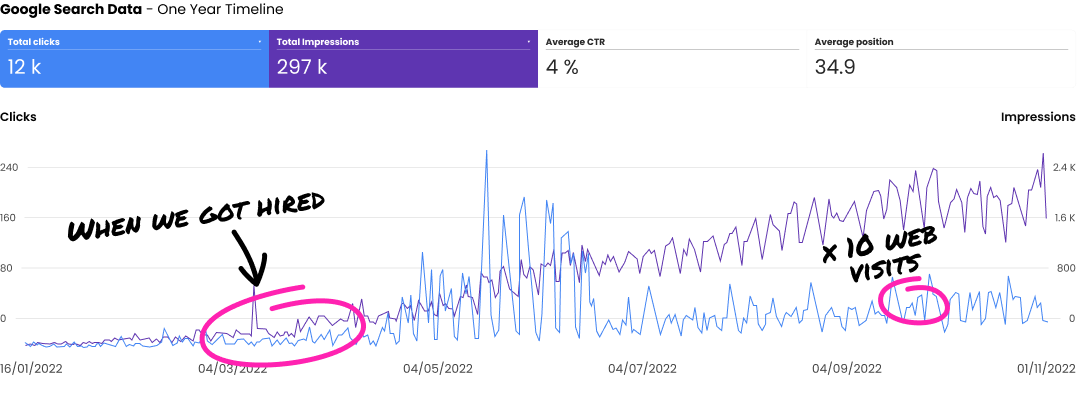
Before SEO, the business received only a handful of visits per day and inconsistent enquiries, with little visibility for high intent searches around TV signal and antenna issues.
Growth began with a small set of targeted articles answering common questions and helping users diagnose problems and choose the right antenna solutions. This attracted highly relevant traffic from people actively seeking help.
Each article included a clear contact option alongside the content, turning informational searches into enquiries. Over time, this approach drove organic traffic to more than 280 visits per day and delivered a consistent flow of qualified jobs.

The impact compounded over time. A focused content strategy continued to attract qualified traffic and deliver a steady stream of leads well beyond the initial investment.
Should You DIY Your SEO?
SEO combines technical expertise with creative strategy. While businesses can manage the basics, competing in saturated Australian markets without experienced specialists and the right tools significantly reduces your chances of success.
Today, the cost for SEO is no longer just about rankings. It is about visibility, authority, and sustainable demand in an AI-driven search landscape. When technical execution is paired with creative content and transparent reporting, results compound over time.
At Mindesigns, SEO pricing is tailored to your industry, competition, and growth goals. We combine technical expertise with creative execution, recognising that modern SEO is as much about how content is created and distributed as it is about how it is optimised.
If you want confidence in your SEO investment, clarity on timelines, and strategies that deliver sustainable growth, contact us today. Our experienced team will help you navigate SEO in an AI-driven search landscape with confidence.