Marketers & Business Owners

Most B2B campaigns fail because they speak to companies, not to the people making the decisions. A logo never signs a contract. It is a marketing director under pressure to prove ROI, a CFO nervous about risk, or a procurement manager guarding compliance. Forget them, and your message will miss every time. That is where a B2B buyer persona changes everything. Instead of broad, lifeless targeting, it gives you a clear picture of the human behind the deal, their goals, fears, and the triggers that push them to act. With that clarity, your content speaks to what truly matters and earns real attention. Without it, even your best campaigns fade into the noise.
The gap between B2B and B2C buyers explains why this shift matters so much. Their motivations, timelines, and decision-making patterns operate in completely different worlds:
| Aspect | B2B Persona | B2C Persona |
| Decision-Making | Multiple stakeholders, formal committees, long approvals | Individual or household, fast and personal |
| Key Drivers | ROI, compliance, risk management, scalability | Price, convenience, lifestyle, emotional appeal |
| Sales Cycle | Months to over a year, structured evaluation | Minutes to weeks, often impulsive |
| Content That Works | Case studies, white papers, ROI tools, thought leadership | Social media, ads, reviews, influencer content |
| Buying Triggers | Regulatory changes, funding rounds, leadership shifts, tech upgrades | Trends, discounts, peer recommendations, personal needs |
Consumer-style personas lean on lifestyle and age, which might sway a retail purchase but carry little weight when a million-dollar decision winds its way through committees and budget reviews. In B2B, the stakes are higher, the process is slower, and the drivers are sharper. This is why structured personas are essential for creating communication that cuts through complexity and drives real results.
To guide you through building these personas and tying them into a broader strategy, we created The Sticky Fix Digital Marketing Template. Inside, you will find a full framework for planning campaigns, mapping funnels, and most importantly, creating buyer personas. You can download it here.
In this article, we will take a closer look at the buyer persona side of that strategy and explore how understanding the people behind the process can lift the performance of every campaign.

B2B vs B2C Buyer Personas Core Differences
It is tempting to think of buyer personas as a one-size-fits-all tool. After all, whether you are selling to a consumer or a business, the goal is to understand who is on the other side. But B2B marketing involves layers of complexity that make its personas very different from those in consumer markets. A business purchase rarely rests on one person’s choice. Instead, it involves a group of people, each with their own priorities and concerns.
The decision-making process is the first clear divide. A B2C purchase is often made by a single individual or a household, while a B2B purchase can pass through committees of 10 or more. Finance directors, technical leads, compliance officers, and department heads all weigh in before a contract is signed. That alone changes the type of information they look for and the time it takes to decide.
The cycle itself is another factor. Consumers can make a purchase in minutes, days, or weeks, but B2B buyers often move through a process that stretches across six months or longer. During that time, they research, compare, evaluate risks, and present their findings internally. What guides their decision is less about emotional appeal and more about measurable business outcomes like cost reduction, efficiency, compliance, or scalability.
| Feature | B2B Persona | B2C Persona |
| Example | Marketing Director | Millennial Shopper |
| Decision-making | Group of 10–11 stakeholders | Single consumer |
| Purchase cycle | 6–12+ months | Hours to weeks |
| Motivators | ROI, compliance, efficiency | Price, brand loyalty, lifestyle |
| Content used | White papers, case studies, webinars | Ads, social posts, reviews |
Imagine a Marketing Director persona in a mid-sized tech company. Her days are filled with campaign reports, ROI pressures, and constant requests from sales for better leads. She cares about efficiency and measurable results, and she consults her finance and operations teams before approving new tools. Now compare that to a Millennial Shopper persona. He scrolls through social media, finds a product endorsed by peers, checks reviews, and buys within hours if the price feels right.
Without that perspective, it is too easy to design campaigns that sound convincing to an individual consumer but fall flat in a boardroom discussion.
Why a Well-Defined B2B Buyer Persona Matters
A B2B persona sharpens marketing’s focus, helps sales see which stakeholders hold influence, and shows product teams the problems that matter most. With everyone working from the same picture, the business moves together instead of in silos.
It also clears up the murky question of who makes the final call. A strong persona maps out influencers, blockers, and champions, be it the procurement officer slowing approvals, the CFO approving budgets, or the technical lead comparing specifications. That clarity makes outreach far more precise.
Personas then guide the content you create. Each stage of the buyer’s journey demands a different approach: broad industry insights at the awareness stage, deeper case studies in consideration, and detailed demos or ROI proof near the decision. With personas in place, the right story reaches the right person at the right time.
These outcomes show how personas transform a vague idea of a “target market” into a practical tool that drives growth. The next step is to understand what exactly makes up a strong persona and how to build one that reflects the real dynamics of a B2B buyer.
Mapping Personas to the B2B Marketing Funnel
A buyer persona comes to life when it is mapped against the journey a prospect takes from first contact to final commitment. Your funnel in The Sticky Fix Digital Marketing Template lays out a clear path that moves someone from casual awareness through to becoming a client. By tying each stage to persona insights, you make the funnel more precise and far more effective.
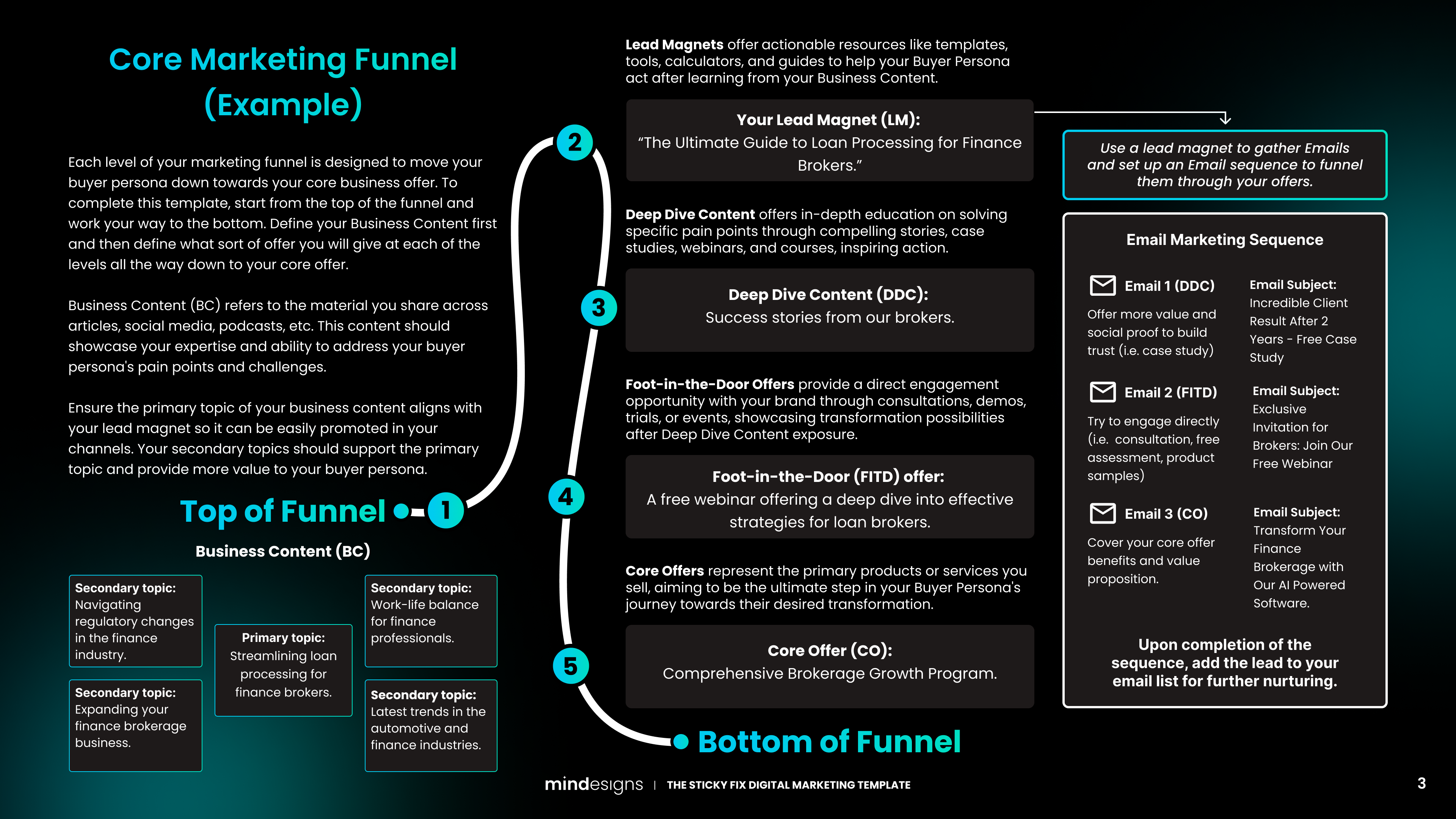
At the top of the funnel is Business Content (BC). This is the everyday material you publish across blogs, LinkedIn, social media, and podcasts. It introduces solutions to the problems your persona is already facing. Primary topics should speak directly to their biggest challenge, while secondary topics add supporting context. For example, a Marketing Director persona might value guidance on campaign ROI, while a Procurement Manager might be drawn to content about compliance or supplier risk.
The next step is the Lead Magnet (LM), where you offer something genuinely valuable in exchange for contact details. For us, that lead magnet is The Sticky Fix Digital Marketing Template. It is the core free resource we use to attract and qualify leads. The template bundles practical tools and marketing frameworks that address specific pain points our personas face, which makes it both useful and highly relevant.
Personas then move into Deep Dive Content (DDC) and Foot-in-the-Door (FITD) offers. Deep Dive Content, such as case studies, webinars, or detailed guides, builds trust by showing clear results and success stories. The FITD step creates direct engagement, such as a free consultation or webinar invite, where the persona experiences your expertise first-hand. These touchpoints match the middle-of-funnel need for credibility and confidence.
Finally, the Core Offer (CO) meets the Decision stage. This is your primary service or program, designed to solve the persona’s challenge fully. At this point, the buyer persona looks for ROI evidence, detailed proposals, and proof from peers. With the funnel aligned to persona needs at each stage, the buyer’s journey feels guided and logical, making it easier for stakeholders to reach a decision together.
Best Practices and Mistakes to Avoid When Creating a B2B Buyer Persona
Creating personas is as much about discipline as it is about research. Done well, they bring clarity and focus to your marketing. Done poorly, they create noise and confusion. That is why using a structured template is so powerful. A template ensures you capture the details that matter, bio, goals, challenges, pain points, platforms, and buying triggers, without drifting into irrelevant data.
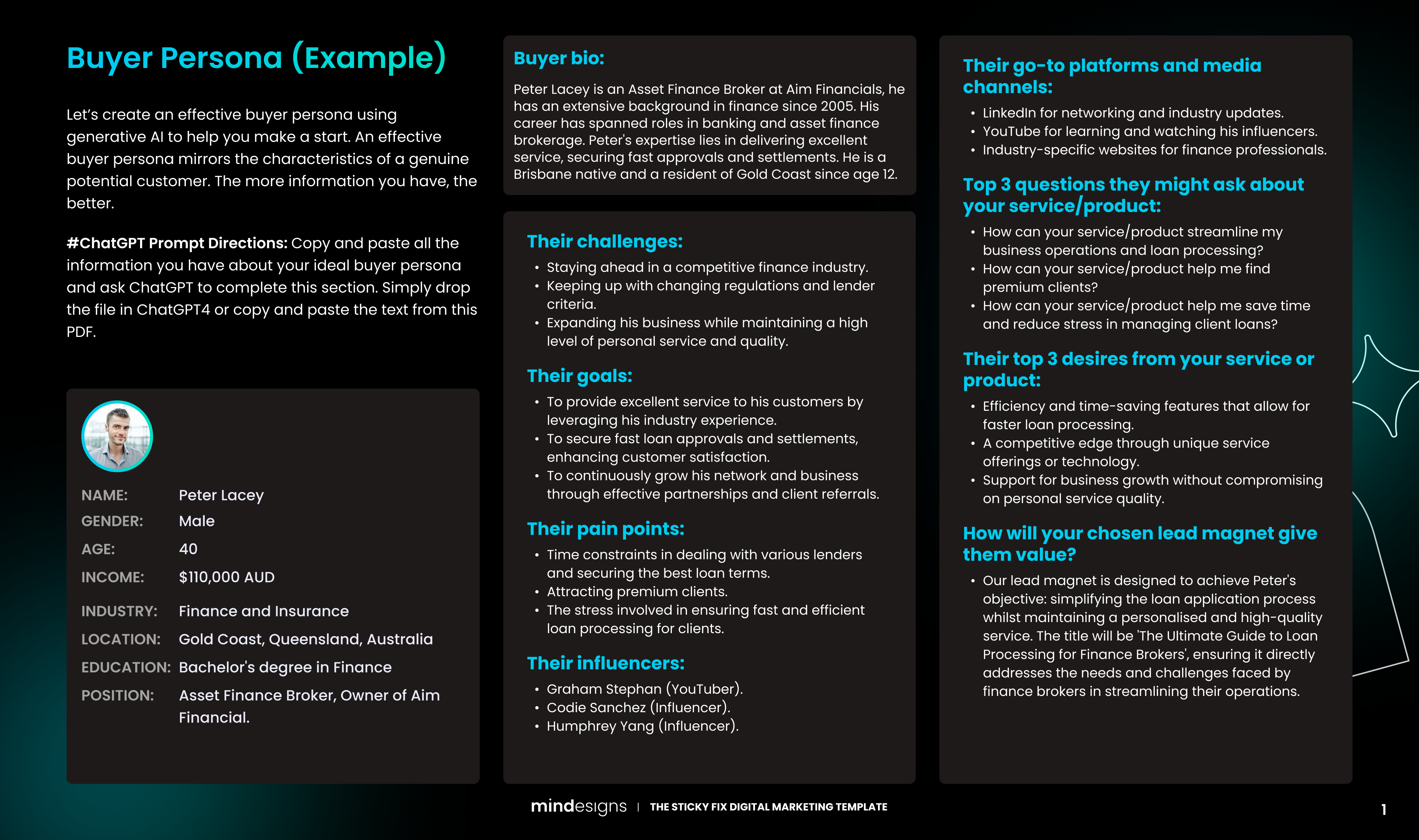
When you fill out the template, think about how each section connects to your strategy. The challenges point you toward problem-focused content. The goals highlight how your solution should be positioned. The pain points tell sales where objections will come from. Even the media channels and influencers shape where you publish and promote your campaigns. With everything in one view, marketing, sales, and product teams can align around the same profile and pull in the same direction.
To make your template work, there are a few practices to follow and some common traps to avoid:
Best Practices for Creating a B2B Buyer Persona
- Base personas on real customer interviews and market research, not assumptions.
- Involve cross-functional teams so marketing, sales, and product share and confirm buyer information .
- Begin with one or two personas and expand later, rather than overwhelming your team with too many at once.
- Treat personas as living documents. Update them each year or when industry trends or buyer behaviours shift.
- Use persona insights to shape messaging, content formats, and sales enablement so they stay active in daily workflows.
Mistakes to Avoid when Creating a B2B Buyer Persona
- Overloading with irrelevant personal details such as marital status or hobbies that do not affect business decisions.
- Creating too many personas without clear distinctions, which spreads resources too thin.
- Neglecting to validate personas against customer data or feedback from sales.
- Allowing personas to sit unused in a file instead of embedding them into campaigns and product planning.
- Treating personas as static documents instead of evolving guides that adapt to market shifts.
With best practices in place, the template stops being a tick-box exercise and becomes a practical tool. When kept accurate and embedded into strategy, it shapes sharper campaigns, more relevant content, and stronger alignment across teams. That is what turns an abstract profile into a guide that influences results throughout your entire marketing funnel.
From Profiles to Performance
A B2B buyer persona should act as a working guide that shapes how your business speaks, sells, and builds trust. When based on real research rather than assumptions, personas create alignment across teams, sharpen your content, and lift the return on every campaign.
The path forward does not need to be complex. Begin with one clear persona that reflects your most important customer type. Refine it with insights from real conversations, data from your market, and feedback from your sales team. Keep it active by applying it across your campaigns, product planning, and sales enablement, and update it as your market evolves.
Personas should feel alive inside your business, not buried in a strategy file. They are tools that guide decisions day to day, ensuring every message, offer, and piece of content has a clear audience in mind.
If you are ready to build sharper personas and create campaigns that truly connect, get in touch with us. Our team can help you craft a persona-driven strategy that delivers real results for your business.