For Marketing Leaders
Real estate marketing used to reward whoever shouted the loudest across a city. Big portals, glossy ads, wide targeting, and generic brand promises carried weight. That approach is losing traction, fast. Buyers and sellers now respond more to familiarity. They trust agencies that feel present in their street, and authentic not just present online.
Trust forms through repetition. Seeing the same agency name on a signboard. Hearing their name in radio. Noticing the same agency brand appear when searching a specific suburb or house on realestate.com.au.
Over time, that presence feels earned. It feels grounded. This is where territorial agencies quietly win. They do not try to be everywhere. They focus on knowing a few suburbs deeply and showing up there consistently, more than any other agency.
Discovery has also shifted, buyers and sellers behaviour is changing. Buyers no longer go window shopping for properties, they scroll suburb content on social media before they open a portal. They ask AI tools about neighbourhoods, price ranges, and liveability. They notice local signs, letterbox drops, and community involvement long before they enquire. Marketing now happens across screens, streets, and search results at the same time. Each touchpoint reinforces the others, this gives us clues of what we need to do better
If you want to learn where the future of real-estate marketing is heading, you are in the right plate. This article is built for agencies who are hungry to turn a stagnating profit margin into eye watering success.
Old-School vs New-School Real Estate Marketing
Real estate marketing has changed. It used to be about reaching as many people as possible across a city. Now it is about becoming the “default” agency in a few specific suburbs through repeated, local visibility.
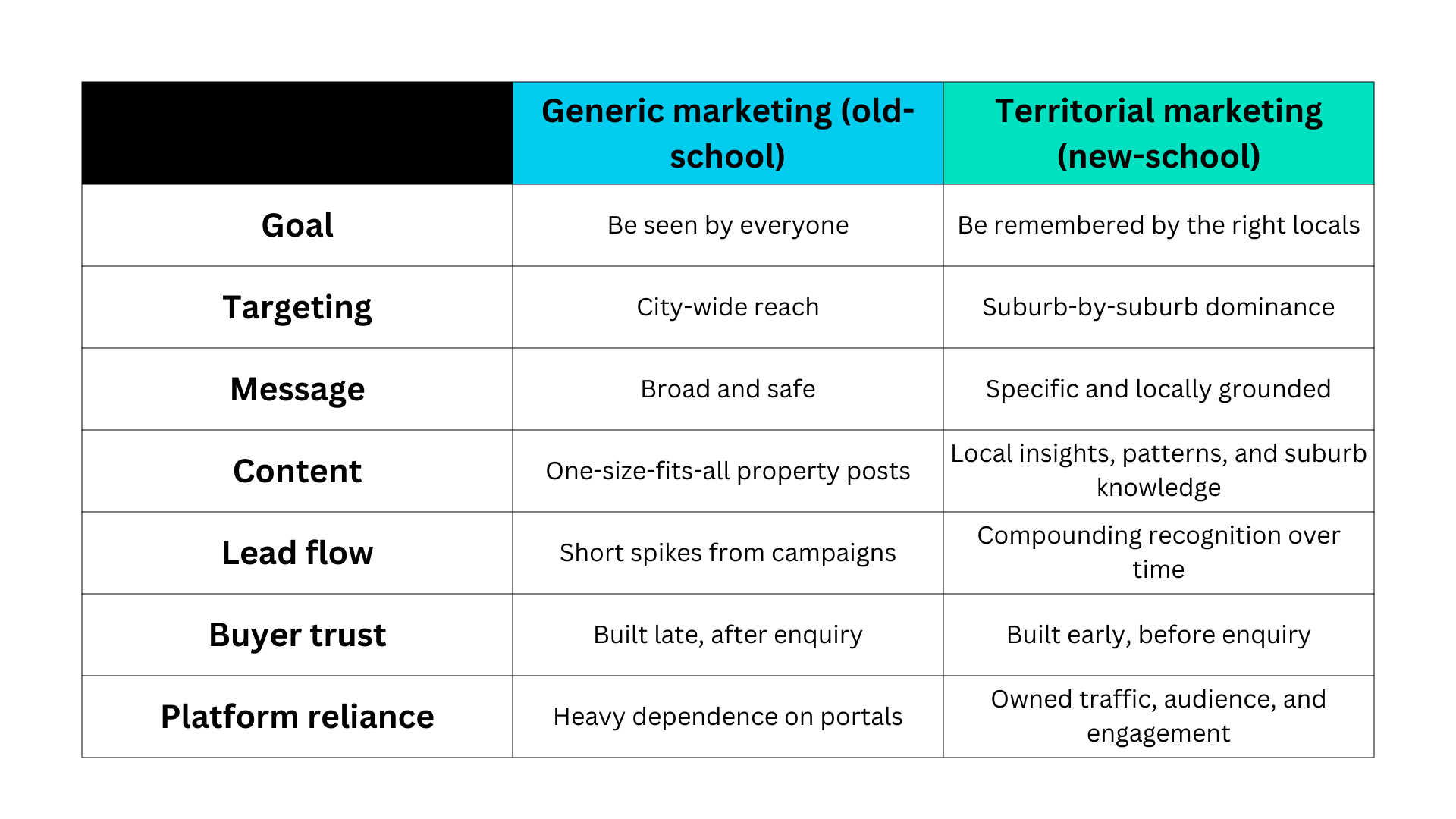
Understanding this shift sets the foundation. Buyers rarely enquire the moment they become interested. They observe first, compare quietly, and move when they feel confident. That is why suburb authority influences decisions long before someone ever picks up the phone.
How Local Authority Shapes Decisions
Property buyers are becoming more cautious . Interest rates move, high property prices, borrowing power shifts, the risks are higher today more than ever. In uncertain conditions, people look for signals that reduce risk. Local expertise does exactly that. An agent who understands how one suburb behaves in different market cycles feels safer than one that speaks in averages across an entire city.
Migration has intensified this need. Many buyers are no longer upgrading within familiar neighbourhoods. They are relocating across cities, states, or countries. These buyers are not searching for properties first. They are searching for understanding. They want to know where to live, what it costs to run a household, how streets feel on a weekday, and which areas hold value. Familiarity lowers perceived risk, which is why agencies that focus on a few suburbs win trust faster.
Property discovery now happens in layers. Early exposure comes from short-form video and social content that makes a suburb feel recognisable. Mid-stage research moves into Google searches, AI tools, and suburb-specific queries. Buyers ask direct questions about liveability, pricing, and demand. Late-stage validation is physical and reputational. Signboards, sold stickers, local mentions, and word of mouth confirm that an agency is active where it claims to be.
AI is tightening this funnel further. When buyers ask for suburb recommendations, AI tools summarise information instead of sending them to ten different links. These summaries rely on clear, structured, and consistent local content. Agencies that publish suburb-specific insights on their website and social media repeatedly become trusted sources, even when they are not named directly. This is where local authority compounds. The more precise and consistent the suburb focus, the more likely an agency becomes a reference point in how buyers learn. That shift changes how marketing today must be built from the ground up.

The Three Pillars of Territorial Real Estate Marketing
Territorial real estate marketing works when strategy comes before tactics. Posting more content, running more ads, or listing on more platforms rarely fixes weak results. Agencies that win locally build their marketing on a few clear pillars and let everything else support them. These pillars shape how buyers experience the brand long before a client conversation begins.
Pillar 1 – Authentic Social Media Content Focused on Area and Expertise
Local audiences respond to familiarity, not production value. A simple video that mentions a street name, a school zone, or a known traffic pattern signals real experience. Repeating suburb names, landmarks, and local rhythms trains both algorithms and people to associate the agency with that area. Over time, the agency feels less like a broadcaster and more like a neighbour who knows what is happening.
Pillar 2 – Relentless Local Visibility Online and Offline
Buyers trust brands they see repeatedly in their environment. Offline and online. A signboard on the way to work. A local Facebook ad that mirrors the same suburb language used on social media. A website page that appears when they search a specific location. Digital visibility reinforces physical presence, and physical presence improves digital performance. Recognition builds before intent, which is why many enquiries feel familiar from the first interaction.
Pillar 3 – Owning Listings and Engagement Through Your Website
Marketplaces attract attention, but they control it. When listings don’t just happen on realestate.com.au but live on an owned platform, agencies shape the story, collect first-party data, and continue the relationship beyond a single enquiry. Listings become engagement assets when they educate, invite interaction, and connect buyers to the wider suburb narrative.
With these three pillars in place, execution becomes clearer. The focus shifts from chasing visibility to building attention that compounds and supports consistent local growth.

High-Performance Content Frameworks for Real Estate Marketing Local Authority
Local authority comes from content that feels specific and useful. Strong real estate content focuses on one idea, one location, and one clear takeaway. This makes the agency easier to recognise and easier to trust over time.
The best formats are grounded in local relevance. Micro-property tours highlight a single feature buyers care about in that suburb. Lifestyle POV videos show everyday moments that help people imagine living there. Neighbourhood deep dives answer practical questions around cost, safety, walkability, and demand. Market explainers break down suburb data using simple charts, while renovation ROI content shows what improvements actually pay off locally.
Formatting matters as much as topic choice. Vertical video should be the default. Each piece should deliver one clear message without filler. Suburb context should feel natural through language and visuals rather than forced repetition.
Turning Content Into a Real Estate Marketing Conversion Funnel
Content only becomes valuable when it leads somewhere. In real estate, that path is rarely direct. Most buyers and sellers do not wake up ready to enquire. They notice an agency repeatedly, absorb information quietly, and only act when timing and confidence align. A conversion funnel connects those early moments of attention to inspections and conversations later on.
Cold content builds recognition before intent exists. Suburb reels and lifestyle POVs sit naturally in a feed and introduce the agency without pressure. They familiarise viewers with locations, rhythms, and perspectives. Most importantly they give value. When people start thinking seriously about buying or selling, the agency already feels authoritative and trustworthy rather than new.
Warm content is where trust forms. Walkthroughs, neighbourhood deep dives, and market explainers show depth and clarity. This content answers the questions buyers are already asking but struggling to phrase. It positions the agency as competent and reliable at the exact moment people begin to compare options quietly.
Hot content converts that trust into action. Listing announcements, inspection invites, FAQs, and social proof give clear next steps. At this stage, the audience is smaller but more serious. The message can be direct because the groundwork has already been laid.
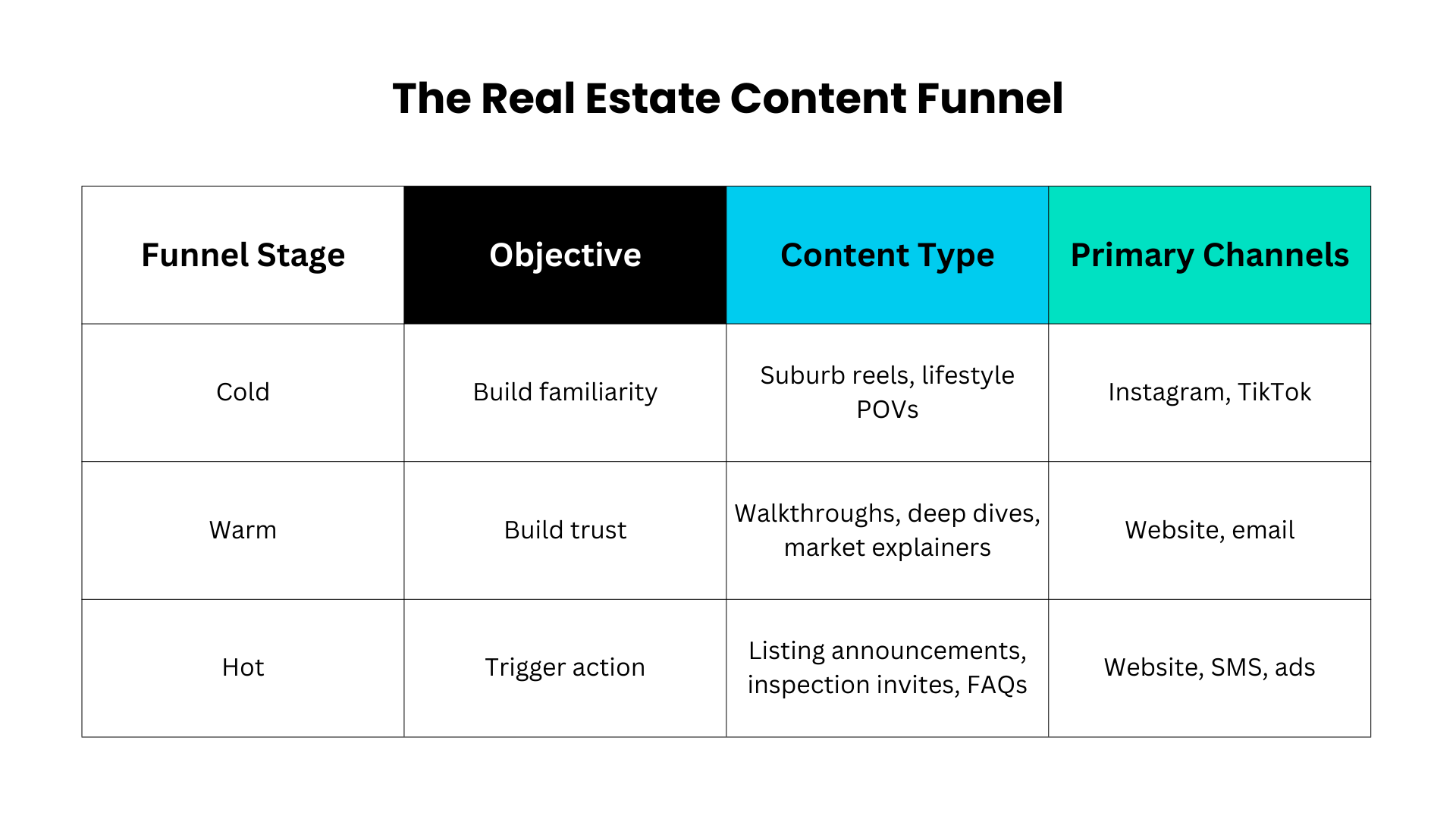
Agencies struggle when they skip the middle. Jumping straight from awareness to listings leaves buyers unconvinced and disengaged. Warm content fills that gap and turns attention into confidence. Once that bridge exists, visibility efforts begin to work harder and with less friction. That is where local presence starts to compound across both digital and physical channels.
Building a Sustainable Local Real Estate Marketing Engine
Territorial marketing scales quietly. As local recognition grows, agencies rely less on portals to generate demand. Enquiries arrive warmer because buyers already understand the area and trust the voice guiding them. Over time, cost per enquiry drops while conversion rates improve. Sellers notice this too. Agencies that feel embedded in a suburb attract listings because they appear active, informed, and present long before an appraisal takes place.
The next five years will amplify this effect. First-party data will matter more as platforms restrict targeting and tracking. Agencies that own their audience through websites, email, and direct engagement will have an advantage. Community-based visibility will continue to outperform broad campaigns as buyers seek familiarity in uncertain markets. AI tools will increasingly surface trusted local authorities when people ask questions about suburbs, pricing, and liveability. That trust will belong to agencies who consistently publish and participate at the local level.
Building this engine does not require complexity. It requires discipline and clarity. Agencies that define their territory and show up there consistently create momentum that compounds week after week.
For agencies ready to move beyond generic exposure and build a marketing system that reflects how real estate actually works locally, guidance can make the difference between effort and momentum. If you want help structuring or executing a territorial real estate marketing system that compounds over time, reach out for a conversation.