Marketers & Business Owners

Your phone rings during lunch. It’s another booking request. Later, you find a double-booked slot, an unanswered message, and a no-show that wasted an hour of your staff’s day. Multiply that by weeks or months, and you start to see why many businesses are turning to AI booking agents to alleviate the pressure. While this new tech claims to be the silver bullet to scheduling problems, can they deliver on the promise, especially when only 38% of people report being satisfied with chatbot support?
In this article, we’ll explore if AI booking agents really cut costs. Also, can they win customer trust despite doubts about AI? And most importantly, should all businesses adopt this technology?
What Is an AI Booking Agent?
An AI booking agent is like a digital assistant that manages reservations, schedules, and handles customer queries in real time. Unlike traditional booking systems that need manual inputs from staff members or the users, AI agents use natural language processing (NLP) to take input from customer interactions and turn it into context-aware responses that mimic what a real human agent will say.
The use cases vary per niche. A service-based business might use one to book appointments, a real estate agency to schedule property viewings, and a restaurant to handle table reservations. But the goal is the same, which is to help take admin pressure off staff while keeping customers satisfied.

What Are the Benefits That Make AI Booking Agents Attractive?
Because of the tangible improvements the technology offers, the use of AI booking agents is rapidly taking off across many industries. In tourism alone, over half of companies now use AI to assist customers during the booking process, and nearly 50% leverage it to recommend activities or venues.
So what makes them so appealing? Here are the core benefits that explain why AI booking agents are gaining ground with SMEs.
Provides 24/7 availability
Since AI agents don’t need to sleep nor take lunch breaks, they are available around the clock. While interactions with human agents are indispensable, their AI counterparts can be used to plug holes when they are not available, especially beyond business hours.
Reduces admin tasks
Much of a team’s time goes into repetitive admin like checking calendars, confirming appointments, chasing payments, etc. AI agents take over these routine tasks, especially when they are sync’d with scheduling tools and CRMs. The result? It frees up valuable time for your team so that they can focus on higher-impact work inside the business, or simply enjoy more time outside of it.
Increases booking conversions and decreases no-shows
AI booking agents don’t just make handling admin easier. They also directly improve booking outcomes. In fact, an analysis of 500,000 restaurant calls aided by AI shows that no-show rates can drop by as much as 30% within just 90 days of implementation. With instant responses, customers are less likely to drop off before confirming. After that, they can set reminders, offer rescheduling, and even handle cancellations. This combination not only boosts conversion rates but also keeps no-shows to a minimum.
Delivers customer insights
A big part of AI is its ability to learn from every interaction. Each customer interaction creates valuable data that businesses can use to improve their services. With these insights, managers can adjust pricing, staffing, or promotions.
Improves margins
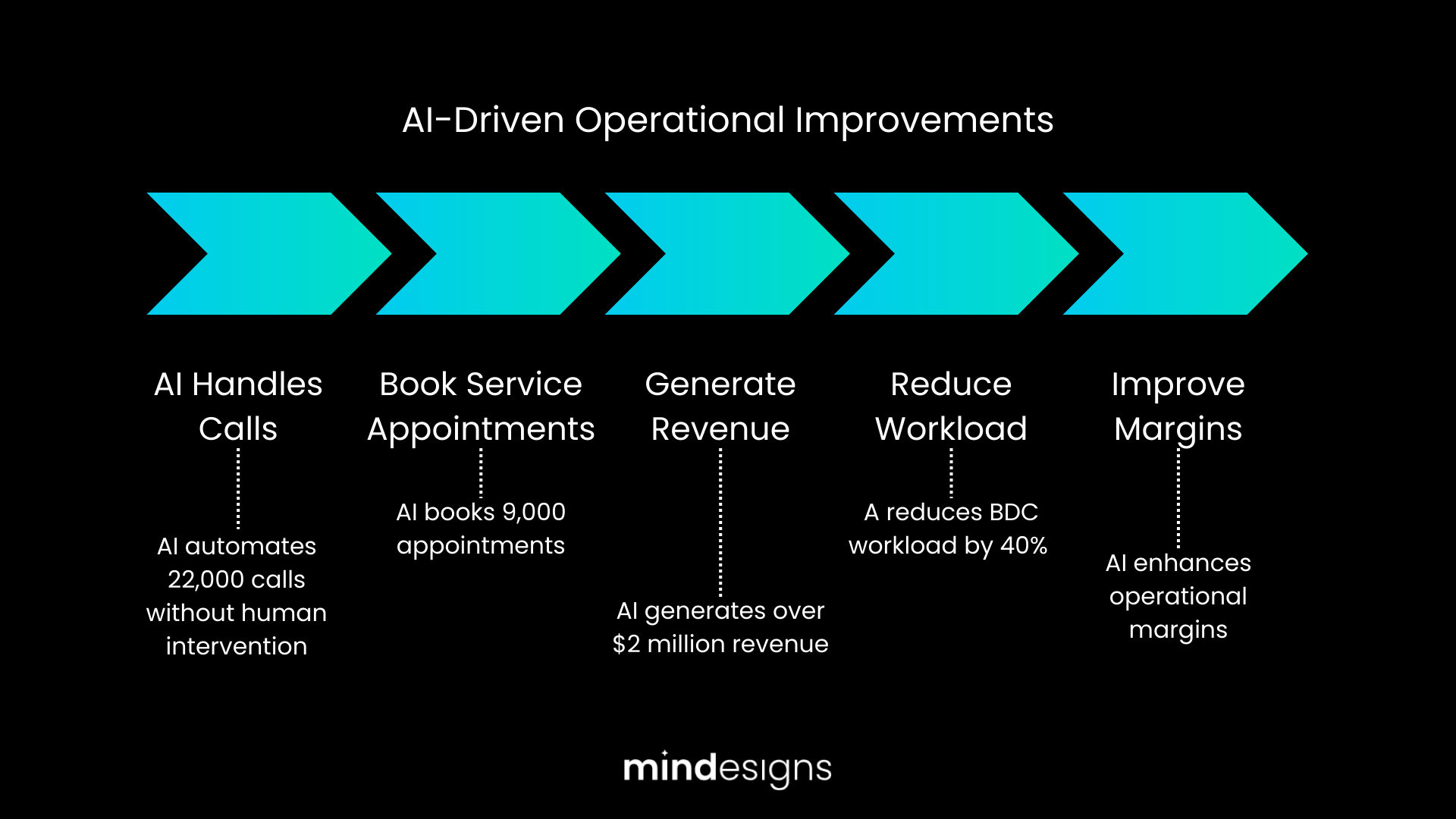
Ever since its adoption, AI has been touted as a stalwart tool of business scalability, thanks to its ability to drive higher output without increasing labour costs. In one case, an automotive group operating multiple dealerships used an AI booking agent to automate over 22,000 calls and book 9,000 appointments in just 90 days. The shift reduced staff workload by 40% and generated more than US$2 million in revenue.
What Are the Common Issues With AI Booking Agents?
While AI booking agents promise efficiency, several key risks deserve attention. Left unchecked, they can frustrate customers, damage trust, or even expose your business to fines and data breaches. In other words, having the wrong setup can create bigger problems than the ones you were trying to solve.
Accuracy and customer miscommunication
AI agents can misinterpret speech patterns, slang, or complex requests, leading to incorrect bookings or frustrated customers. Even beyond misfires and AI hallucinations, NLPs often lack emotional nuance, sometimes sacrificing the personal touch that builds rapport and trust
Integration with calendars, POS, and CRM
It’s easy to assume that traditional administrative errors like typos, missed follow-ups, and double bookings won’t happen with AI agents, but that is not always the case. AI agents are still liable to make these mistakes, especially if they are not synced with your company’s booking systems, point-of-sale system, and your CRM.
Security, privacy, and compliance
AI booking agents often handle sensitive details (i.e. names, contact information, payment details, even health or travel preferences). That means they fall under the scope of major data privacy laws worldwide, and businesses remain responsible for compliance regardless of the vendor they choose.
Some of the key frameworks include:
- GDPR (General Data Protection Regulation – Europe): strict rules on consent, data portability, and customer rights.
- CCPA (California Consumer Privacy Act – U.S.): gives customers rights to know, delete, and opt out of data use.
- Privacy Act 1988 (Australia): requires transparency around collection, disclosure, and security of personal data.
While the details differ, the underlying principle is the same everywhere, and companies must adopt a privacy-by-design approach to ensuring transparency, limiting unnecessary data collection, and protecting customer information through encryption, secure integrations, and access controls.
Brand perception and customer trust
The efficiency of AI should not come at the expense of customer goodwill. If interactions become too transactional or feel impersonal, clients can feel disregarded. Worse, they can alienate audiences, too. Your business may be perceived as cutting corners by replacing human care with automation. This perception is especially strong among customers who already worry that AI is “taking jobs” or that businesses use it as a lazy substitute for real service.
A recent survey highlights the trust gap between consumers and AI. Only 45% of shoppers trust AI-powered chatbots and recommendations, while just 38% report being satisfied with chatbot support. Transparency is a key issue, with 43% believing brands are not upfront about how data is used
For businesses adopting AI booking agents, this means trust and transparency must be built into every interaction. Otherwise, the efficiency gains may come at the cost of long-term customer loyalty.
The Cost of AI Booking Agents
Investing in an AI booking agent can look far cheaper than hiring a human agent, but the real costs and trade-offs aren’t always so straightforward.
More importantly, it is a tool that may or may not be right for your business. For smaller or newer companies, the upfront costs and integration work can outweigh the gains, especially if there is just a low volume of bookings. You should also take the following factors into consideration.
Subscription and platform fees
Most AI booking agents operate on a subscription model. Entry-level plans typically start at AU$40–$80 per month, while advanced platforms with voice capabilities, CRM syncing, and analytics can cost several thousand dollars per month.
To put that into perspective:
|
Human Agent |
AI Booking Agent |
| AU$3,800–$5,000 per month
(before benefits) |
AU$39 – $3000+ per month
(depends on features and add-ons) |
At face value, AI booking agents can look dramatically cheaper, yet can still handle dozens, even hundreds, of bookings per week.
The key is scalability. A human agent caps out at a certain number of calls or messages per day, while an AI system can continue handling requests at scale without requiring overtime or additional headcount. This means the ROI isn’t just about replacing labour costs, it’s about absorbing growth without adding new staff and freeing employees to focus on higher-value work.
Implementation and integration setup
Getting the AI booking agent up and running often requires integrating it with your existing systems and platforms. This technical help often requires hefty professional fees. Some providers include basic integration in higher tiers, but more complex systems may require agency help or developer time. Setup fees can range from a few hundred to several thousand dollars, depending on complexity.
Ongoing support, training, and optimisation
While the most common USP of AI is automation, AI agents are not “set and forget.” They require regular fine-tuning to remain effective and aligned with your customer journey lest they go rogue. A well-known example is Microsoft’s Tay chatbot, which went offline after failing to handle unmonitored interactions appropriately.
- To prevent this from happening, you must do these regularly:
- Update service lists, pricing, or promotions
- Train the AI on new FAQs or customer behaviour patterns
- Monitor and refining response accuracy
- Analyse reports and optimise workflows
These activities may be handled internally or through vendor support packages, which often come at an additional monthly fee.
Common Platforms & Brands in the AI Booking Agent Space
AI booking tools are popping up like mushrooms, with new contenders launching every once in a while. We chose this handful of AI booking platforms because they stand out as the most trusted, widely used, and best-reviewed options on the market. Here are some of the top contenders.
Conversica
Conversica is an enterprise-grade solution designed for scale, widely used in industries like automotive and real estate where multiple lead follow-up and high booking volumes are the norm. It offers multi-channel engagement and advanced analytics, positioning itself as a premium platform for larger businesses with complex needs.
Salesforce (Agentforce)
Agentforce is Salesforce’s AI platform for creating autonomous agents within its ecosystem. It integrates directly with business data, supports bookings and customer service, and includes safeguards like the Einstein Trust Layer and Command Center. Adoption is growing fast with 8,000 customers already using it, and within Salesforce it now handles up to 50% of workloads.
Jotform AI Agents
Jotform AI Agents extend the company’s well-known form builder into booking workflows. The platform is particularly useful for SMEs seeking simple, form-driven AI assistants that handle scheduling and FAQs. With entry-level access and scalable tiers, it sits in the affordable-to-midrange bracket, appealing to businesses starting small but planning to grow.
Relevance AI
An Australian startup, Relevance AI focuses on customisability and multi-agent workflows, making it ideal for technical teams and agencies. It can support enterprise-grade authentication and complex deployments, but also offers accessible entry points for experimentation. This places it in the midrange to premium category, depending on how deeply businesses customise their use.
So, are AI Booking Agents Worth It?
AI booking agents can absolutely deliver value, but their impact depends on the type of business you run and how your customers respond. For business with high-volume clients like, salons, dental clinics, and agencies, the efficiency gains may far outweigh the risks.
On the flip side, some businesses may require more nuanced information. For example, fine dining restaurants may need allergy information, dietary restrictions, or take special instructions into account. Moreover, customers in luxury niches expect personal interaction as part of the experience, which makes automation feel out of place. Adopting an AI booking agent is less about whether your business is “ready” and more about whether the trade-off makes sense. It’s a calculated risk: explore where automation enhances service without eroding the human touch, and weigh whether the efficiency boost is worth it in your specific context.
If you’re exploring how AI tools like booking agents can fit into your digital strategy to boost sales or to automate your processes, Mindesigns would love to support you. Book your free session today and let’s build something that actually works and helps your business grow.