For Marketing Leaders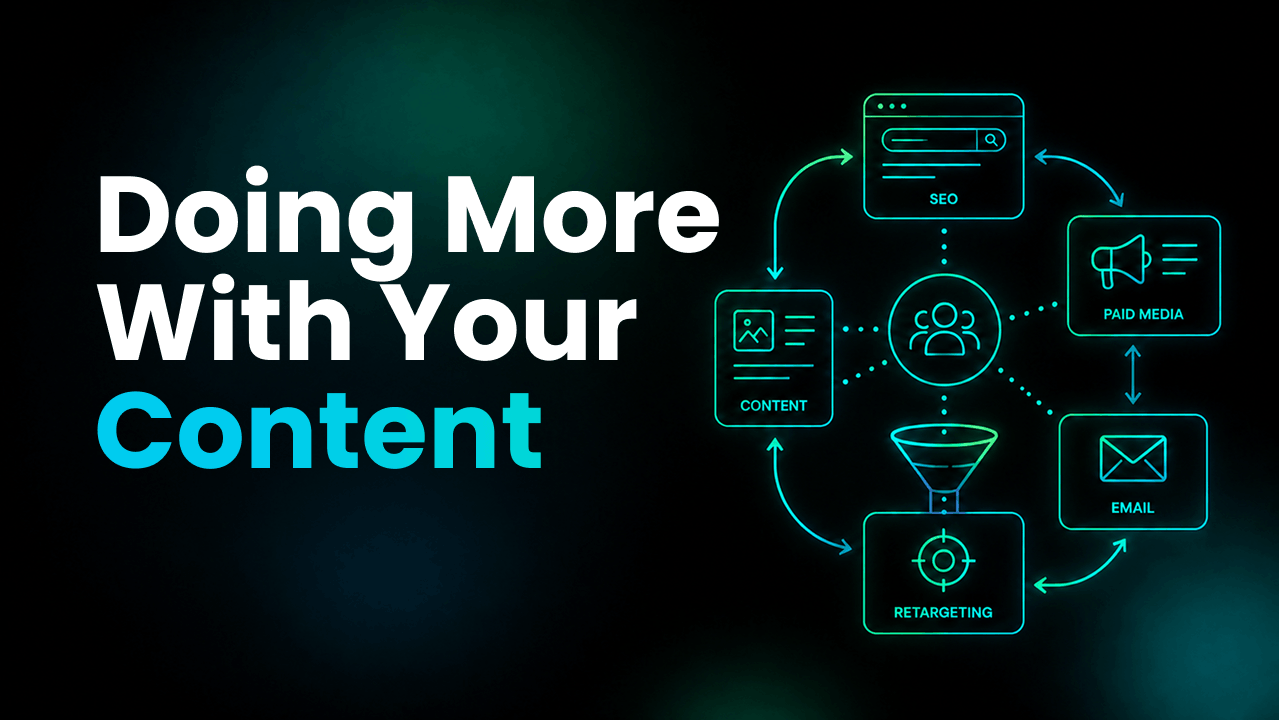
Over the last year, we’ve been reworking more of our own campaigns around an omni-channel model. We wanted Mindesigns to be present in more places, but in a way that felt connected and intentional rather than simply adding more platforms for the sake of visibility.
Even with that in mind, we quickly realised that adding more channels often created more marketing activity without necessarily improving momentum. And it’s not just us. We have seen this across more than 100 client engagements. Most businesses do not have a channel problem. They have a coordination problem. The channels are working individually, but they are not working together..
So, how did we start adjusting our approach to make everything work together more effectively?
In this article, we’ll walk through some of the biggest lessons we’ve learned while building more connected omni-channel campaigns, including channel structure, content workflows, attribution, retargeting, and how to measure growth beyond surface-level engagement metrics.
Build the Growth System Before You Choose the Channels
In the past, like many marketing teams, we would often start with the platforms first. What are we posting on LinkedIn? What campaigns are running on Meta? What SEO content are we publishing this month?
The problem was that even though each activity made sense individually, they did not always connect into a larger growth system. Some channels were overlapping, while other parts of the customer journey were barely supported at all.
One adjustment that helped was defining the growth outcome much earlier in the planning stage. Whether the goal was booked demos, qualified leads, enrolment enquiries, or quote requests, working backwards from one conversion outcome made it easier to decide what role each platform actually needed to play.
Instead of treating every channel as a direct lead generation tool, we started separating platforms by function.
|
Channel / Platform |
Primary Role in the Journey |
Messaging Focus |
|
SEO and Organic Search |
Capture existing demand |
Educational, search-intent driven, solution-aware content |
|
Google Ads |
Capture high-intent traffic |
Direct problem-solving messaging with clear service intent |
|
|
Build authority and nurture awareness |
Industry insights, thought leadership, and strategic perspectives |
|
Meta Ads |
Create and amplify demand |
Pain points, brand positioning, and attention-grabbing concepts |
|
Retargeting Campaigns |
Continue the conversation |
Objection handling, proof points, and next-step messaging |
|
Email Marketing |
Nurture and educate warm audiences |
Relationship-building content and deeper educational material |
|
Landing Pages |
Convert interest into action |
Clear outcomes, trust signals, and conversion-focused messaging |
Once we started assigning clearer roles to each channel, the next challenge was figuring out how they should work together over time. That became the foundation for what we now refer to internally as the Mindesigns Omni-Channel Growth Loop.
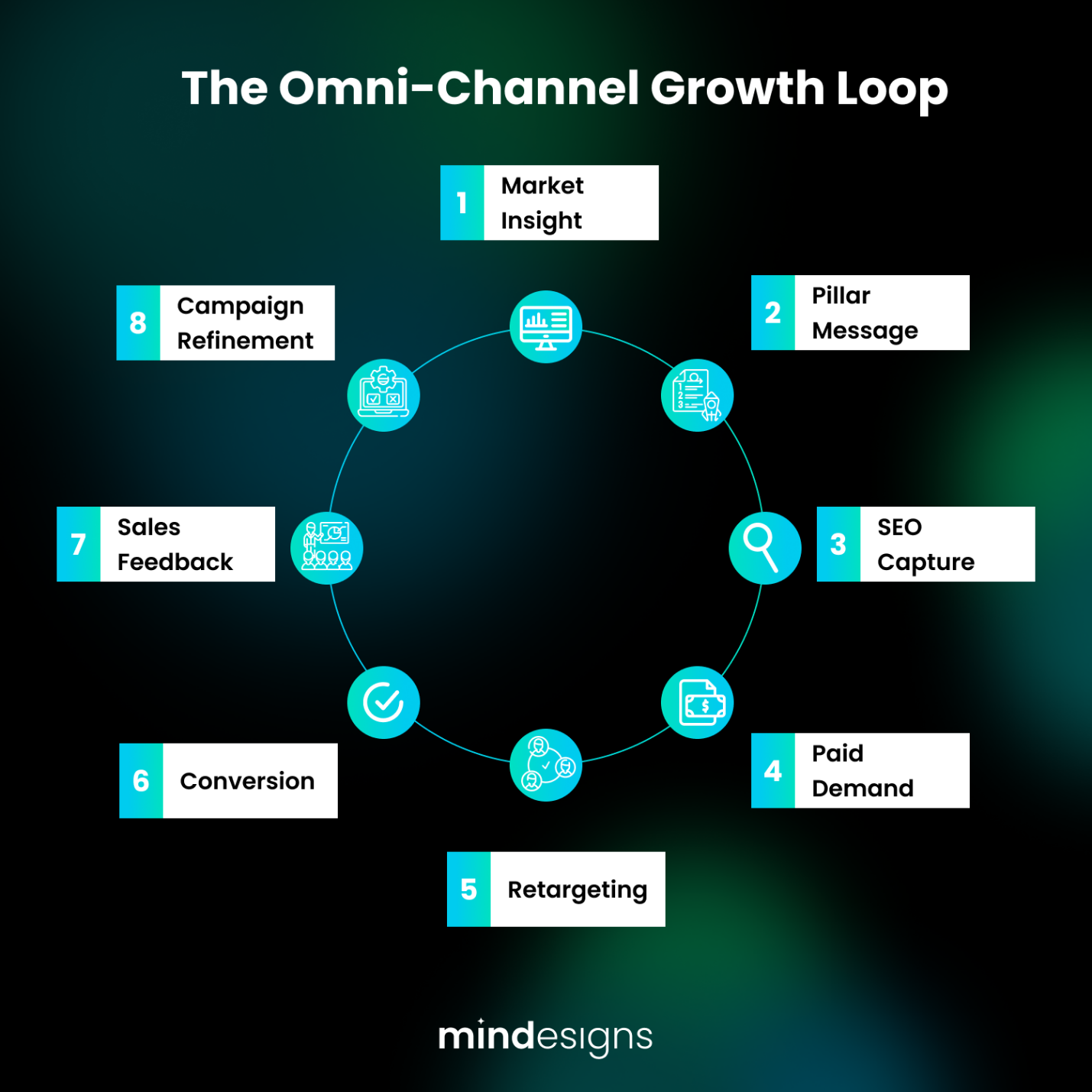
- Market Insight – Identify the audience tension, challenge, or opportunity driving the campaign.
- Pillar Message – Develop one core message that every channel can reinforce.
- SEO Capture – Convert campaign insights into searchable content assets that build long-term visibility.
- Paid Demand – Use paid media to accelerate awareness and reach new audiences.
- Retargeting – Continue the conversation based on previous engagement and behaviour.
- Conversion – Guide audiences toward a clearly defined next step.
- Sales Feedback – Capture insights from enquiries, stakeholder conversations, and sales interactions.
- Campaign Refinement – Use performance data to improve future content, targeting, and messaging.
The loop is less about adding more marketing activity and more about creating continuity between channels. This led us to treat channels as connected stages within the same customer journey instead of isolated campaign activities.
Create One Pillar Asset, Then Cascade It
Another thing we started noticing internally was how easy it is for content production to take over the strategy itself. When you are managing SEO, paid campaigns, social media, email marketing, and creative production at the same time, the pressure to keep every platform active can quickly become the main focus.
What helped us was simplifying the process around one central idea instead of treating every channel as its own separate campaign. Rather than creating completely different content for each platform, we started building one strong pillar asset first, then adapting it across channels.
Here’s how we turn one long-form blog article into multiple pieces of content:
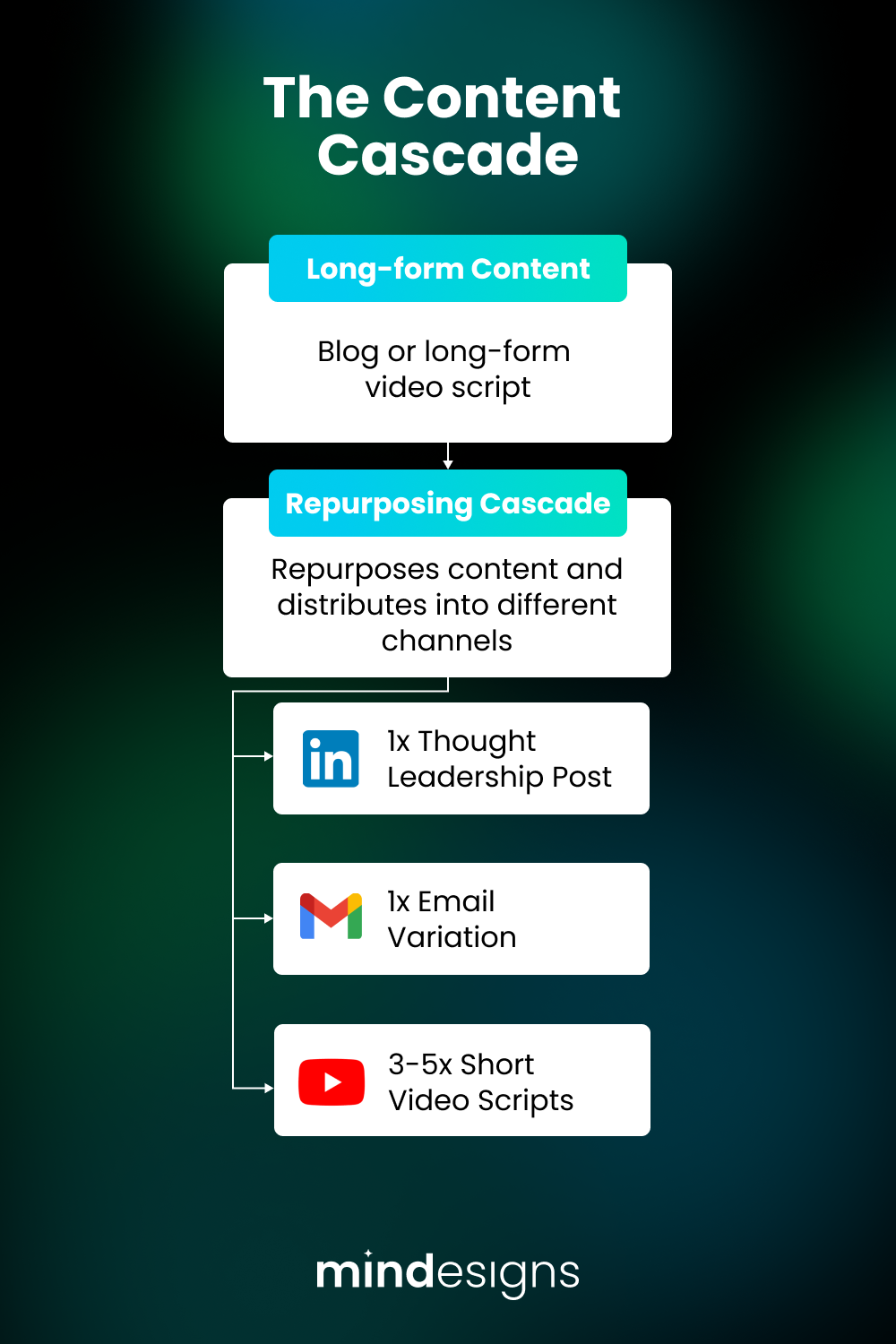
That gave us seven to eight content assets from one strategic idea instead of creating separate creative briefs for every platform each week. The immediate benefit was being able to increase content output without dramatically increasing production workload.
Here’s What the Content Cascade Looks Like in Practice
We’ve applied the content cascade across multiple clients. We have seen a single strategic asset generate visibility, engagement, stakeholder amplification, and long-term search value without requiring entirely separate campaign concepts for each channel.
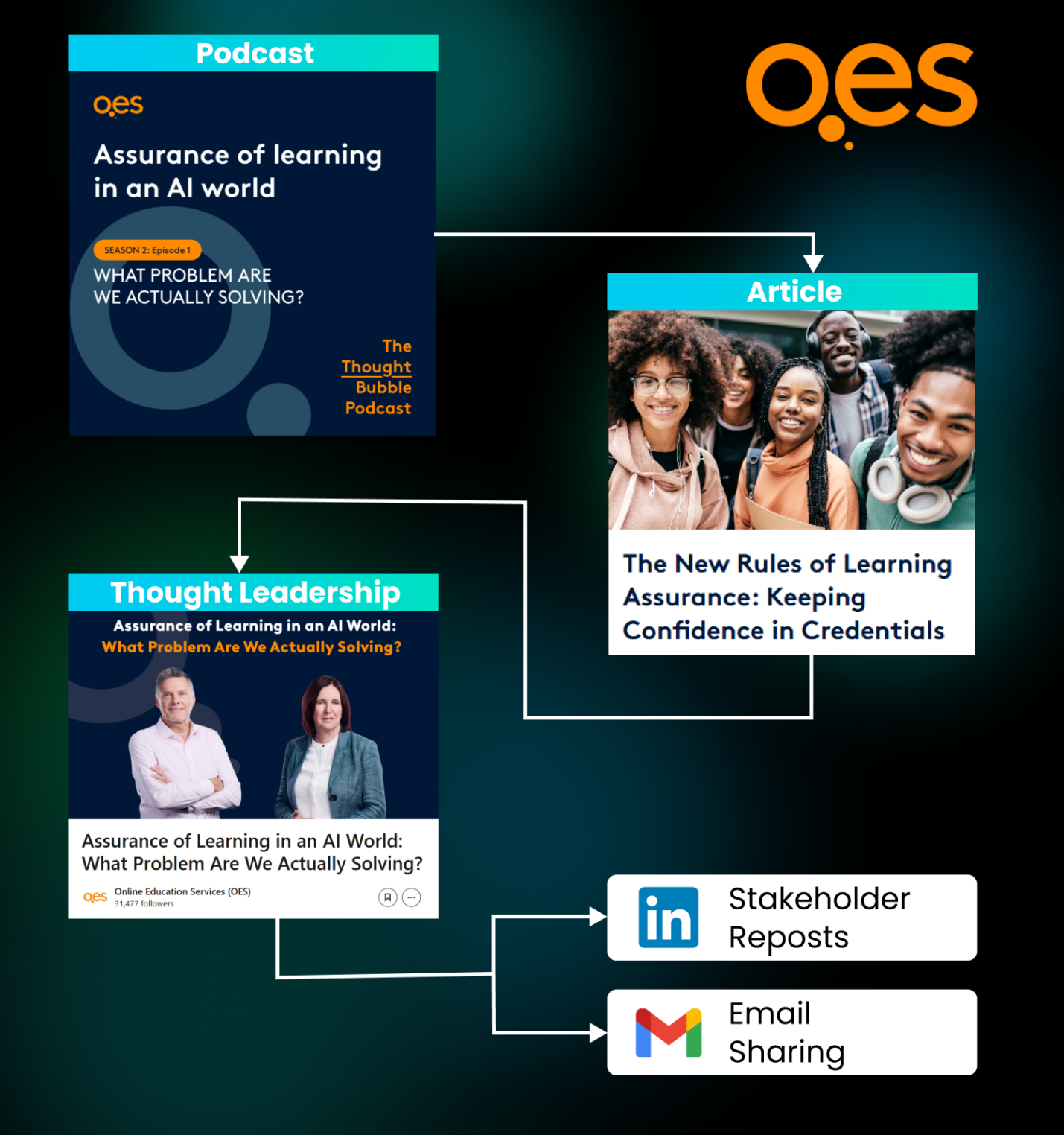
For OES, a Thought Bubble podcast episode discussing AI and assurance of learning became the anchor asset for a broader content campaign. The discussion was expanded into a long-form Q&A article on the OES website, creating a searchable resource that could continue generating value beyond the initial recording.
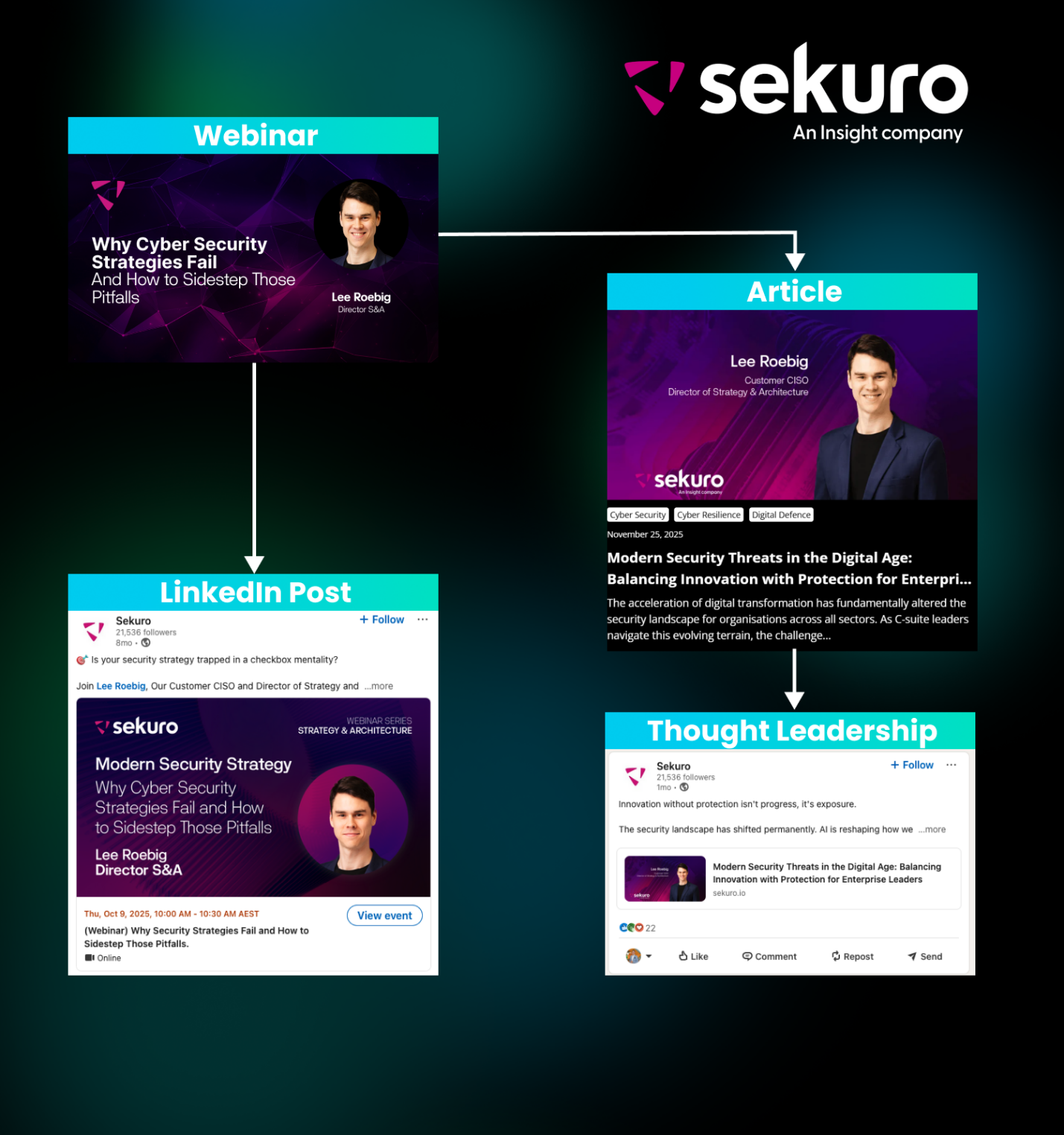
Similarly, we turned a webinar from Sekuro and it became the foundation for multiple supporting content pieces. The insights were repurposed into supporting articles, integrated into broader marketing workflows, and used to reinforce thought leadership around cybersecurity and organisational risk.
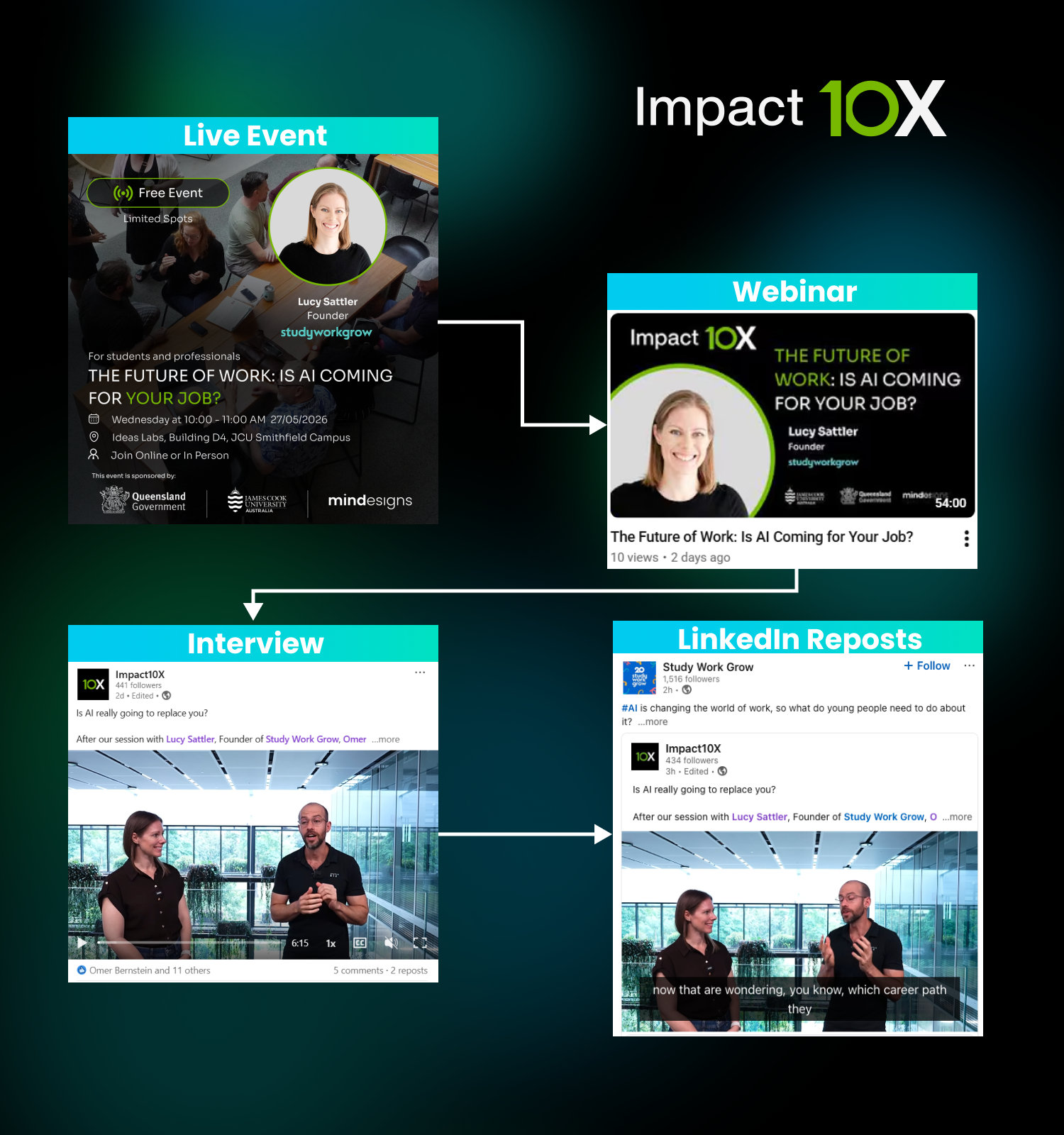
For Impact10X, a live event exploring the impact of AI on future careers became the foundation for a broader content campaign. The session was recorded and repurposed into a webinar, followed by an interview discussing the key themes and insights that emerged from the event. The content was then distributed through LinkedIn and partner networks, generating more than 150 registrations, over 80 event attendees, and new conversations with schools, universities, and industry stakeholders interested in future workforce development.
A common thread across all three campaigns was stakeholder participation. Once the core content was created, internal teams, executives, partners, and industry advocates helped distribute the message through their own networks. This extended reach beyond the organisation’s owned channels, increased credibility through third-party endorsement, and helped create the kind of organic amplification that many paid campaigns struggle to achieve on their own.
Adopt Journey-Based Measurement
One thing this process highlighted very quickly was how difficult omni-channel reporting becomes when attribution is viewed too narrowly. As more touchpoints became involved in the customer journey, we found ourselves needing a clearer picture of how channels were influencing each other, not just which platform received the final click before conversion.
Because of that, we started focusing less on isolated platform metrics and more on channel contribution. This has changed the way we evaluated performance. An SEO article might not generate direct enquiries on its own, but it could still play an important role in building trust before conversion. A Meta campaign with high reach might still be valuable if it improves retargeting performance or increases branded search activity later in the funnel.
|
Channel |
Assigned Role |
Commercial Value |
Contribution Score |
|
Meta Ads |
Create demand |
Supports top-of-funnel awareness |
High |
|
SEO Article |
Capture research intent |
Builds trust before enquiry |
High |
|
Google Ads |
Capture high-intent demand |
Direct lead generation |
Very High |
|
Retargeting |
Continue the conversation |
Improves conversion efficiency |
Medium |
|
Email Marketing |
Nurture warm leads |
Strengthens lead quality |
Medium |
Tools like Google Analytics 4 became important for understanding how channels contributed across the customer journey instead of relying too heavily on final-click attribution.
To better understand that journey, we focused on:
- Setting up consistent UTM tracking across campaigns
- Defining key conversion events inside Google Analytics 4
- Separating awareness, consideration, and conversion touchpoints
- Tracking assisted conversions rather than only final-click conversions
- Comparing lead quality across channels, not just lead volume
This helped us move away from evaluating platforms in isolation and towards understanding how channels supported each other across the funnel.
Use Retargeting to Continue the Argument
One thing we noticed when first reviewing retargeting campaigns for some clients was how often the strategy relied on repeating the same message over and over again. Someone would visit the website, not convert, and then continue seeing the same “Book a Call” or “Get a Quote” ad for the next few weeks.
At first glance, that approach makes sense. But in many cases, the issue was not awareness, but that there was still hesitation somewhere else. They might still be comparing providers, researching options internally, or trying to better understand whether the solution was the right fit for them.
That changed the way we thought about retargeting. Instead of treating it as a reminder system, we started approaching it more like a continuation of the customer journey. The goal became delivering the next useful piece of information based on what the customer had already engaged with.
|
Customer Behaviour |
Likely Mindset |
Better Retargeting Approach |
|
Visited pricing page |
Comparing options and evaluating fit |
Show proof points, FAQs, or comparison messaging |
|
Downloaded a guide |
Interested but still researching |
Share case studies, outcomes, or deeper educational content |
|
Watched a video ad |
Early-stage awareness |
Introduce clearer service explanations or pain points |
|
Abandoned enquiry form |
Interested but hesitant |
Reduce friction with a softer CTA or reassurance messaging |
|
Read multiple SEO articles |
Looking for expertise and trust |
Promote authority-building content or client success stories |
This was another area where the content cascade approach became valuable. Because campaigns were already built around one central idea, we naturally had supporting content available for retargeting, including FAQs, proof points, comparison angles, customer outcomes, and objection-handling content.
We also found that effective retargeting depended heavily on cleaner audience data and better tracking infrastructure. As privacy updates continue to reduce the reliability of third-party tracking, first-party data, properly configured events, and clearer audience segmentation have become increasingly important for maintaining retargeting performance across channels.
In practice, this meant segmenting audiences around actions like guide downloads, pricing page visits, video engagement, and enquiry activity instead of broad website traffic alone. Proper event tracking through tools like Google Analytics 4 and Meta Ads Manager helped make those audiences more useful over time.
Turn Campaign Learning Into the Next Growth Cycle
With all of these interconnected channels, touchpoints, and customer journeys, reporting started taking on a far more central role in our process.
That led us to develop what we now refer to internally as the Mindesigns 30-Day Omni-Channel Optimisation Rhythm. Instead of treating campaign reporting as a retrospective exercise, we started using it as the planning engine for the next campaign cycle.
One of the most valuable optimisation loops came from feeding high-performing paid media angles back into SEO. Strong Google Ads headlines, Meta creatives, and retargeting messages often became landing page copy, FAQs, SEO articles, and sales content.
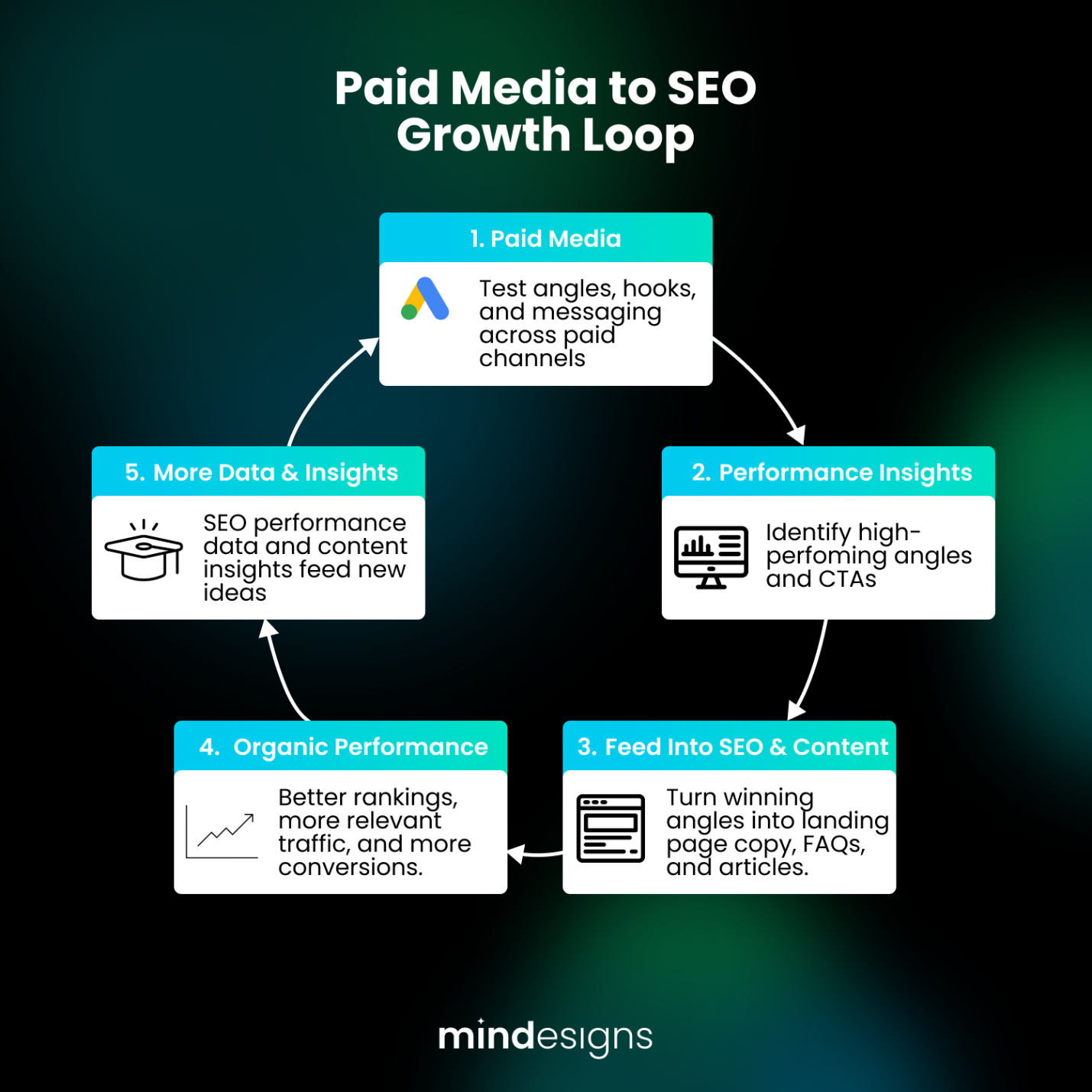
The reverse became equally valuable. Search queries, SEO engagement, and organic content performance regularly revealed the language customers were already using, helping improve Google Ads messaging, Meta hooks, email campaigns, and retargeting copy.
Each campaign cycle generated more reusable messaging, stronger audience insights, refined targeting, and higher-performing conversion assets instead of producing a collection of disconnected one-off creatives.
The Goal Is Not More Channels, But Better Alignment
If you’re managing three or more marketing channels and your attribution reporting still feels inconclusive, the problem may not be channel performance. It may be channel alignment.
At Mindesigns, we help organisations map how SEO, paid media, content, retargeting, email marketing, and stakeholder engagement work together as one measurable growth system.
Speak with Mindesigns about reviewing your current channel structure and identifying where opportunities for stronger alignment already exist.
Reviewed by Omer Bernstein