For Marketing Leaders
Written By Omer Bernstein, Head of Marketing and Sales at Mindesigns
Omer has led integrated brand awareness, outdoor advertising, and digital growth campaigns across Australia, helping businesses connect billboard visibility with measurable search demand, lead generation, and retail performance.
My personal hot take: too many discussions around billboard advertising focus only on visuals and clever concepts. After working on integrated outdoor campaigns across Australia, I have seen visually impressive billboards fail commercially because they were disconnected from audience behaviour and they don’t have any measurable follow-ups. What interests me more is why certain campaigns generate results and how outdoor advertising connects with broader marketing systems.
A billboard can look visually impressive and still fail commercially if there is no strategic thinking behind it. In my experience leading billboard marketing campaigns at Mindesigns, outdoor advertising performs best when it is treated as part of a connected ecosystem rather than a standalone awareness exercise.
In this guide, I’ll break down what makes billboard campaigns effective, from smarter placement and stronger creative through to digital follow-up and measurable results.
Let’s start with a mistake I see constantly in outdoor advertising. Location is one of the most important parts of billboard strategy, yet many brands still fail to use it to its full potential.
Make the Billboard Location Carry Part of the Message
One of the smartest billboard campaigns in recent years came from McDonald’s and it barely looked like advertising at all. In the “Follow the Arches” campaign, fragments of the Golden Arches logo were transformed into directional cues that guided drivers toward nearby restaurants.
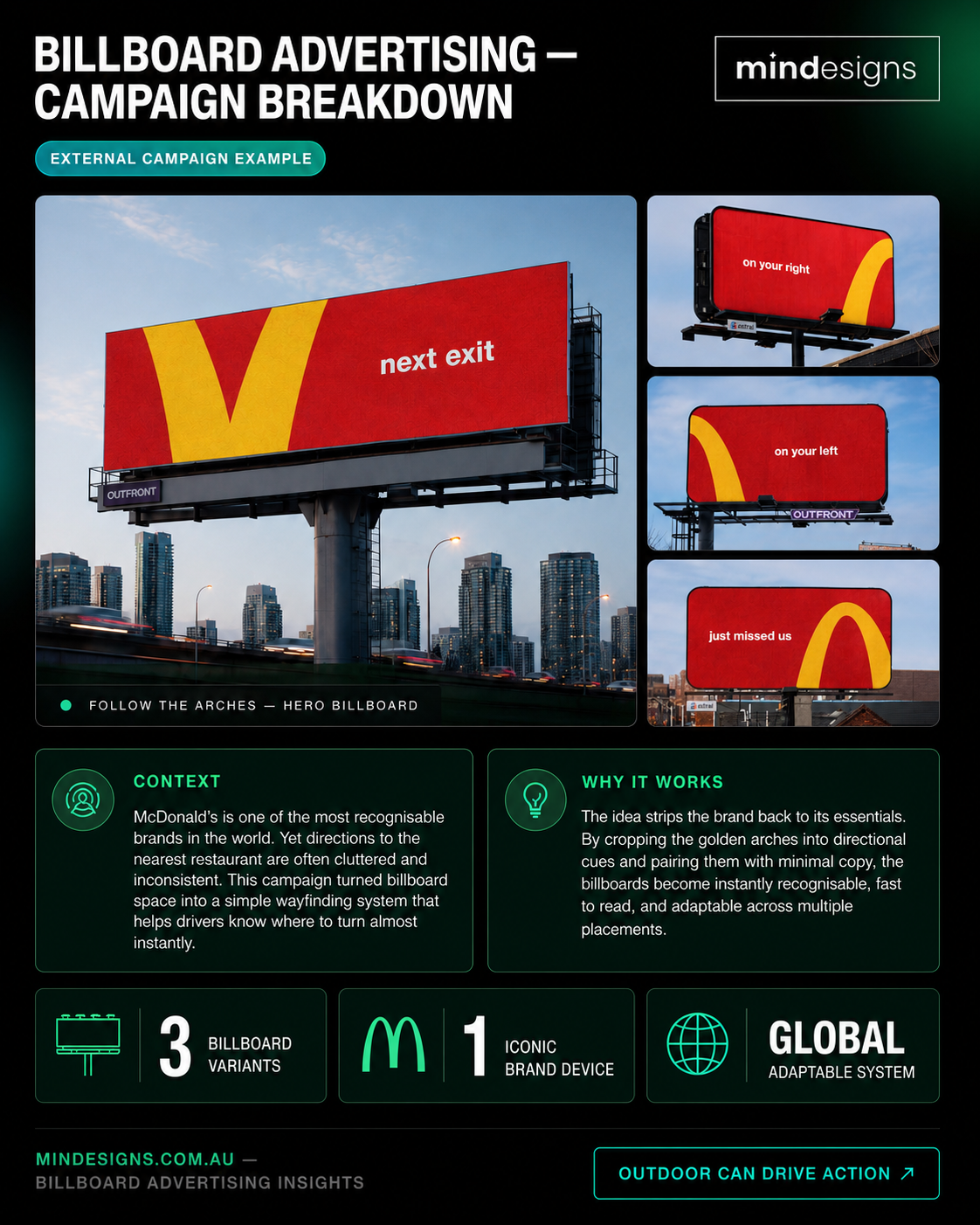
Images from adsoftheworld.com
What made the campaign so effective was not just its clever use of branding and recall but also using its location context to its advantage.
Highway billboards are usually valued for their high traffic and visibility. But instead of placing a generic brand ad in front of passing drivers, McDonald’s used those placements to reduce next-step friction and encourage immediate action by directing audiences to nearby branches. The company understood that drivers on highways are not looking for a brand story or a long sales pitch, so they play to their impulses instead. The creative worked because it matched the mindset of the audience in that exact environment.
This is the same principle we at Mindesigns call the Location-Message Fit Framework. Before developing billboard creative, we look at factors the following factors:
- Audience density
- Traffic speed
- Dwell time
- Buying context
- Competitor proximity
- Next-step friction
The goal is to understand not just where the billboard is placed, but what the audience is likely thinking and doing in that moment.
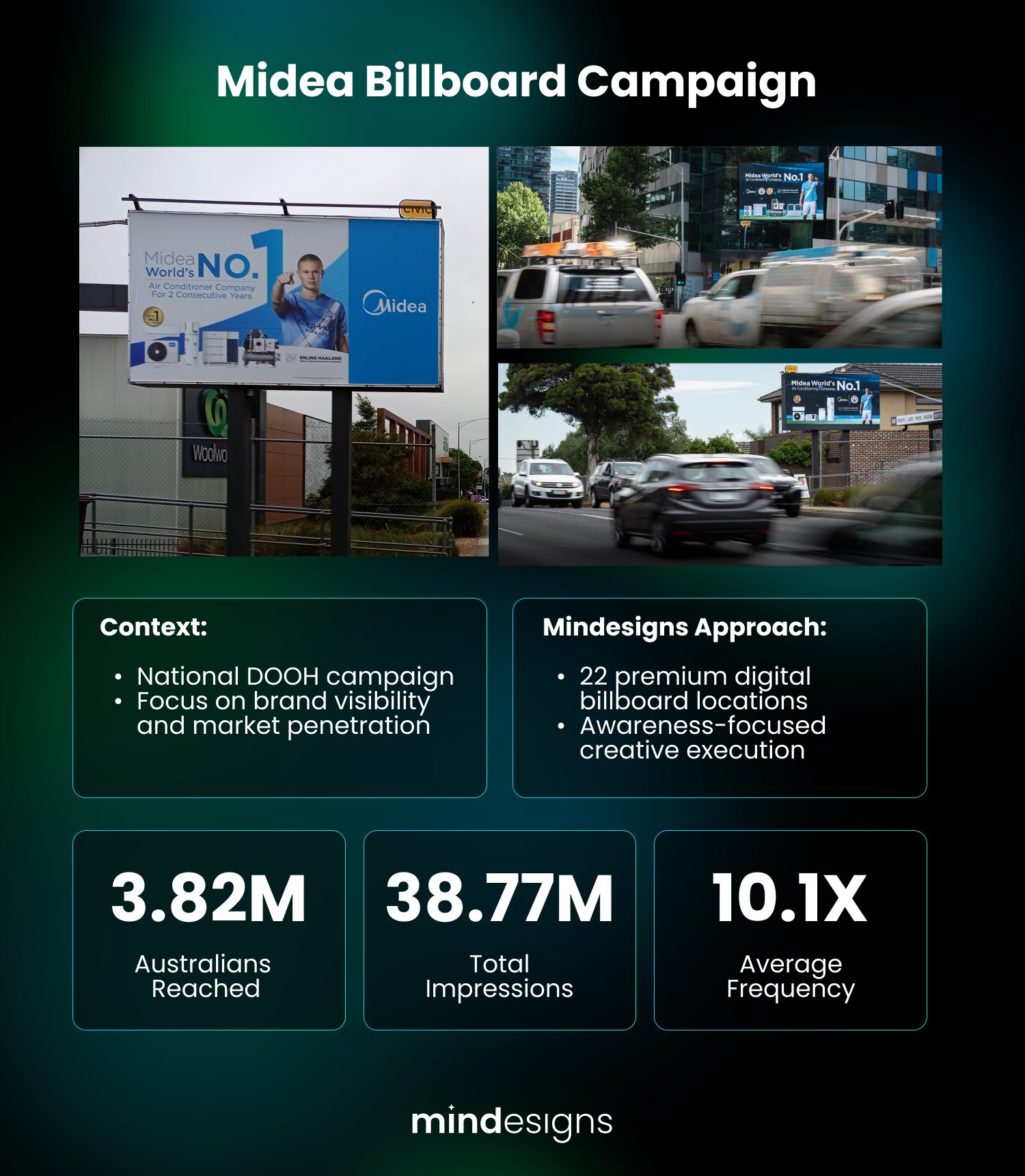
We applied similar thinking during a recent campaign for Midea as the brand continued strengthening awareness across Australia. Rather than simply selecting sites with the highest traffic volumes, placements were chosen to maximise exposure among appliance buyers in key metropolitan markets where retail distribution and consumer demand already existed. The campaign ultimately reached more than 3.8 million Australians with an average frequency of 10.1 exposures per person, helping build familiarity before consumers entered the research and purchasing phase.
This is not a one-size-fits-all approach. A fast-food brand like McDonald’s may use highway billboards as directional prompts because the buying decision is low-friction and often impulsive. A car brand, on the other hand, operates within a much longer buying cycle. Instead of pushing audiences toward the nearest dealership, billboard placements near commercial precincts or premium commuter routes are more effective for reinforcing long-term brand recall. The goal is not immediate conversion, but staying top-of-mind when the audience eventually enters the research and consideration stage.
Turn Outdoor Attention Into Search and Retargeting Demand
One thing I constantly remind clients is that visibility alone is no longer the goal in billboard advertising. The real value comes from what audiences do after they see the billboard. Today, the strongest billboard campaigns are connected to a broader digital ecosystem that captures audience intent after the first exposure.
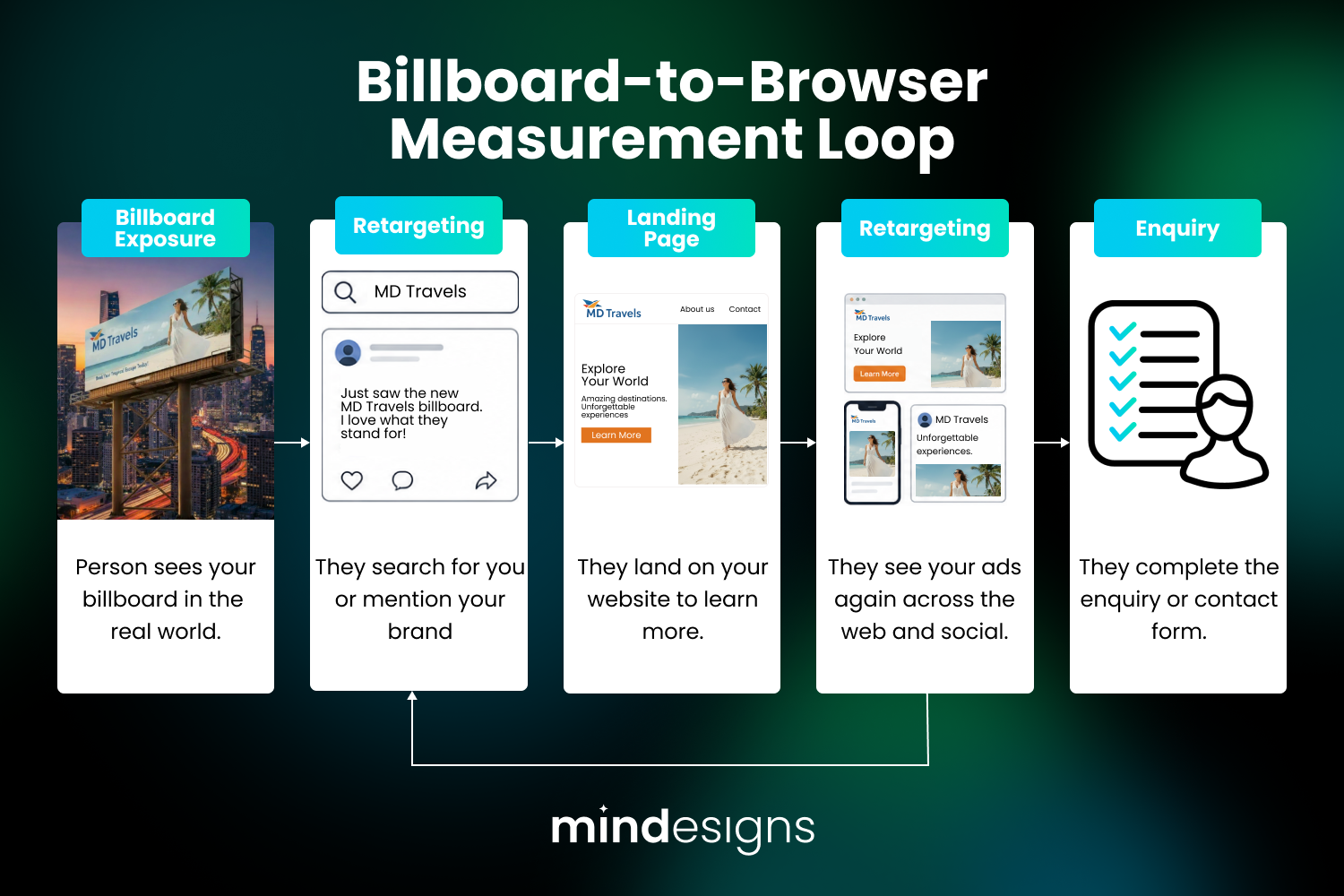
At Mindesigns, we call this the Billboard-to-Browser Measurement Loop. The goal of the loop is to connect outdoor visibility with measurable digital behaviour.
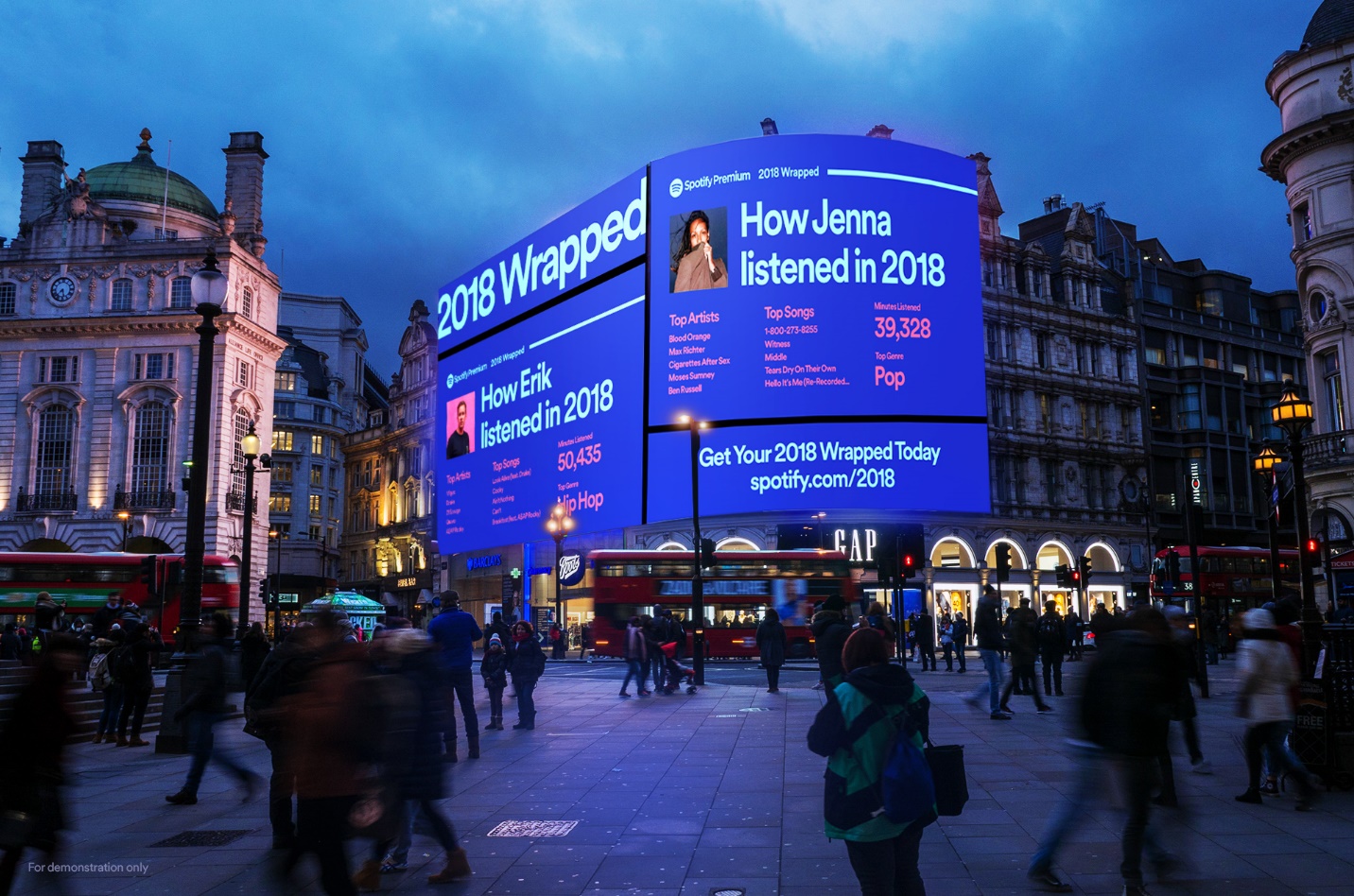
Take Spotify Wrapped, for example. The billboards sparked online conversation, social sharing, branded searches, and digital engagement long after audiences passed them. The outdoor campaign was not the final destination. It was the trigger for a second digital interaction.
Before the internet, billboard success was mostly measured through visibility and foot traffic, with very limited ways to track real business impact. Apart from indirect signals like traffic spikes, search lift, and branded search tracking, businesses can now measure direct billboard impact through:
- QR codes
- Short URLs
- Dedicated landing pages
However, not all billboards should use these response layers. QR codes and short URLs work best in environments with longer dwell times, such as malls or airports, where people can comfortably pull out their phones and interact. It makes far less sense on a highway billboard where drivers should not be distracted. In those environments, memorable recall-based messaging is usually the stronger strategy.
The same thinking guided our work with Midea. Outdoor advertising wasn’t treated as the end goal. The campaign was designed to increase brand familiarity before consumers encountered Midea products through major Australian retailers and began researching appliance options online. Across the campaign period, the outdoor activity generated more than 38.7 million impressions nationally, creating the awareness layer needed to support future demand capture initiatives.
Compress the Campaign Into One Visual Proof
If there’s one mistake I see repeatedly in billboard advertising, it’s brands trying to turn billboards into oversized brochures filled with excessive text and visual clutter. That’s why I almost always urge clients to simplify. At Mindesigns, we have what we call the 3-Second Proof Test. Within three seconds, viewers should be able to:
- Understand the core promise
- Recognise the brand
- Remember the idea later
That’s it. Outdoor advertising works best when it creates recall rather than trying to complete the entire sales process. The deeper explanation should live on your website, landing pages, and supporting marketing collateral.
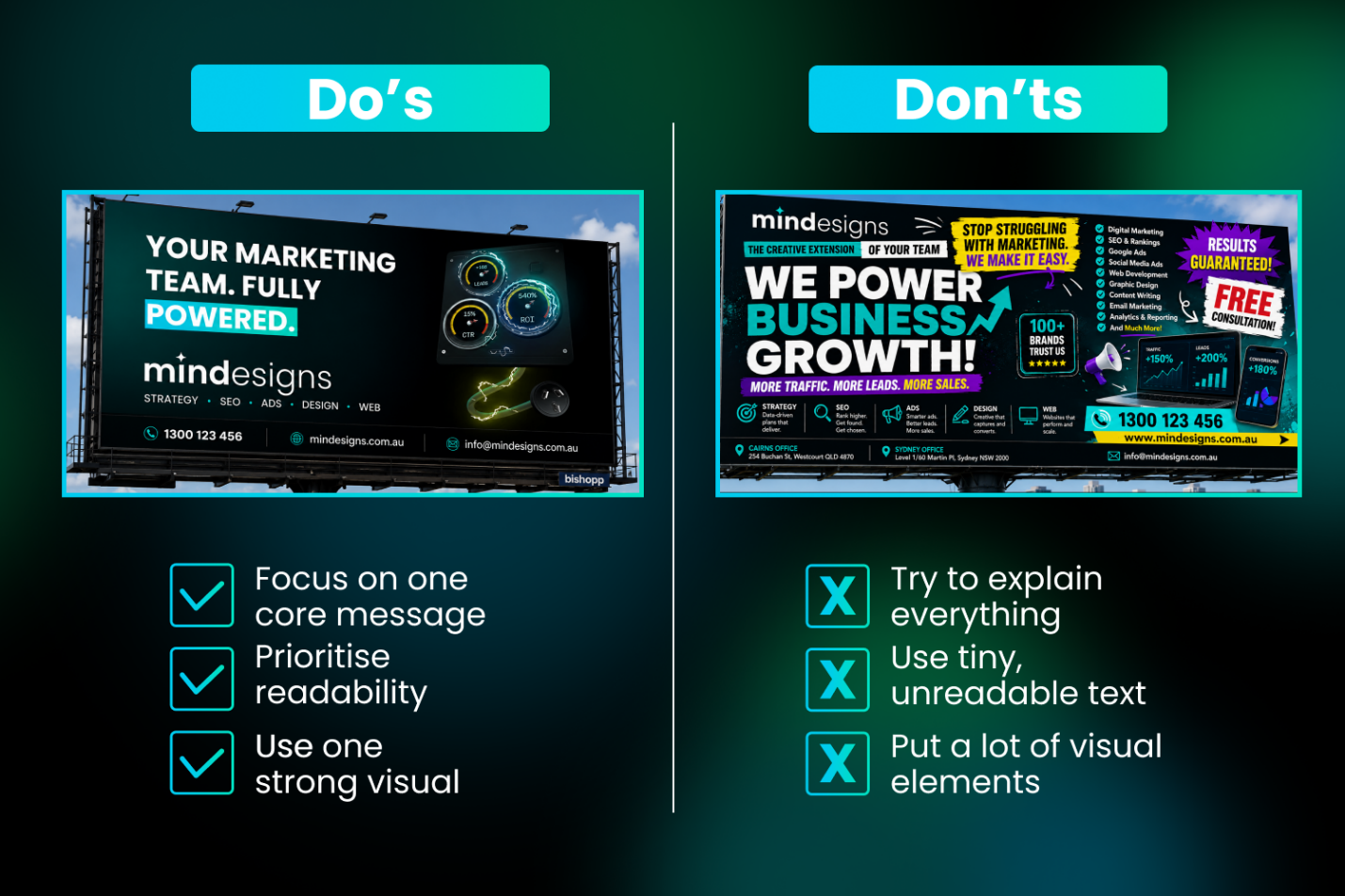
I still see many businesses simply resize website banners for billboard placements, which usually leads to weak outdoor creative. Billboards require a completely different visual hierarchy and viewing experience. One approach I often recommend is using AI tools like Nano Banana for early-stage mockup testing. Start with your existing website banner or campaign creative, then use AI to explore simplified billboard concepts that follow outdoor advertising best practices. From there, a graphic designer can refine the strongest directions into production-ready creative.
AI can also be useful for generating placement mockups before launch so you can evaluate visibility, readability, and environmental fit. What I would avoid is relying on AI to fully generate billboard campaigns from scratch. In most cases, the results still lack the strategic thinking and creative quality needed to protect long-term brand perception.
Use DOOH for Adaptive Campaigns
Billboards used to just be static printed banners, but with the rise of screens and digital out-of-home advertising (DOOH), has transformed billboard strategy in recent years. With screens, billboards can now function as flexible campaign system that allows businesses to adapt messaging based on real-world conditions without have to print and install different banners.
Unlike static billboards, Modern DOOH campaigns creates opportunities for highly adaptive campaign execution because they can respond to:
- Location
- Time of day
- Weather conditions
- Event schedules
- Stock availability
- Local demand shifts
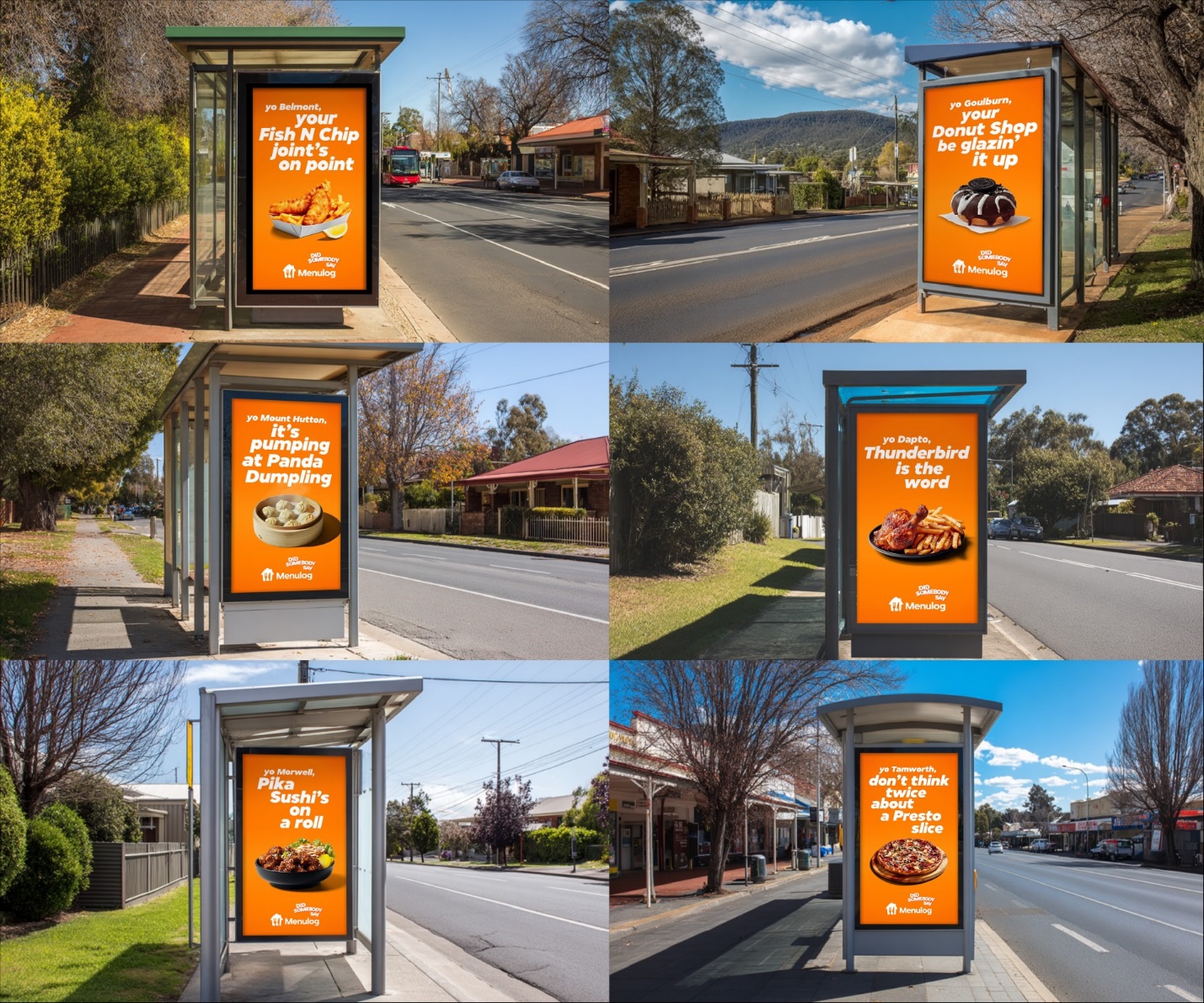
Menulog ran a campaign that changed billboard and audio ads depending on the suburb people were in. Instead of showing the same restaurants everywhere, the ads featured local restaurants and suburb-specific messages to make the campaign feel more relevant to each community. The campaign also used AI tools to help scale hundreds of localised ad variations, while creative teams still guided and refined the final output.
That said, digital billboards have not replaced traditional static billboards entirely. I still see strong value in using static placements for long-term brand recall, while DOOH works better for shorter tactical pushes, rotating offers, and time-sensitive campaign updates.
Before launching a DOOH campaign, businesses should also establish optimisation rules early. That may include rotating messages by location, shifting budget toward boards driving stronger search lift, or pausing creative variations that fail recall or response checks.
Build Fame Without Losing Commercial Accountability
One of the best billboard campaigns in recent years came from the BBC Dracula series. During the day, the billboard appeared as scattered stakes. At night, lighting transformed those stakes into Dracula’s silhouette. The campaign worked because the billboard itself became the product idea rather than simply displaying an ad about it.
What made the campaign so effective was that it balanced fame with relevance. It generated more than 7 million online views, widespread press coverage, and strong social sharing, while the series itself reportedly grew to around 7 million viewers through streaming and catch-up audiences after launch.
That distinction matters because I have seen many billboard campaigns generate visibility and social engagement without creating meaningful business impact. Attention alone is not enough if there is no system behind it. That is why I always separate billboard performance into three areas:
|
Area |
Key Question |
How It Is Measured |
|
Brand salience |
Is the right audience more likely to think of us in a relevant buying moment? |
Branded search lift, brand tracking studies, and direct traffic patterns within the campaign region |
|
Demand capture |
Is the campaign creating measurable digital intent? |
Campaign-region search volume, landing page traffic, retargeting audience growth, and form submissions linked to the OOH campaign |
|
Sales contribution |
Is the campaign contributing to pipeline and revenue conversations? |
Self-reported attribution data, CRM analysis of leads from campaign regions, and sales-team feedback on brand recognition during conversations |
Last-click attribution will systematically undervalue billboards because billboards do their work weeks or months before conversion. Any measurement model that doesn’t account for that lag is going to tell you OOH doesn’t work, and you’ll cut a channel that was actually contributing.
We assess this through what we call the OOH Performance Stack. Rather than evaluating placement, recall, search readiness, landing page engagement, retargeting performance, CRM feedback, and post-campaign search lift in isolation, we assess how all of these factors work together to influence campaign performance.
The Best Billboard Campaigns Do More Than Get Seen
If there is one heuristic our agency consistently follows, it is that the best billboard campaigns should win attention and give the marketing team something to optimise. Rather than treating outdoor advertising as a standalone branding exercise, we build connected campaigns designed to support broader marketing goals and measurable growth over time.
At Mindesigns, we’ve seen firsthand that the most effective billboard campaigns are never just about visibility. Through our work supporting brands such as Midea, we’ve learned that outdoor advertising delivers its greatest value when it is connected to audience behaviour, digital channels, and broader business objectives.
If you’re planning a billboard or DOOH campaign, our team can help develop a strategy that combines creative execution, placement planning, and measurable marketing outcomes. Get in touch with us so that we can discuss your connected advertising strategy.