Marketers & Business Owners
High traffic with weak engagement and low conversions are often signs that the audience arrived interested but never felt understood quickly enough to stay.
That matters more than many marketers realise. According to communication researcher Karen Eber, data alone activates only a small portion of the brain and much of it is forgotten almost immediately. Stories, on the other hand, activate multiple regions of the brain simultaneously, create what neuroscientists call “neural coupling” between speaker and listener, and can even increase oxytocin, a hormone associated with trust.
Her broader point is even more relevant for marketers: data never speaks for itself. When audiences are given information without a narrative, they fill the gaps with their own assumptions and biases. Stories act as the interpretation layer, helping people arrive at a shared understanding of what the information actually means.
We see the same problem in marketing every day.
Many brands assume that if they clearly explain who they are, what they do, and why they are qualified, the audience will naturally connect the dots. In reality, audiences arrive carrying their own problems, pressures, and priorities. If the message does not immediately connect to those realities, attention begins to disappear long before the value proposition arrives.
That is why we believe most brand storytelling starts in the wrong place.
Brands should not see themselves as the author of the story. They should see themselves as a character inside it. More specifically, the guide. Think Mr. Tumnus guiding the Pevensie children through Narnia. The customer is the main character, already under pressure from a problem they want solved. The brand’s role is to help them move forward before the problem gets worse.
That changed the way we approach storytelling for both our own brand and our clients, and pushed us to develop storytelling frameworks designed to hook attention faster. The formulas in this article are the structures we now use across SEO, YouTube, and paid ads.
Open With the Customer’s Problem Before Introducing the Business
The most expensive storytelling mistake is not establish the relevance as early as possible. Every sentence spent explaining the business before acknowledging the customer’s problem increases the likelihood the audience disengages before reaching the value proposition.
But then again, there is a fine line between relevance and credibility. If all you do is talk about the customer’s problems, the audience may feel understood, but they still won’t know why they should trust you to solve them.
Trust us, we know. When we first started, our homepage had this headline:
Mindesigns is a creative digital marketing and design agency
The issue was not that the headline lacked clarity. Quite the opposite, actually. It clearly stated what we are. The issue was that it completely failed to acknowledge the customer and their problems. This made the story feel detached from the person reading it.
This realization led to us developing what we call the Customer-First Story Starter:
“Your audience wants [desired outcome], but [specific obstacle] keeps getting in the way.”
This framework is more effective because instead of making the audience sit through an introduction about the business, it immediately shows that the brand understands what they are dealing with.
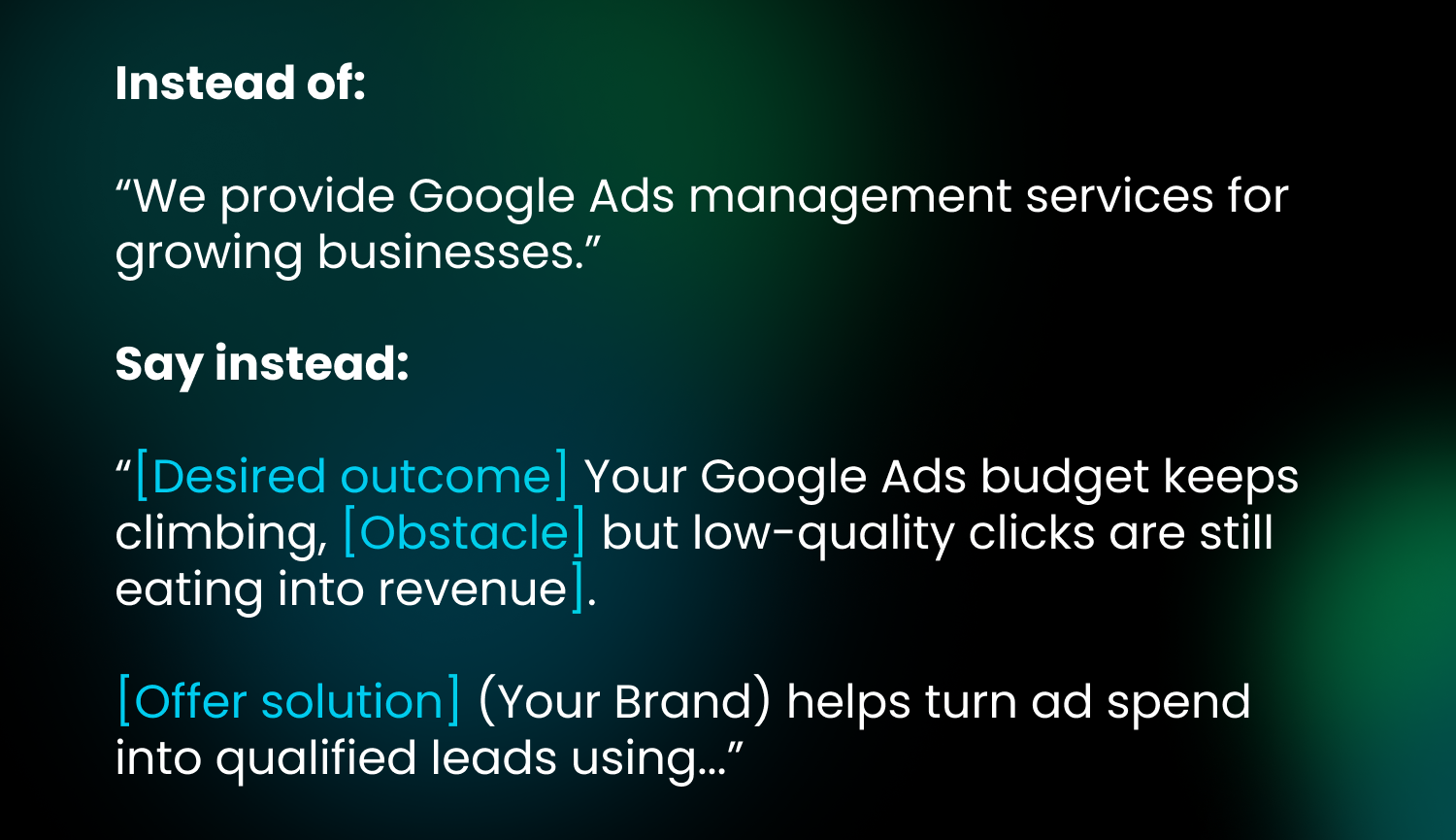
The difference is immediate. One introduces the business. The other introduces the problem the customer is already trying to solve.
Make the Desired Outcome Concrete Enough to Sell
If there is one thing I always tell my team to abide by, it is this: sell the outcome, not the service.
One of the most common mistakes we see in client messaging is that businesses describe their services in technical terms while completely missing the result the customer actually cares about.
That is why we use what we call the Outcome Anchor Formula:
“Your audience does not only want [service]. They want [business outcome].”
Strong storytelling makes the result specific enough for the audience to immediately picture how their business improves after the problem gets solved.
In practice, we often focus more heavily on the second half of that formula, especially when writing hero sections or ad copy. The outcome should feel immediate, commercial, and easy to visualise.
|
Instead of (1st half): |
Say instead (2nd half): |
|
“We provide SEO services for growing businesses.” |
“Turn Google searches into qualified inbound enquiries.” |
|
“We offer Google Ads management.” |
“Stop wasting ad spend on clicks that never become customers.” |
|
“We create modern websites.” |
“Turn more website visitors into qualified leads.” |
Customers want to know what changes operationally, financially, or strategically after working with you.
Enter as the Guide With Proof, Process, and Restraint
Once the customer’s problem is named and the outcome is made concrete, the brand’s role finally comes into focus. This is where many businesses make the second version of the same mistake. They hear the advice to “position yourself as the guide, not the hero,” then respond by creating a slightly more customer-friendly version of their credentials page.
A good guide does not interrupt the story to announce how impressive they are. They enter by proving they understand the terrain the customer is already trying to navigate. That is why empathy has to come before authority.
We use the same approach when telling founder stories. In a recent Impact10X post, we did not begin by explaining the venture builder, the program, or the sponsors involved. Instead, we opened with a challenge many students face when transitioning into the workforce and introduced Jessica Uhiriwe’s mission to solve it. Impact10X entered later as the guide supporting that journey. The story remained focused on the founder and the problem she was addressing, making the message more engaging than a traditional organisational announcement.
The same principle guided our approach to the Cryosite case study for SEQOS. We did not open by introducing SEQOS, listing its capabilities, or explaining its technology. Instead, we started with the operational pressures facing pathology and biobanking organisations, including sample integrity, compliance requirements, and the growing complexity of managing critical biological assets at scale.
SEQOS entered later as the guide. Once the problem, stakes, and desired outcome were clear, the company’s expertise had context. The result was a story that felt less like a company introduction and more like a solution to a problem the audience already recognised.
That is why I advocate for writing in the first person because it sounds lived-in. It sounds like the insight came from real conversations, real campaigns, real mistakes, and real observations instead of rehashed content from other websites. Internally, we follow the Guide Entry Formula:
“We have seen [specific pattern] across [context], so we help teams to [solution], which [results].”
The difference becomes obvious in the writing itself:
|
Instead of: |
Say instead: |
|
“Companies should improve attribution tracking.” |
“One client could not explain which campaigns were driving revenue during budget reviews, so we rebuilt their attribution reporting around pipeline visibility, which reduced reporting confusion across teams by [result]%.” |
The strongest guides do not speak like detached experts delivering a lecture. They speak like practitioners who have spent enough time inside the problem to recognise patterns before the customer fully explains them.
Give the audience a simple plan they can picture following
A customer who understands the problem and trusts the guide still needs one more thing before they act. They need a path they can actually picture following.
This is the step most marketing content skips because many brands are afraid that if they explain too much, the audience will no longer need their services. In practice, the opposite usually happens. When the process is explained clearly, customers begin to understand how much thinking, coordination, and execution is actually required to make the strategy work properly.
That is why we believe in giving away the secrets while selling the implementation. The information itself is rarely the real value. The real value comes from having someone apply the process consistently, strategically, and at scale. For senior decision-makers, that uncertainty creates friction because they are rarely buying alone. A Head of Marketing still has to carry the proposal into leadership meetings, procurement reviews, or finance discussions. If the strategy cannot be explained simply and repeated clearly, the proposal usually stalls.
To tow the line between revealing too much while still providing valuable information, we follow the three-step story plan when breaking down complex concepts:
The Three Step Story Plan: Diagnose the gap -> Build the system -> Measure the signal
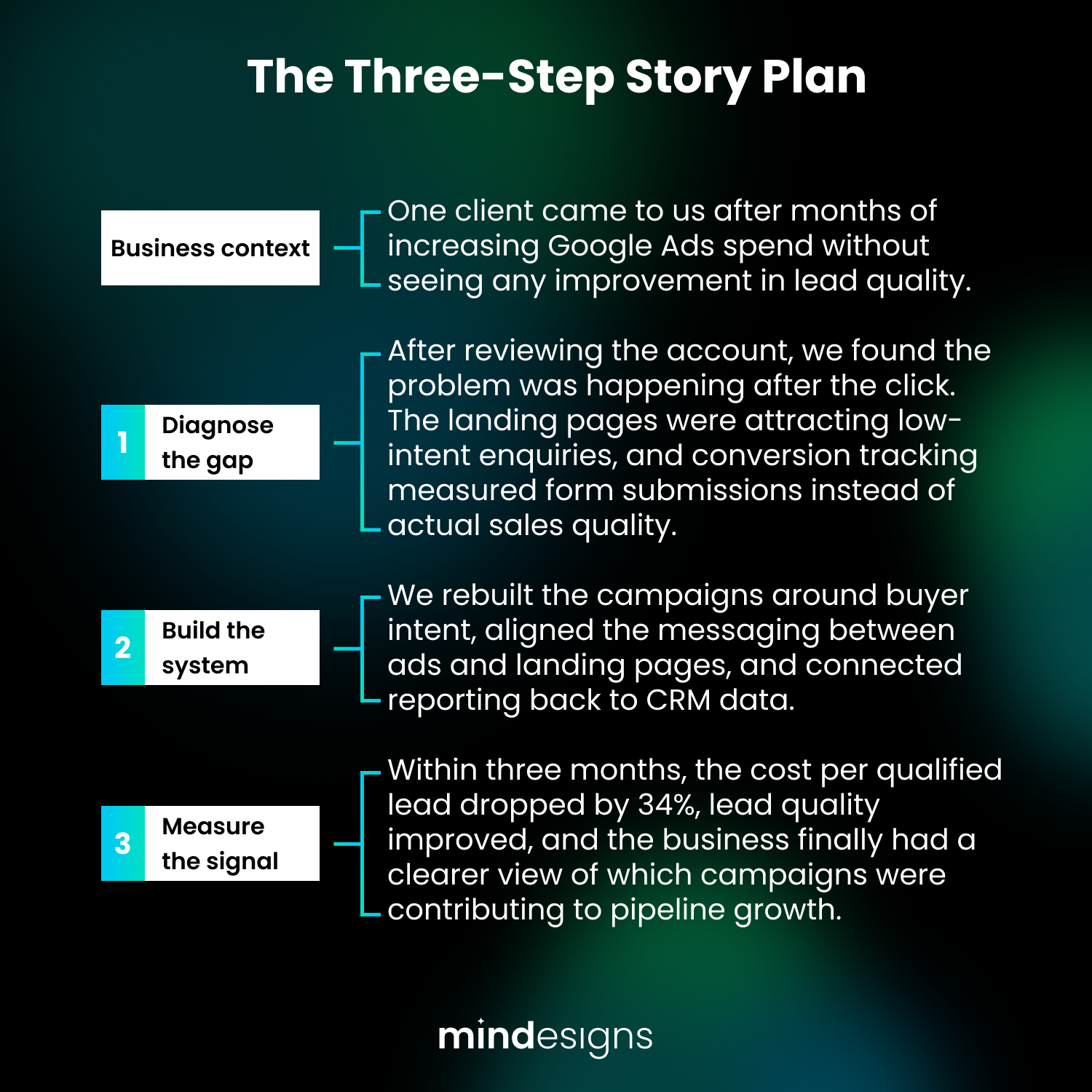
The plan matters because it turns a complex service into a path. It gives the marketing director language they can use in the budget conversation without you in the room. And in a market where buyers are increasingly exposed to AI-generated explanations of every service imaginable, a clear and specific plan gives the brand a stronger memory structure.
End the story starter with stakes and a next action
Most marketing content knows how to start a story, but very few know how to end one properly.
They identify the problem, explain the opportunity, then assume the audience will naturally connect the dots. The reality is that attention fades throughout a piece of content. Good storytelling continuously re-hooks audiences by introducing new questions, new consequences, and new reasons to keep reading.
One of the most effective ways to re-hook the audience is by introducing stakes, because once they understand the problem and desired outcome, they also need to understand the cost of doing nothing. That is why we formulated the Stakes-to-CTA formula:
“If [problem] stays unresolved, [commercial cost] continues. The next move is [specific action].”
This works because good storytelling needs tension all the way through. If the customer understands the problem but cannot see the consequences of ignoring it, urgency disappears.
For example:
- If wasted ad spend continues, marketing budgets keep disappearing into campaigns that sales teams do not trust. The next move is to audit the lead path between the ad, landing page, and CRM.
The action should always feel guide-led rather than sales-led. The audience should feel like they are being shown the next logical step forward, not pushed into a pitch.
This structure works especially well across landing pages, SEO articles, Google Ads, LinkedIn posts, and Meta campaigns because it combines two things every strong piece of marketing needs, which is a clear path forward.
The Storytelling Starter Framework in Full
Taking it all together, a good start to a marketing story would look like this:
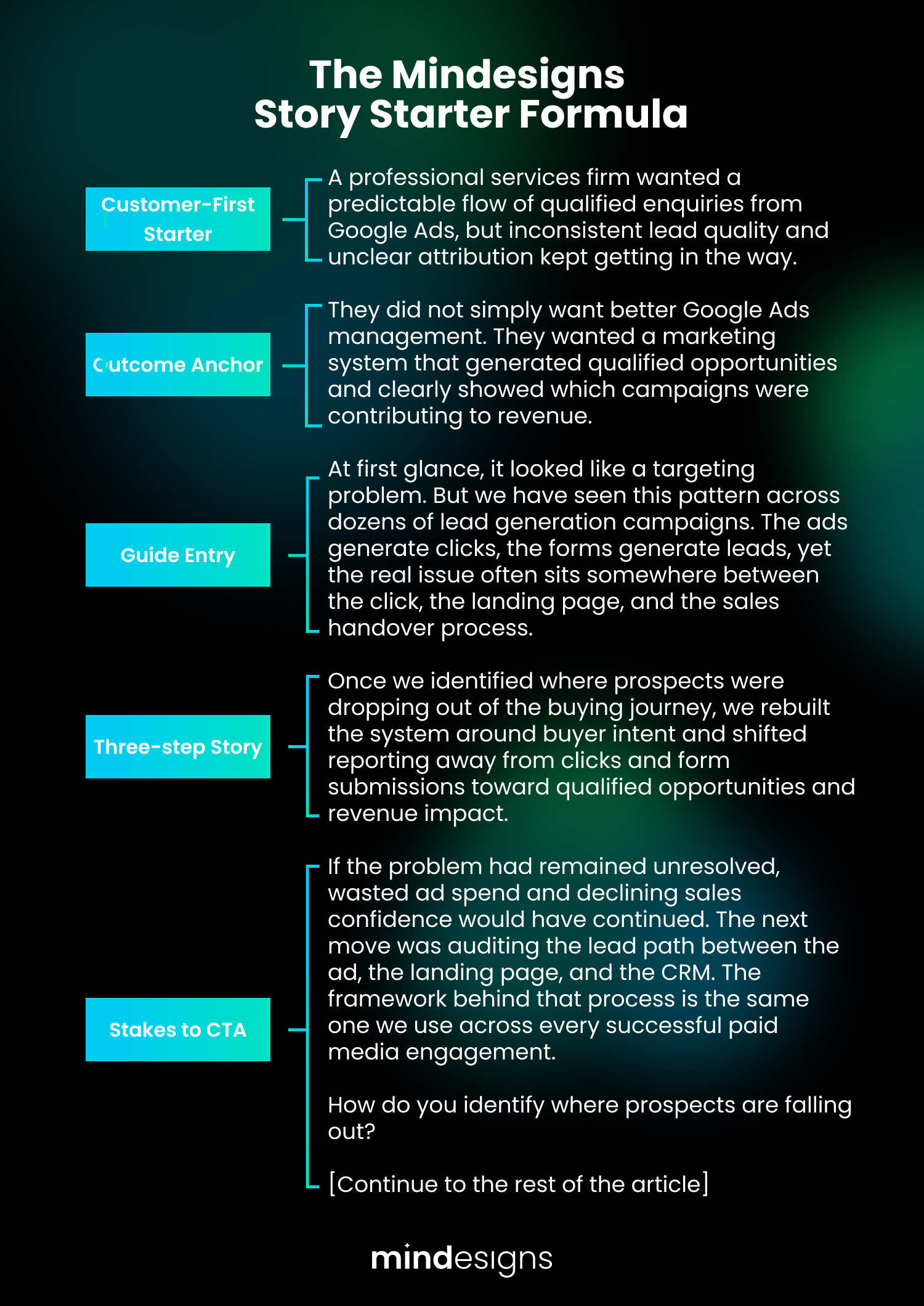
Each formula builds on the one before it, moving the audience from recognising their problem to understanding the outcome they want, trusting the guide, seeing a path forward, and finally taking action.
The exact implementation will vary depending on the format. A television advertisement may use the full framework across a complete narrative arc, while a billboard may only have space for a single emotional beat. Social ads often need to lead immediately with the problem, and short-form video typically requires multiple re-hooks to maintain attention. The structure remains the same, but the delivery adapts to the channel.
Of course, these formulas are exactly that: formulas. They are not rigid rules that must be followed word for word. Different audiences, channels, and campaigns may require different sequencing or emphasis. What matters is not the exact wording, but the structure underneath. These frameworks exist to make storytelling easier, giving marketers a repeatable way to organise ideas and avoid the common trap of talking about the business before establishing relevance.
It is also worth remembering that the opening is only the beginning. A strong story starter earns attention, but the main body of the content is what ultimately delivers value. Once the audience is engaged, the rest of the article, landing page, advertisement, or campaign still needs to educate, persuade, and move the reader toward a decision. No storytelling framework can compensate for weak ideas, poor execution, or a lack of genuine customer understanding.
If you need a customer-led story that strengthens your SEO content, website copy, Google Ads, Meta Ads, and campaign messaging? Speak with Mindesigns about building a StoryBrand-inspired marketing system that turns customer insight into measurable marketing performance.