For Marketing Leaders
Most “top Australian influencers” lists are bio directories. They tell you who has the biggest follower count and stop there — which is the one number that matters least when you’re actually trying to run a campaign that returns money.
We sit on the other side of that decision. At Mindesigns, we run paid social and conversion work for Australian brands, and “should we partner with an influencer, and how do we do it without getting burned?” is one of the questions we field most often.
So this is the guide we wish existed: not ten bios, but how to read a creator’s audience, how to reach out, what the agreement should actually look like, and how to keep the whole thing on the right side of Australian advertising and financial-services law.
We’ve still included a shortlist of well-known Australian female creators — but re-sorted the way a marketer should think about them, by what you’re buying, not by who has the most followers.
First, decide what you’re actually buying
Follower count is a reach metric. It tells you how many people might see a post. It tells you nothing about whether those people are your buyers, whether they trust the creator’s recommendation, or whether any of them will convert.
Before you shortlist anyone, get clear on which of three things you’re buying, because it changes everything downstream — who you pick, what you pay, and how you measure it:
- Reach — broad awareness and aspirational association. You’re buying eyeballs and brand halo. Mega-tier creators are the tool. Measure on reach, impressions and brand lift, not direct sales.
- Trust — a credible recommendation inside a tight community. Mid-tier niche creators are the tool. Measure on engagement quality, saves, shares, and assisted conversions.
- Conversion — direct, trackable sales. Often micro-creators with high engagement and a warm, transactional audience. Measure on tracked revenue via codes and links.
A single creator rarely does all three well. The mistake we see most is a brand paying mega-tier reach money and then judging the campaign on direct sales — buying a billboard and being disappointed it didn’t ring the till.
The shortlist, re-sorted by use case
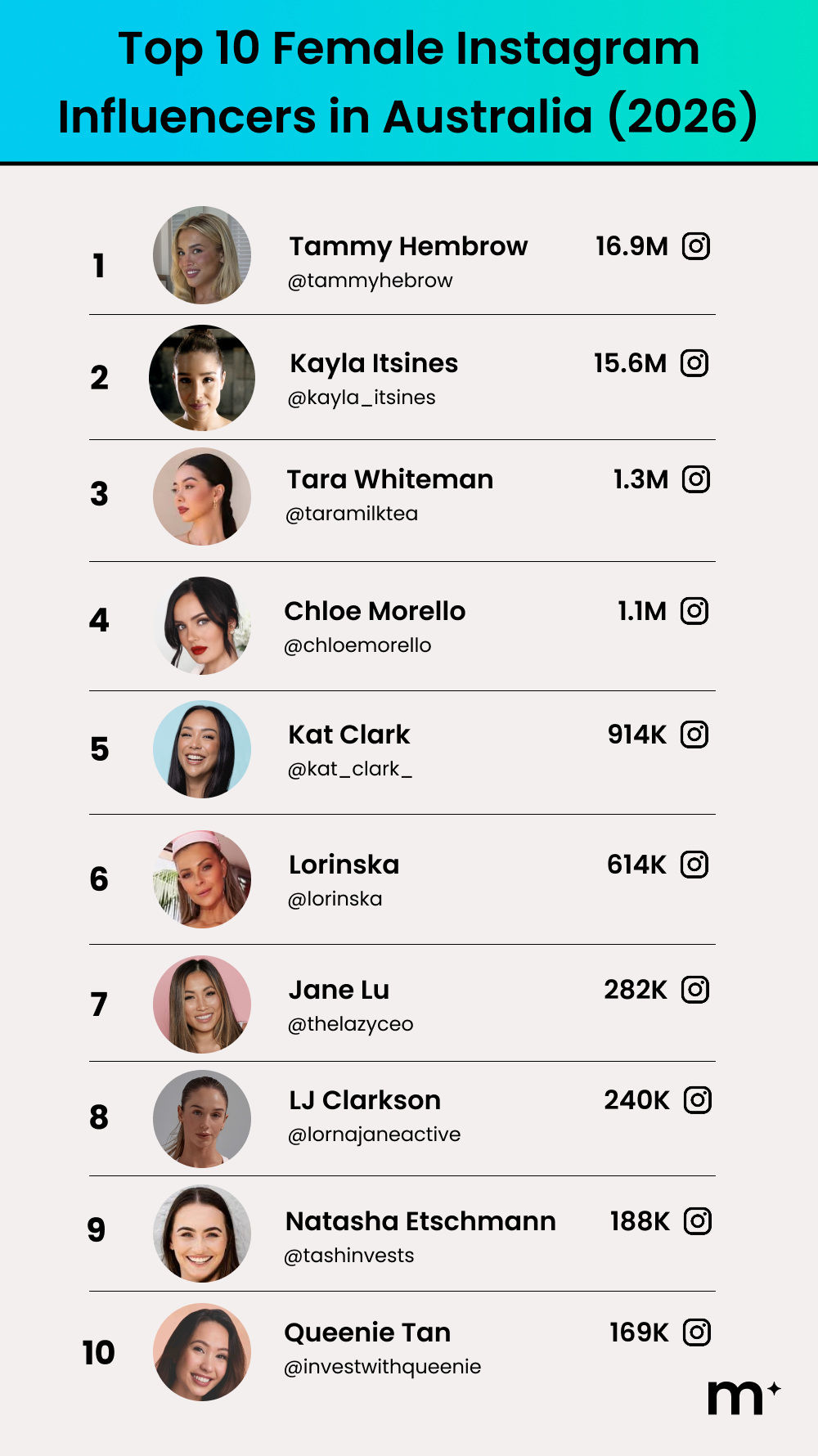
Here are well-known Australian female creators grouped by the job they’re suited to. Follower numbers are given as reach bands rather than exact counts — exact figures go stale fast, so always pull a creator’s current media kit before you commit. The “what you’re really buying” and “watch-outs” columns are the part a bio directory never gives you.
Tier 1 — Mega-reach awareness plays
These are for launches and broad brand association, not for efficient direct response.
Tammy Hembrow (eight-figure cross-platform reach — fitness, athleisure, family/lifestyle). You’re buying mass reach and aspirational association with a predominantly young female Australian audience. Her own brands (Saski, Tammy Fit) prove she converts in apparel and fitness. Watch-outs: at this scale, engagement rate and cost-per-true-fan suffer. Brief her for launch-level reach and model the deal on guaranteed reach plus usage rights, not on a follower headline.
Kayla Itsines (mega reach — fitness, women’s health). Deep authority in the women’s fitness space and a global product engine (Sweat). Strong for health, wellness and women-first product launches. Watch-outs: highly fitness-coded audience — fit only matters if your product sits naturally in that world.
Tier 2 — Mid-tier niche fit (where most campaigns should live)
This is where reach is smaller but trust and relevance are higher, and where the maths usually works best.
Chloe Morello (~1M — beauty, skincare). Long-tenured beauty authority with a track record of moving product (she’s sold items out). Good for beauty, skincare and tutorial-led launches. Watch-outs: premium positioning; price the credibility, not just the reach.
Tara Whiteman / Tara Milk Tea (~1M — travel, luxury lifestyle). “Luxury but playful” aesthetic; established luxury and travel brand partnerships. Good for travel, hospitality and premium lifestyle. Watch-outs: highly aspirational feed — make sure your product earns its place in that aesthetic.
Kat Clark (500k–1M — food, family, recipes). Built on healthy recipes, now strong family-and-lifestyle content with a loyal, relatable audience. Good for food, FMCG and family brands. Watch-outs: relatability is the asset; over-produced briefs break it.
Lorinska (100k–250k — parenting, lifestyle). Reality-TV profile plus founder credibility (parenting app, clothing label). Existing ambassador deals (Myer and others). Good for parenting, baby and family categories. Watch-outs: confirm category exclusivity given existing partnerships.
LJ Clarkson (100k–250k — wellness, sustainability). Author and sustainability advocate (sustainable activewear, clothing stewardship). Good for purpose-led and sustainable brands where values alignment matters. Watch-outs: values-driven audience — greenwashing will be punished, so the partnership has to be genuine.
Jane Lu / The Lazy CEO (100k–250k — business, founders, fashion). Founder of Showpo and a recognised voice for women in business. Good for B2B-to-founder, SaaS, finance-adjacent and women-in-business brands. Watch-outs: business audience, not a fashion-buying audience, despite the Showpo link.
Tier 3 — Finance creators (high value, higher compliance bar)
Finance is a “Your Money or Your Life” category. The audience is valuable and engaged, but pairing a brand with a finance creator carries real Australian regulatory exposure — covered in the compliance section below. Vet licensing before you go near these partnerships.
Queenie Tan / Invest With Queenie (100k–250k — personal finance, licensed). Educational, beginner-friendly money content; a licensed personal-finance creator. Good for fintech, banking, budgeting and first-home-buyer products. Watch-outs: anything touching a financial product must respect her licensing scope and yours.
Natasha Etschmann / Tash Invests (100k–250k — personal finance, authorised for general advice). Ethics-and-access angle, strong millennial/Gen-Z trust, authorised to provide general advice. Good for ethical finance, investing platforms and financial-education brands. Watch-outs: “general advice” is a specific, limited authorisation — keep the brief inside it.
How to tell if she actually has the audience you want
This is the step brands skip and then regret. A creator’s follower count belongs to her; the slice of it that matches your customer is what you’re really paying for. Here’s how we pressure-test that before recommending anyone.
Ask for the media kit — and read the audience data, not the reach data. Any professional creator has one. The numbers that matter are audience location (what % is actually in Australia — for some “Australian” creators it’s lower than you’d think), age band, gender split, and top cities. A 1M-follower creator who’s 40% Australian is a 400k-Australian creator for your purposes.
Benchmark the engagement rate against her tier, not in the abstract. Bigger accounts have lower engagement rates — that’s normal. As a rough guide we treat ~1–3% as healthy at the macro/mega tier and expect more at the micro tier. A mega account sitting well below its tier benchmark is a flag; a micro account with genuine 5%+ is often worth more than its size suggests.
Read the comments, not just the count. Real community looks like real conversation — questions, names, specifics. Generic emoji-only comments, or a comment-to-like ratio that feels off, can signal pods or bought engagement. We read a creator’s last 10–15 posts manually; no tool replaces it.
Run a fake-follower / authenticity check. Third-party tools (the category includes HypeAuditor, Modash and similar) score audience authenticity and flag sudden follower spikes. We use them as a filter, not a verdict — a clean score gets a creator into the manual review, it doesn’t end it.
Check audience overlap with your existing customer. The best signal is whether her audience looks like the people who already buy from you. If you run Meta ads, compare her stated demographics against your best-performing customer segments. Alignment over audience size, every time.
If a creator can’t or won’t share audience demographics, that’s an answer in itself.
How to reach out
Once you’ve got a verified shortlist, outreach is mostly about being specific, professional and easy to say yes to. The brands that get ignored send vague “we’d love to collab!” DMs; the ones that get good rates send a tight, concrete brief.
Pick the right channel. Larger creators almost always list a management or booking email in their bio — use it. DMs work for smaller and micro creators but get buried fast on big accounts. If there’s an agency or talent manager, go through them; it’s slower but cleaner on contracts.
Lead with fit, not flattery. Open with why her specifically — the audience overlap or the content style that made you choose her. It signals you’ve done the work and aren’t mass-blasting fifty accounts.
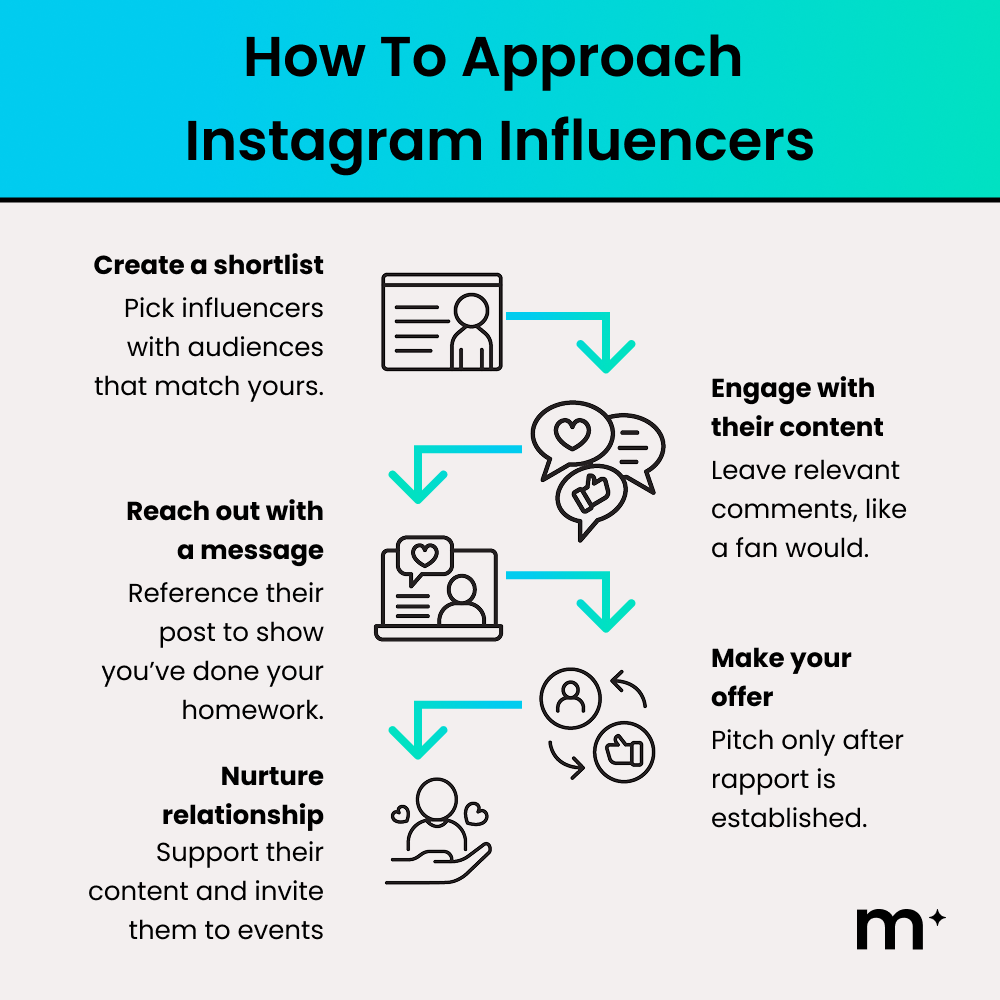
Be concrete in the first message. A good opener names the brand, the product, the rough deliverable (e.g. “one Reel plus two Stories”), the rough timing, and that there’s a paid budget. You don’t need to state the number yet, but signalling that it’s a paid partnership, not a “for exposure” ask, immediately separates you from the noise.
Ask for the media kit and rate card in that first reply. It moves the conversation to substance and gives you the audience data to finish your vetting.
Then get everything in writing. Once you’ve aligned on scope, message, deliverables and timeline, put it in a contract or at minimum a written agreement. Verbal “yeses” on Instagram are where campaigns go wrong.
What the agreement actually looks like (and what’s most popular)
This is the question we get asked most: is it a fixed price for a few posts, is it commission, or is it sponsorship — and what do people actually use? Short answer: there are four main structures, and most real Australian campaigns in 2026 use either a flat fee or a hybrid.
| Structure | How it works | Best for | Reality in 2026 |
|---|---|---|---|
| Flat fee per deliverable / bundle | A set price for a defined set of posts (“1 Reel + 2 Stories, by this date”). | Launches and tightly scoped creative where you want cost certainty. | The most common one-off structure. Finance and procurement like it because the cost and the deliverables are fixed. |
| Affiliate / commission | The creator gets a unique code or link and earns a % of tracked sales (commonly ~5–30%). | Performance and ecommerce, where attribution is clean. | Popular because there’s no upfront cost — but most established creators won’t work commission-only, since they’re taking all the risk. |
| Hybrid (base + commission/bonus) | A smaller guaranteed fee plus a performance bonus or affiliate cut. | When pure commission feels risky to the creator and flat fee alone doesn’t reward sales. | Increasingly the default. It protects your cash, rewards results, and keeps the creator motivated — the “$500 base plus commission” shape. |
| Ambassadorship / retainer | A recurring monthly fee over 3–12 months for ongoing content and exclusivity. | Long-term advocacy once a creator is proven. | Used after you’ve validated a creator through a shorter campaign — not as a first move. |
| Gifting / product seeding | Free product in exchange for (often non-guaranteed) content. | Cheap testing and easy-to-try, visually shareable products. | Good for filling the top of the funnel and finding creators worth paying — but disclosure rules still apply even when no cash changes hands. |
The practical play: start low-risk (gifting or affiliate) to test a creator, move proven performers to a hybrid base-plus-commission deal, and reserve flat-fee and retainer money for creators already delivering consistent ROI.
A few line items brands routinely forget to negotiate, and then overpay for later:
- Usage rights — if you want to run her content as a paid ad or use it on your own channels, that’s a separate, priced right. Don’t assume the post fee includes it.
- Exclusivity — stopping her promoting a competitor for a window costs extra; price it deliberately.
- ABN and tax — if you pay an Australian creator more than $75 (ex GST) and they haven’t quoted an ABN, the ATO generally requires you to withhold 47% PAYG. Get the ABN before you pay.
- Payment terms — for larger or multi-stage deals, split payment into milestones (e.g. part on signing, balance on approved delivery). It de-risks both sides.
A real Australian example that worked
A widely cited Australian example of audience fit done right is Runaway The Label’s partnership with Tammy Hembrow. It works as a teaching case because it isn’t about her follower count — it’s about overlap. Tammy’s audience skews heavily to young Australian women (her own fitness product’s user base is reported as overwhelmingly young women, and her apparel brand sells exclusively to women), which is exactly Runaway’s customer. Because the creator’s lifestyle, audience and the brand’s target buyer were the same people, the sponsored content read as a genuine recommendation rather than an ad.
The lesson we take from it for every brief: when a creator’s world genuinely mirrors your target market, the partnership stops feeling like advertising — and that alignment, not the size of the following, is what drives the result.
Brand safety and compliance before you sign
This is the part that protects you, and the part most listicles never mention. It’s also, in our experience, what separates an agency that has actually run these campaigns from one that’s just naming tools.
Disclosure is not optional — and the brand is on the hook too. Under the AANA Code of Ethics (clause 2.7), advertising must be clearly distinguishable as advertising. In practice that means any paid or gifted partnership must be disclosed — #ad, or Instagram’s Paid Partnership / Branded Content label. The ACCC has been actively scrutinising undisclosed influencer ads, and responsibility doesn’t sit with the creator alone; as the brand, you should require correct disclosure in writing and check it went live as briefed.
Finance creators carry specific legal risk. In Australia, you generally can’t provide financial product advice without an Australian Financial Services Licence (AFSL) or authorisation as a representative of a licensee. ASIC has run repeated “finfluencer” crackdowns — issuing warning notices, reviewing licensees, and reminding licensees they remain liable for what their authorised finfluencers say. If you’re a financial brand pairing with a finance creator, verify their licensing or authorisation status and make sure your brief keeps them inside the scope of what they’re permitted to say (for example, “general advice” is a specific, limited authorisation). Disclaimers like “this is not financial advice” do not cure the problem.
Vet for past controversy and authenticity. Before we recommend any creator to a client we run a quick reputation pass (a creator’s old posts become your brand’s problem the moment you partner) and the fake-follower check described earlier. A clean audience and a clean history are worth more than a million low-quality followers.
Confirm image and content rights. If you’re repurposing a creator’s content — or if your campaign uses imagery you don’t own — confirm the usage rights in writing. It’s exactly the compliance brands lean on us to get right.
What this looks like when we run it
Our approach is built from the paid-social and CRO work we do every day, so we treat an influencer partnership like any other performance channel: a clear objective, a tracked path to revenue, and a verdict at the end.
- Define the objective and the metric first — reach, trust or conversion (see the top of this guide). The metric is chosen before the creator.
- Build and verify the shortlist — media-kit audience data, engagement-vs-tier benchmark, manual comment review, authenticity and reputation checks.
- Brief tightly — deliverables, hook, must-have shots, disclosure requirement, timeline, and a defined revision/reshoot rule so “good” is agreed up front.
- Structure the deal to the goal — flat fee for launches, hybrid for performance, retainer for proven long-term partners; usage rights and exclusivity priced as line items.
- Track to revenue, not vanity — unique codes and UTM links per creator, so we can see assisted and direct conversions, not just likes.
- Judge and decide — measure against the objective set in step one, keep the creators who moved the number, and drop the ones who didn’t.
The takeaway
Picking an Australian female influencer to partner with isn’t a follower-count exercise. It’s a fit exercise: decide what you’re buying, verify her audience is actually your audience, reach out with a concrete brief, structure the deal to your goal, and get the compliance right before you sign. Do that and the partnership behaves like every other channel that earns its place — it returns money.